Posts

Showing posts with the label reactive oxygen specimen

Popular topics

Show more

Update on Antioxidants & Exercise - Neither Vitamin C Nor E Have ANY Effect on the Response to Intense Exercise.

Image
Image 1: If you add some reactive oxygen species to this mitochondrium, this will trigger beneficial, (mito-)hormetic adaptations, that could be blunted by too many antioxidants. As a diligent reader of the SuppVersity, you have probably been following my posts on antioxidants and their potentially negative effect on the adaptive (hormetic) response to the exercise induced formation of reactive oxygen specimen. Although, I still believe that the theory may have its merit - especially in metabolically deranged people, where the exercise induced ROS formation would initially have to overcome the low-grade chronic "background" stress - it appears that for healthy people, and "moderately trained young men" on an intense exercise protocol, in particular, the ingestion of reasonable amounts (<1g of vitamin C and <400IU of vitamin E) does not pose a problem . At least this is what the results of two relatively recent studies by scientists from Washington Schoo...

Mitohormesis - Suffocated Mitochondria Live Longer: Scientists Probe Longevity-Effect of Low-Level Stressors.

Image
Image 1: Walter Breuning died in April 2011at the biblical age of 114! And you bet that a man who has seen two world wars has had his share of mitohormetic stress in his life. As a diligent reader of the SuppVersity you will be familiar with the work of S. Schmeisser and M. Ristow from the Department of Human Nutrition at the University of Jena , here in good old Germany (where not everyone eats Sauerkraut und Weisswurst, even now that the Oktoberfest is in full swing). In previous publications, the scientists have (at least in my mind conclusively) argued against the publicly accepted free-radical hypothesis of aging, which implies that the presence of free radicals is one of the fundamental mechanisms of aging. Now, a few month after the publication of their last review back in May 2011, they are presenting the latest results from their own lab in a paper that is going to be published in the October issue of Hormone and Metabolic Research ( Schmeisser. 2011 ) . Want to liv...

N-Acetylcysteine Hampers Adaptive Response To Exercise. 50% Reduction in JNK Phosphorylation Entail Reduced Expression of Genes Involved in Cell Proliferation, Apoptosis, Inflammation and DNA Repair.

Image
Image 1: The "beneficial" bad guys under the microscope: Reactive oxygen species (green-yellow) within endosomes of human smooth muscle cells ( Circulation Research . 09/2007 ) If you listened to my dissertation on the sulfur-amino acids on Carl Lenore's Super Human Radio (cf. shownotes ), you will be aware that I was and still am quite skeptical as far as the touted beneficial effects of n-acetylcysteine (NAC) supplementation on exercise performance are concerned . A very recent study that has been conducted by a team of Australian scientists from Deakin and Victoria University in Melbourne appears to warrant this skepticism. In a 2006 study ( McKennah. 2006 ) the same group had found that N-acetylcysteine can attenuate the decline in muscle Na+,K+-pump activity and thus delay fatigue during prolonged exercise in humans. But even then, the data on real-world and long-term benefits of n-acetylcysteine supplementation was conflictive and the authors' conclu...

Are You Stressed Enough for a Longer Life? Reactive Oxygen Specimen and Oxidative Stress May Contribute to Longevity

Image
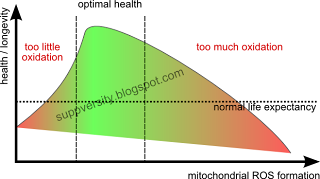
In June 2010 my fellow countrymen Michael Ristow from the Department of Human Nutrition at the University of Leipzig formed an interesting hypothesis ( Ristow. 2010 ) stating that the dreaded reactive oxygen species [ROS], most scientists associate with accelerated cell-aging and degenerative diseases were in fact " essential signaling molecules which are required to promote health and longevity ". In a more recent paper he picks this hypothesis up and, in cooperation with Sebastian Schmeisser from the Department of Clinical Nutrition at the German Institute of Human Nutrition in Nuthetal, Germany, reviews the current literature on selected longevity-promoting intervention. Figure 1: Health and longevity as a function of mitochondrial reactive oxygen species (ROS) formation. Both too much and too little ROS are detrimental, due to either insufficient stimulus for or overtaxing of hormetic processes (this graph is a mere illustration and is not based on any existing exp...

Antioxidant Gear: Anabolic Steroid Stanozolol Decreases Mitochondrial ROS Generation and Oxidative Stress Induced by Acute Exercise in Rat Skeletal Muscle

Image
Figure 1: Molecular structure of Stanozolol (from Wikipedia) Oswaldosalcedo, a member of the Mind&Muscle forum came up with a recent study ( Saborido. 2011 ) that found some surprisingly healthy "side-effects" of Stanozolol , a synthetic anabolic orally available steroid derived from testosterone, also known as Winstrol . The scientists tested the effect of Stanozolol administration on markers of mitochondrial oxidative stress in rats after an acute bout of exhaustive exercise and found:  Stanozolol treatment markedly reduced the extent of exercise-induced oxidative damage to mitochondrial proteins, as indicated by the lower levels of the specific markers of protein oxidation, glycoxidation, and lipoxidation, and the preservation of the activity of the superoxide-sensitive enzyme aconitase. This effect was not due to an enhancement of antioxidant enzyme activities . Acute exercise provoked changes in mitochondrial membrane fatty acid composition characteri...
Disclaimer:The information provided on this website is for informational purposes only. It is by no means intended as professional medical advice. Do not use any of the agents or freely available dietary supplements mentioned on this website without further consultation with your medical practitioner.