Posts

Showing posts with the label alanine

Popular topics

Show more

Are You Afraid that the Fructose Boogieman Clogs Up Your Liver? Citrulline or Alanine, Glycine, Proline, Histidine and Aspartate Mix Will Protect You + Maybe Lean You Out

Image
If you belong to the people who simply cannot stay away from HFCS foods and beverages, you may be happy to hear that the equivalent of as little as 10g citrulline or NEAAs in your diet may do much more than "just" fully prevent its negative effects on your liver. You will probably remember from previous articles I wrote that NAFLD, or rather the development of non-alcoholic fatty liver disease, is one of the earliest markers of metabolic syndrome and beginning type II diabetes. In the Western obesity societies in North America and Europe, NAFLD is among the most common causes of chronic liver disease and its prevalence is increasing rampantly (Marchesini. 2001). In spite of the fact that its development is most strongly linked to the consumption of a generally unhealthy, energetically dense diet, there are several lines of evidence which suggest that the ingestion of exorbitant amounts of fast-digesting fructose from high fructose corn syrup (HFCS) sweetened beverages ...

There is More To Glucose Control Than Carbohydrates (1/?): Non-Carbohydrate Nutrients And Their Effects On Blood Glucose Management ➲ Amino Acids, Proteins, Peptides

Image
This is part I of a multipart series, you will be able to navigate by clicking on the pictures in the box below. While it appears to be obvious that eating a low-to-no-carbohydrate diet would be the easiest way to manage your blood glucose levels, carbs are by far not the only nutrient that will have an effect on your blood glucose levels. In a recent overview article, Martina Heer and Sarah Egert from the Department of Nutrition and Food Science at the University of Bonn provide a decent overview of the multiple ways by which "other nutrients, such as dietary protein and amino acids, the supply of  fat, vitamin D, and vitamin K, and sodium intake seem to affect glucose homeostasis." (Heer. 2014). In the coming weeks I will use their review as a starting point for my own overview of the effects of non-carbohydrate and "almost cabohydrate" nutrients   on glucose metabolism. And for today, I decided, to conclude this week that was full of exciting protein news...

Alanyl-Glutamine or Alanine + Glutamine? Dipeptide or Free Form Aminos? What Offers Maximal Muscle Protection?

Image
"Wouldn't have happened if she'd used alanyl-glutamine instead of regular that cheap alanine + glutamine combo!" - True or False? Recent study says: False! If you combine your liver's favorite gluconeogenic amino acids, i.e. alanine and glutamine, into a single peptide the result is called alanyl-glutamine and marketed as the ueber-potent alternative to regular l-glutamine supplements. It goes without saying that a comparison like this is about as stupid as comparing french fries with mayo to regular french fries and saying that the former are worse because they contain more fat, or whatever. Even if we didn't care about the physiological significance of the effects of alanyl-glutamine, we would obviously have to compare the purported cryogenic effects of this "innovative" dipeptide to those of a simple combination of free form amino acids to deserve the bragging rights for having created an advanced form of glutamine. Alanine + glutamine vs. a...

Leucine Only Tops Ergogenic Effects of BCAAs: Increased Alanine Cycle Activity Spares Muscle Glycogen, Boosts Endurance Performance - BCAAs Have Opposite Effect

Image
Alanine is the liver's favorite gluconeogenic amino acid and leucine appears to increase its usage. Being among the first to learn about the "Glucose-Repartitioning Effect of Iso-Leucine" in February 2013 ( read up on it ), you, as SuppVersity reader, belong to the selected few who know that valine and isoleucine may be more than unnecessary props in the leucine-powered BCAA show. With the recent publication of a rodent study from the University of Sao Paulo in Brazil (Campos-Ferraz. 2013), however, it looks as if you had to revise your perspective on the purportedly auxiliary BCAAs - at least, with respect to their ability to reduce fatigue, and muscle and liver-glycogen degradation, in trained rats and possibly (!) humans. So what did the Brazilian researchers do? Basically, the idea Campos-Ferraz et al. had in mind, when they came up with their 8 week exercise + 2 week supplementation protocol (see Table 1 ) was to ... Table 1: Exercise progression; suppl. ...

Glutamine, a Better Glucose Source Than Glucose? Can You (Ab-)Use It As an Intra-/Post Workout Supplement? Human Study Suggest: Yes You Can! 8g Will Do the Trick

Image
Could it be better to use glutamine as the main energy source in an intra-workout beverage? Or is the latter superior to glucose, only when it's already to late, meaning only, when you already are hypoglycemic? I see the irritation on your face. How on earth should glutamine be a better glucose source than glucose: Adel obviously has lost his mind under the pressure of putting out interesting stuff on a daily basis... well, while the latter may be true (how would a sane person do what I do?), I am actually just reformulating the main message of a recently conducted study from the State University of Maringá in Brazil. In the corresponding paper, which was published online in the International Journal of Endocrinology (Nunes Santiago. 2013). So yes, glutamine is in fact the better glucose...or maybe I should clarify it is a superior source of glucose to promote glycemia recovery after insulin-induced hypoglycemia. In other words, it will help you to lose the dizziness, the ...

Leucine, Citrulline or a Non-Essential Amino Acid Mix - Which Amino Acid(s) are Most Effective in Preventing Muscle Loss During an 18h (Intermittent) Fast?

Image
Image 1: If Chris, "the Techician", Aceto's usually well-informed sources are right and the former Mr Olympia Jay Cutler is currently trying to lose muscle (I heard him say that on Heavy Muscle Radio ), Cutler would be ill advised if he ingested ~20g of non-essential amino acids during and / or in-between extended fasts and hours of arduous low-intensity cardio sessions (img  MuscleTech ) Those of you who followed the " Amino Acids for Super Humans " series I did earlier this year on Carl Lanore's Super Human Radio may remember the arginine < > citrulline < > ornitine cycle and how I tried to explain that, from a physiological perspective, arginine's role in ammonia detox is probably as, if not more important than its role in the production of nitric oxide. What most of you will probably have overheard, or, in the respective shownotes, over-read, was my reference to a 2006 study from the University of Paris , which was - at least to my ...

Glutamine: Alanyl-Glutamine or L-Alanine + L-Glutamine - Is There a Difference?

Image
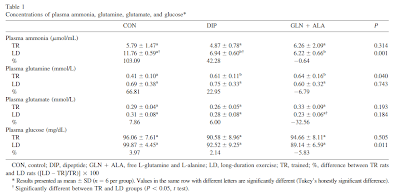
Some athletes, mostly bodybuilders, swear by it, yet the results of studies on the ergogenic effect of l-glutamine supplementation are quite unequivocal. A recent study ( Petry. 2010 ) investigated the effect of alanyl-glutamine (DIP, at 1.5 g/kg, n=8) , L-glutamine + L-alanine (GLN+ALA, at 1 and 0.61 g/kg, respectively; n=8 ) or water (CONTR, n=8 ) supplementation on various exercise-related parameters in rats after 21 days of training. The results are promising, yet far from earth-shattering: "Supplementation with DIP or GLN+ALA increased plasma glutamine concentration by 23% and 21% respectively , as compared to CONTR group (p<0.0001). Plasma ammonia concentration was lower in both supplemented groups (DIP, 3.8 ± 0.1 μM and GLN+ALA, 4.1 ± 0.2 μM), compared with CONTR group (5.3 ± 0.2 μM) (p<0.0001). DIP and GLN+ALA groups exhibited in the soleus muscle high glutamine (33.4% and 28%), glutamate (21.7% and 10.8%) and glutathione (GSH, 52.2% and 48.4%), compar...
Disclaimer:The information provided on this website is for informational purposes only. It is by no means intended as professional medical advice. Do not use any of the agents or freely available dietary supplements mentioned on this website without further consultation with your medical practitioner.