Posts

Showing posts with the label emg

Popular topics

Show more

Where do Your Strength Gains Come From? Muscle Activity > Hypertrophy > Initial Strength - 3/5 Candidates Matter

Image
Find out what's taking you from PR to PR, is it an increase in muscle size or activation on how important is how strong you already are? Have you ever asked yourselves why you've been adding 20lbs of weight to your squat and your legs still don't look any bigger? If you're a man you're probably not happy about that. I am not sure if the insights into Balshaw et al.'s recent study provide into the mechanism behind the resistance-training-induced strength gains will help you will make you happy/-ier, but certainly smarter ;-) The British scientists got to the bottom of your gains by assessing the individual and combined contribution of the adaptations in neural (agonist quadriceps EMG, antagonist hamstring EMG) and morphological (quadriceps muscle volume and θp, the fascicle pennation angle) variables. Are you looking for muscle builders for your new workout plan? Find inspiration here: What's the Latest on Failure? Drop-Sets: Vol-ume ↑, Gains ↕...

EMG Study Can Tell Us Something About Using Dumbbells, Barbells and Machines During Chest & Triceps Workouts

Image
The dumbbell bench press is a pec stretcher. Doesn't it already look like maximal pectoralis major activity? No, a high EMG activity will not  necessarily translate into improved long-term muscle or strength gains, but it can tell you a lot about the biomechanics of different exercises and/or, as in the latest study by de Araújo Farias et al. (2016), exercise equipment and order. The true purpose of this study by scientists from Brazil and the US was to investigate muscle activation, total repetitions, and training volume for three bench press exercise modes, the smith machine (SMBP), barbell (BBP), and dumbbell (DBP) - all followed by a triceps extension (TE). Want to try something very different? Try BFR and Hypoxia Training BFR, Cortisol & GH Responses BFR - Where are we now? Hypoxia + HIIT = Win? BFR for Injured Athletes Strength ⇧ | Size ⇩ w/ BFR Training & Living in Hypoxia With nineteen trained men as subjects, the scientists had ea...

Cables or Machines: Muscle Activity, Angle & ROM of Arms, Abs, Chest & Shoulders on Chest & Overhead P. & Curls

Image
This is the cable curl as it was performed in the study at hand (Signorile. 2016) As Joseph F. Signorile et al. point out in their latest paper, "cable resistance training machines are showing resurgent popularity and allow greater number of degrees of freedom than typical selectorized equipment" (Signorile. 2016). Ok, the "freedom" maybe not as absolute as it is with our beloved free weights, but cables come sign. closer than the average rigid Cybex machine. It is thus only logical that the scientists assume that "given that specific kinetic chains are used during distinct activities of daily living (ADL), cable machines may provide more effective interventions for some ADL" and eventually certain athletic endeavors (Signorile. 2016). To identify these activities and corresponding exercise equipment, the scientists from the University of Miami came up with a study that examined differences in activity levels (rmsEMG) of six major muscles (Pectoralis...

Bench Press - The Truth About the Effects of Bench Angle on Pec Activity Varies Depending on the Phase of the Lift

Image
The bench press, in one form or another, is part of almost everyone's workout, but what's the best way to do it? You may have seen Brad Schoenfeld's post about the just accepted study of his that confirms the well-known link between muscle activity and poundage (higher weight = higher activity | see EMG Series ). Well, another recent study provides additional intricate insights into the link between muscle activity and the way you perform the bench press. Just like Schoenfeld et al.'s study, the study compared the muscular activation during bench presses - albeit in this case that of the pectoralis major , anterior deltoid and triceps brachii during a freeweight barbell bench press performed at different angles: 0°, 30°, 45° & -15° angles, to be specific. Want to become stronger, bigger, faster and leaner? Periodize appropriately! 30% More on the Big Three: Squat, DL, BP! Block Periodization Done Right Linear vs. Undulating Periodizationt 12% ...

Training to Failure and Modifying Rest Times: Two Ways to Maximize Muscle Activity? Two Studies, Similar Implications

Image
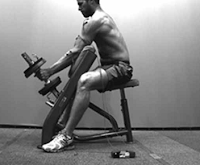
This is what science looks like... Well, at least in the Hiscock study, where the subjects, 10 young men with at leas 12 months of training experience did regular and hammer dumbbell curls on the preacher bench - (photo | Hiscock. 2015). In today's SuppVersity  feature article, I am going to address not one, but two potentially highly relevant articles from the  Journal of Strength and Conditioning Research  (Looney. 2015) and the European Journal of Sport Science (Hiscock. 2015). What makes these papers interesting is the fact that both investigated the effect of commonly prescribed remedies to "bust a plateau" by providing novel growth triggers: (a) Training to failure and (b) modifying rep schemes and whether you fail or don't fail on every set. If you believe in what you can read in many articles on strength training, both, training to failure and decreasing rest times / drop sets should significantly increase the muscle activity and thus - this is the most...
Disclaimer:The information provided on this website is for informational purposes only. It is by no means intended as professional medical advice. Do not use any of the agents or freely available dietary supplements mentioned on this website without further consultation with your medical practitioner.