Posts

Showing posts with the label brain health

Popular topics

Show more

Microbes, Mycotoxins, Milk Fats, and the Na:K Ratio - What's the Latest in Nutrition Science in February 2019?

Image
If you want to keep up with the very latest nutrition researc, be sure to follow the SuppVersity on Facebook ! Nutrition sciences are all about the microbiome, these days. Against that background you probably won't be surprised that my brief overview of studies from the latest edition of  Molecular Nutrition & Food Research  features 3+1 studies that deal with the food <> microbiome <> health interaction or could at least be related to it... before we get to the details, I want to warn you, though: The way people ascribe everything to gut bugs and try to sell random probiotics to customers is not science. That's quackery ! Review older articles about the gut - health  axis.at the SuppVersity Bugs Dictate What You Crave Sweeteners & Your Gut Foods, Not Ma- cros for the Gut Lactulose For Gut & Health Probiotics Don't Cut Body Fat Microbiome <> Bread's H. Effects Harnessing the microbiome to battle the ill-effects ...
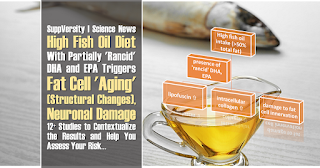
High Fish Oil Diet ➯ N3-Oxidation ➯ Fat Cell 'Aging', Plus Neuronal Damage | 12+ Studies to Contextualize the Results

Image
Athletes could be at particular risk of 'going rancid' You will probably remember both my previous article about the "rancidity" problem with over-the-counter fish oil products (see "3/3 TOP-Selling US Fish Oils Exceed Maximal Peroxide and Total Oxidation Levels - Levels Roughly 4000% Higher Than in Medical Grade N3 Supplements, Harvard Study Shows" | read more ), as well as my often-phrased general skepticism about the usefulness of high dose (>1-2g/d) fish oil supplements. You can learn more about omega-3 & co. at the SuppVersity Krill vs. Fish Oil - Is one Better? How to Avoid N3 Oxidation N3/N6 Ratio Doesn't Matter!? MUFA & Fish Oil Don't Match Fish Oil Doesn't Help Lose Weight Rancid Fish Bad 4 Health Back in the day, I already mentioned that the evidence on whether and how detrimental the consumption of (partly) oxidized fish oil actually is 'skinny' to say the least. As researchers from the U...

Magnesium - Beyond Bioavailability: Bioaccumulation in the Brain 1.2-Fold Higher for Mg-Taurate | No Effect on Muscle

Image
Brainiacs listen up: Magnesium + taurine can also be achieved from a (high seafood) diet. You will remember that the year 2017 saw the publication of the first study to lend credible support to the use of transdermal magnesium . If you go back to my article discussing the results of the study, you will find the following items in the overview of CNS symptoms of magnesium deficiency (48% of the Americans don't get enough Mg | Moshfegh 1997 ): "Nervousness, increased sensitivity of NMDA receptors to excitatory neurotransmitters, migraine, depression, nystagmus, paraesthesia, poor memory, seizures, tremor, vertigo." What you will also find is a figure depicting the effects of administering different forms of magnesium (orally) to rodents on plasma, bone, and red blood cell (#RBC) magnesium levels. Mineral water contains Mg, a lot of other minerals and bicarbonate you don't want to miss: Hydrogen Rich Water = Quackery? Glass of Water Before Meals as Diet ...

Krill vs. Fish: Krill Oil Still More Rapidly Absorbed, but Does it Matter in the Long-Run? Plus: Krill Research Update 2018

Image
Bio-advantage of krill may not be relevant in the long run | Plus: What we learned about krill oil in 2018 I've previously written about the question whether krill oil is, in fact, as the proper Latin name of the small critters it is made of, i.e.  Euphausia superba , would suggest "superba", ahh... I mean better than fish oil when it comes to its effects plasma and organ DHA and EPA. A large number of previous trials - almost all short-term, by the way - verify the commonly held belief that the largely (35-65%) phospholipid-bound krill oil (KO)  has a bioavailability advantage over the exclusively   triglyceride-bound fish oil (FO)  Di Marzo 2010 ;  Konagai 2013 ;  Ramprasath 2013 ). Another "K" you should have plenty of in your diet is  potassium (K)  (in German it's Kalium)! Potassium vs. Diet-Inducded Insulin Resis. In the Lime Light: The Ill Effects of Low K Intakes Bad News: Most Americans are Sign. K Deficient Lean...
Disclaimer:The information provided on this website is for informational purposes only. It is by no means intended as professional medical advice. Do not use any of the agents or freely available dietary supplements mentioned on this website without further consultation with your medical practitioner.