Posts

Showing posts with the label diet

Popular topics

Show more

AGEs: Where do You Find (>500 Foods), How do You Avoid (a Dozen Tips) Them? And Why Should You Even Care?

Image
100g fried bacon contains record-breaking 91,677 kU of AGEs. If you microwave it instead, you reduce the AGE concentration (and its taste) by ~90%! Learn more about the complex relationship between food, type, processing, AGEs and your health... "AGEs kill!" That's the message many headlines of mainstream science-news outlets have been sending over the last 2-3 decades - headlines that are usually based on observational studies. Most of them will then discuss epidemiological data, commonly ignoring that the very same food groups that are most likely to contain significant amounts of advanced glycation end products will also contribute to metabolic disturbances, which, in turn, increase the endogenous production of AGEs... So, is the answer your usual "just eat healthily"? Don't worry I am going to go beyond that recommendation in today's SuppVersity  article, but I would say: eating a minimally processed whole foods diet, should be the basis of ...
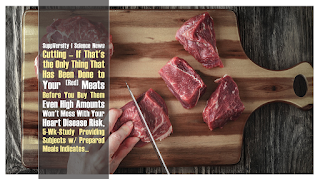
#RedMeat for Your #Heart: 500g/Week = Nothing but Healthy for Myocardium and Arteries if it's Lean + Unprocessed

Image
This is the degree of processing that's tolerable ;-) Fat, ground, burnt, and adulterated with steroids, antibiotics, nitrates, sulfites, and chemical preservatives - that's how the average Westerner "likes" his meat ('cause it's cheap, you know). No wonder that the majority of epidemiological studies (you know that's the branch of science, where people invent explanations for observations) "shows": red meat kills! As a SuppVersity  reader, you know from previous articles that experimental evidence suggests otherwise... at least for lean, properly prepared meats from appropriately reared animals (those are the animals that don't make taking extra steroids and antibiotics obsolete). Learn more about meat at the SuppVersity You May Eat Pork, too! Body Fat > Meat for CVD Meat & Prostate Cancer? Meat - Is cooking the problem Meat Packaging = Problem? Grass-Fed Pork? Is it Worth it? With the publication of ...

BCAA Free = Body Fat Free | Do BCAAs Make Us Fat or Are They Elevated when We're Fat? Study Suggests the Former

Image
First fat, then carbs and now protein? Are we ever going to stop pointing fingers at individual macronutrients and acknowledge that it's our caloric excess that's making us fat? As a SuppVersity reader the notion that the BCAA levels of obese mammals are chronically elevated is no news for you. In fact, I've written about the potential link between BCAAs and obesity repeatedly over past decade and the findings have been astonishingly consistent: Branched-chain amino acids (BCAAs; leucine, isoleucine, and valine) are elevated in the blood of obese, insulin-resistant humans and rodents. What is not consistent, though, is the interpretation of this observation. In most previous articles I've highlighted that the "BCAA question" is - eventually - yet another of those nasty chicken-or-egg questions, where the accumulation of BCAAs in the blood could be both, a cause or consequence of metabolic disease. Learn more about amino acid and BCAA supplements at ...

Which Fats Should Mothers-to-Be Consume if They Don't Want Their Kids to be Obese as Early as With 2-7 Years?

Image
Fat is an important nutrient for the unborn child. Accordingly, the question is not if pregnant women should consume fat, it's rather how much and at which ratios saturated, monounsaturated (MUFA) and polyunsaturated (PUFA) fatty acids should be consumed. A new study does now go even one step further and tries t assess the optimal amount of individual fatty acids like arachidonic acid (ARA), Eicosapentaenoic acid (EPA) or Docosahexaenoic acid (DHA). It should be obvious: Out of ethical reasons, the question from the headline can only be answered based on rodent or epidemiological studies. Now, I am not exactly a fan of epidemiology, but  in this important case, I wouldn't like to rely on rodent data, which tends to deviate significantly from human data in long-term trials spanning several developing periods. As you will probably know, a high-intake ratio of n -6/n-3 polyunsaturated fatty acids (PUFAs) has been suggested to contribute to excess fetal adipose tis...
Disclaimer:The information provided on this website is for informational purposes only. It is by no means intended as professional medical advice. Do not use any of the agents or freely available dietary supplements mentioned on this website without further consultation with your medical practitioner.