Posts

Showing posts with the label speed

Popular topics

Show more

Explosive Reps May Pay Off - At Least on the Bench: Fast Reps = Higher Muscle Activity, Higher Volume... Gains?

Image
Explosive training can, but it does not have to involve medicine balls and plyometric exercises. You can also do the regular bench press as fast as possible and will - as the study at hand says - achieve higher levels of muscle activity and an increase in rep volume. You will probably have heard the acronyms EMG = electromyography and TUT = time under tension before, but did you know how they go together? The simple assumption that a higher time under tension would yield greater EMG values and thus higher muscle activations is - as a recent study confirmed, once more - as far from being correct as it is from being logical. Think of it: It's simple physics. The force you apply is the product of the mass you move and the acceleration you exert on that mass. It's F = m · a - Force equals mass times acceleration. If you go slow to achieve a maximal time under tension, the acceleration will be low and so will be the force. Since my friends from the exercise physiological depar...

Power Up Your Bench With Maximal Velocity on the Bench: Almost 2x Greater Strength Gains Compared to 50%

Image
Bench press bros, listen up! You better push that weigh up fast, if you want to make maximal strength gains - O-lifting says "Hello" ;-) Do you train deliberately slow? If so, you may be limiting your strength gains. A recently published paper in the European Journal of Sports Science shows: "Movement velocity can be considered a fundamental component of RT intensity, since, for a given %1RM, the velocity at which loads are lifted largely determines the resulting training effect" (Gonzalez-Badillo. 2014). Before we take a closer look at how "large" the effect of training the training velocity actually is, I would like to invite you to take a closer look at the design of the corresponding experiment that was conducted at the Pablo de Olivade University in Seville, Spain. Squatting will always remain the most versatile muscle builder & fat shredder Optimizing Rest for Size and Strength Gains Alternate Squats & BP for GAINS! Farm...

Building the Jack-of-All-Traits Legs Workout With Squats, Jump Squats and Body Weight Plyometrics? At Least for Physical Education Students that Seems to Work.

Image
Image 1 (musclemag.com): You don't have to restrict your plyometrics to leg exercises - plyometric push ups, for example can help you to build a bigger chest and a bigger bench. "How many sets, how many reps, which exercises...?" These are the standard topics people are chatting about at the gym. Things like ROM (range of motion), explosive training or plyometrics , on the other hand, are almost as rarely talked about as they are done. What about you? When was the last time you counted the seconds it took you to compile the concentric phase of a squat? What about "plyos" (=plyometric exercises) do you have some in your current routine? No? According to the results of a recently published study by Eduardo Sáez de Villarreal and his Spanish co-workers, this may be a mistake - at least if your goal is not solely to maximize muscle size, but also muscle function. Plateau busting plyometrics and power building explosives - more than just hilarious bogus? ...

Double Your Workout Volume With 3,4-DA - Chlorogenic Acid Metabolite, Dihydroxycinnamic Acid, Makes Rats Run 60% Longer, 30% Faster 90% Further!

Image
Image 1 (sodahead.com): Another reason to supersize your cup of coffee; no not the girl, or ... well ;-) Those of you who can no longer be without their well-deserved daily dose of SuppVersity news will probably remember the amazing weight loss effects an extract from green coffee beans yielded in a 2012 trial by Vinson et al. (cf. " GCB Another Fatloss Acronym: Green Coffee Bean Extract Helps Pre-Obese Men and Women Shed 16lbs in 22 weeks "; Vinson. 2012) and while I am still not convinced that you would see similar results in non-obese individuals, another recently published study by Novaes et al. does suggest that even those of you who don't think that they have another lbs of body fat to spare, could largely benefit not just from the caffeine, but also from the 0.5-1.0g of chlorogenic acid and the subsequent conversion of the latter into 250-500mg of 3,4-Dihydroxycinnamic acid (3,4-DA) even 400ml of regular coffee do contain (Chung. 2004; Novaes. 2012). 3,4-DA...

Ripped & Buffed vs. Skinny and Sinewy: Training Velocity, not Load, Appears to be Sole Determinant of Exercise Induced Shifts from Slow- to Fast-Twitch Muscle Fibers.

Image
Image 1: Who would you like to be? And how do you train to achieve his physique? Sprinter or marathon runner? Ripped and buffed or skinny and sinewy? Although this is, after all, a question of muscle vs. fat, bone and tissue mass , it is upon closer examination as much a qualitative question, as it is a quantitative one - a question that may well be influenced by the way you train! Unlike our adipose tissue which has almost unlimited capacity to grow, the size of our muscles appears to limited by a number of factors, among which the individual fiber-make-up , i.e. the ratio of slow-oxidative endurance-type fibers (type I) to fast-twitch type IIA (fast-oxidative glycolytic), and fast twitch IIX (fast glycolytic) seems to play an important role, when it comes to getting big and buffed or skinny and sinewy. Figure 1: Slow- and fast-twitch faber composition in athletes and non-athletes (data based on Carrol. 1998 ; Widrick. 2002 ) As the data in figure 1 goes to show...

Exercise Velocity Does not Determine Hypertrophy Signaling in Eccentric Exercises: Akt, mTOR, P70s6k Protein Phosphorylation Identical for Fast and Slow Movements

Image
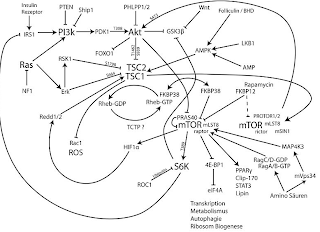
Finally, a study ( Roschel. 2011 ) related not only to nutrition and supplementation for exercise, but to exercise itself! The respective paper was published in the Applied Physiology, Nutrition, and Metabolism on April, 13th, and reports the results of a study on the effects of exercise velocity on markers of muscle hypertrophy, specifically, Akt/mTOR/p70 s6k . Figure 1: Schematic illustration of the mTOR signaling cascade ( Betz, Charles. Wikipedia ) Roschel, et al. had 20 subjects, "not enrolled in any form of strength training for at least 6 months prior to the study and without any history of musculoskeletal disorders" perform 5 sets of 8 repetitions of an eccentric knee extension exercise at either a slow (20°·s –1 ; ES) or fast execution speed (210°·s –1 ; EF) . After the workout, biopsies were taken from vastus lateralis at three timepoints: baseline (B), immediately after (T1), and 2 h after (T2). The results did not confirm the scientists' working hyp...
Disclaimer:The information provided on this website is for informational purposes only. It is by no means intended as professional medical advice. Do not use any of the agents or freely available dietary supplements mentioned on this website without further consultation with your medical practitioner.