Posts

Showing posts with the label overweight

Popular topics

Show more

Alternate Day Fasting & Classic Dieting: Same >5% Weight Loss in 57 vs. 67 Days W/ Unwittingly Increased Deficits

Image
ADF vs. continuous dieting in overweight/obese women: ADF marginally faster, about identically satiatin' but not per se 'superior' "When Weight Loss is Standardized (to 5%), Overweight / Obese Women are Neither Hungrier Nor More Satiated When Eatin' in an Alternate Day vs. Chronic Energy Deficit. Implications?" ⬅ that's the title of a #SuppVersity Facebook and Instagram post I was just about to publish yesterday to then decide: 'Hey, you've spent a lot of time to summarize the results of this study. Spend another 10 min (which became 1h) and you've got a short news item and hence a new article many of you may be (rightly) waiting for...' Learn more about fasting at the SuppVersity Monthly 5-Day Fast Works "Lean Gains" Fast Works Habits Determine Effects of Fasting Protein Modified Fast 4 Health IF + Resistance Training = WIN ADF Beats Ca-lorie Restriction Now, that I am actually in the process of wr...

Serious Lifting Increases SHBG, Muscle & Total Mass, While Decreasing Total and Trunk Fat in Overweight Young Men. Plus: Why an Increase in SHBG is Nothing to Be Afraid Of

Image
Warning: Used correctly, this dumbbell will increase your BMI, your glucose sensitivity and - at least if you still got some fat to shed - your SHBG! And what's the result? Metabolic health, strength and a significantly improved body composition! If you read the headline of today's news closely and did not freak out due to bro-scientific indoctrination and the firmly held believe that "SHGB is bad for you, bro. I'll bind your testosterone, bro!" you will probably have noticed that the 12-week resistance training regimen 36 of the 49 participants (BMI 31.4 kg/m² age 22 years) of a recently published study by Roberts et al. underwent would have to be considered an epic fail, if we went for the mainstream assessment of workout / dietary success - the infamous body mass index. If the add the broscientific notion that you best reduce your SHBG to zero (or into the negative range, if you find a way to do so), squats, deadlifts, lunges, rows, side raises, overhead pr...

What's the Optimal Dose of Vitamin D3 for Lean, Normal-, Overweight & Obese Women With Established Vitamin D Deficiency to Get 25OHD Back into the Normal Range?

Image
Both ladies are D-ficient, but will probably need profoundly different amounts of D3 to get their 25OHD back in range. Actually, I guess, I don't really have to tell you that there is not going to be guest post by Adelfo Cerame , today. Adelfo is busy with the last weeks of school, but will be back as soon as he has passed all the tests. And while I am not sure, whether or not you would call the latest on vitamin D supplementation an adequate replacement for a contest prep update from "your's truly", I suppose that it's better than nothing to bridge the time that still remains until the SuppVersity   Science Round-Up on the Super Human Radio Network is going to air (the show starts at 12PM, EST; the Science-Round-Up airs in the 2nd hour and will thus begin at 1PM, EST; click here to listen live or wait for the podcast // update : now available). I am honestly not yet sure what exactly we will cover today, but among the things I am still thinking about h...

More Protein = Less Fat: Additional(!) Whey, But Not Soy, Induces Slight Body Fat Decrease in Obese Individuals Without Conscious Dietary Intervention(s)

Image
Image 1: Whey proteins are cheap, many are tasty and as this study shows, effective not only for increases in lean, but also for reductions in fat mass. As a faithful visitor of the SuppVersity, it won't surprise you to read about the counter-intuitive effects the addition of 56g of whey protein to the diet of ninety overweight and obese patients (BMI ~30kg/m²; age 51y) had in a study the results of which have finally been published in the Journal of Nutrition on June 15 ( Baer. 2011 ). What could be news to you, however, is that the same amount of soy protein failed to induce similar changes. David J. Baer and his colleagues from the Human Nutrition Research Center in Beltsville (note: this institute is financed by the USDA) instructed the participants of the study to add 56g of a supplement containing either whey (WP), soy protein (SP) or carbohydrate (CHO) to their regular diets for 23 weeks - other than that part...

Binging Counter-Indicated Not Even, but Especially in Pregnancy: Excessive Gestational Weight Gain Associated With Higher Body Fat in Infants

Image
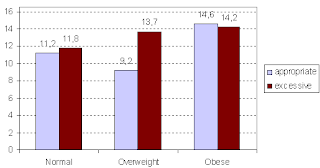
A recent study conducted by a group of researchers from New York ( Hull. 2011 ) found that excessive gestational weight gain in already overweight women had detrimental consequences on the body composition of their offspring: [I]nfants from obese mothers had greater percent fat (%fat) and FM than offspring from normal and overweight mothers. Within the excessive group, infants from normal mothers had less %fat and FM than infants from overweight and obese mothers. This is alarming news, especially if one takes into consideration the results of Conan et al. from Harvard ( Conan. 2010 ) who found that "birth weight [and I would suppose body fat even more so] is significantly associated with incident AF [arterial fibration]" in later life. Figure 1: Infant body fat [%] in formerly normal, overweight and obese women with either appropriate of excessive gestational weight gain These results should remind mothers-to-be that the good old saying "you are what you eat...

Fat or Fire, What Comes First? Scientists Answer: Obesity Alone Triggers Inflammatory Signaling in Mice

The metabolic syndrome, i.e. the combination of obesity, inflammation and insulin resistance, is at the center of contemporary medical research. In my appearance on Carl Lenore's Super Human Radio , I already mentioned that from a logical perspective the mainstream belief, inflammation was the root of all evil, must be flawed. How should the reaction to a problem be the cause of the very problem itself? A recent study coming from a group of Korean scientists strengthens my conviction that out of the triad that not inflammation, but rather obesity or - one step further up in the genesis of the pathology - the combination of an unhealthy diet and a sedentary lifestyle is at the heart of the triad we now call the "metabolic syndrome". Kim et al. investigated the pro-inflammatory signaling cascade in either diet-induced (DIO) or leptin gene deficient (ob/ob) obese mice and found that obesity alone ... [...] up-regulated the expression of TLR1–9 and TLR11–13 in murine adip...

Coffee Manooloigosaccharides Augment Weight Loss in Overweight Men

Certainly, you have heard that coffee is supposed to help with weight los; conversely, you probably won't have imaginged that it may not be the caffeine in everyones favorite baverage which does the magic. A recent study by Salinardi et al. ( Salinardi. 2010 ) investigating the effect of 4g/day coffee manooloigosaccharides on weight loss in 54 overweight men and women (BMI 27-33) came to the surprising conclusion that this hitherto overlooked coffee ingredient positively influences weight loss in men, but has no apparent effect on women: There was a significant beverage x time interaction on total body volume, total adipose tissue (TAT) and total subcutaneous adipose tissue in men, but not in women. Men consuming the MOS beverage had a greater percent change in total body volume and tended to have greater percent changes in subcutaneous and TAT compared with the placebo group. The gender difference hints at some hormonal background of the effectiveness / ineffectiveness of MOS in ...

Coumarins from the Stem Barks of Fraxinus rhynchophylla Inhibit Adipocyte Differentiation. A Novel Candidate for Weight Loss Supplement?

Image
A recent study by Shin et al. ( Shin. 2010 ) identified another potential weight loss drug: The Coumarins from the stem barks of Fraxinus rhynchophylla inhibited adipocyte differentiation and thus the basic mechanism of irreversible fat gain. Figure 1: Effects of Coumarins from F. rhynchophylla on Adipocyte Differentiation in 3T3-L1 Cells on days 1-6 ( Shin. 2010 ) As figure 1 shows, Esculetin a Coumarin from Fraxinus rhynchophylla is highly effective in inhibiting early adipocyte differentiation (day 1). With regard to the underlying mechanism of action, the scientists speculate: Esculetin (1) significantly blocked induction of PPARg expression in differentiated adipocytes, as measured by Western blot analysis (Fig. 4). In addition, esculetin (1) significantly inhibited adipocyte differentiation induced by troglitazone, a PPARg agonist (Fig. 5). These results suggest that esculetin (1) inhibited adipogenic differentiation, in part, via inhibition of PPARg -dependent pathway ....

Poor Children Get Fat. Yet Not Before the Age of Three

It is common knowledge that due to poor dietary choices and limited sources children of economically disadvantaged families are more likely to be overweight than their age-mates coming from better social backgrounds. A recent study by Rossem, et.al. ( Rossem. 2010 ) found, however, that this trend does not emerge before the age of 3 years: "Relative to children from mothers with the highest educational level , mean BMI standard deviation scores was lower at age 24 months in children from mothers with the low, mid-low, and mid-high educational level , and in the mid-low group at 36 months ( P < .001). Prevalence of overweight was lower in children from mothers with the mid-low educational level at age 24 and 36 months (adjusted odds ratio at 24 months: 0.61; 95% confidence interval: 0.43-0.87 and at 36 months: 0.65; 95% confidence interval: 0.44-0.96) but was not significantly different for the other educational levels. There were no significant differences in childho...
Disclaimer:The information provided on this website is for informational purposes only. It is by no means intended as professional medical advice. Do not use any of the agents or freely available dietary supplements mentioned on this website without further consultation with your medical practitioner.