Posts

Showing posts with the label kidney

Popular topics

Show more

Latest Study Shows that a 3.3 g/kg High-Protein Diet is Safe -- And Yes, This Means it Doesn't Hurt Your Kidney or Liver

Image
Don't forget that meat and dairy are not the only good sources of protein in your diet. In fact, even vegan athletes can - albeit with some effort - follow a diet that's so high in protein that traditionalists would say it may put your kidney and liver on the line - plant protein, or not... Guest post by Alex Leaf ( leaf-nutrition.com ) - There is a pervasive myth among vegans and health professionals alike that a high-protein diet is harmful, particularly for the kidneys. This is despite the World Health Organization official report on protein stating that "the most widely quoted potential problems relate to renal function and damage, but as discus-sed above the evidence for such claims in otherwise healthy individuals does not stand up to scrutiny" (WHO. 2016). Still, the vast majority of protein safety data that we have is with intakes less than 2.0 g/kg bodyweight. And for most people, that is all the data we need, because most people don’t eat more than the...

Three Reasons Why Your Doctor May Falsely Believe Your Kidney, Liver or Heart Were Damaged If You Get Blood Work Done Without Adequate Rest After Intense Workouts

Image
Sometimes lab values are deceiving - specifically if allegedly pathological elevations of kidney, liver and (heart) muscle enzmes are a perfectly physiological reaction to exercise.  You already know reason #1. The heavily increased creatine kinase (CK) levels I've discussed in a previous article at length  may look exactly as if you were about to have a kidney failure. In fact, the CK-levels can be elevated more than 100-fold after an intense workout (Pettersson. 2008). Accordingly, Mougios, et al. (2007) attempted to develop revised reference values for athletes in their 2007 study. The scientists' test revealed that CK levels of >1000 IU/L in male and 513 IU/L in female athletes would be better cut off levels for athletes who are still training than the regular upper limit of <208 IU/L. If you want to avoid muscle damage, you may try  BFR and hypoxia training . BFR, Cortisol & GH Responses BFR - Where are we now? Hypoxia + HIIT = Win? ...

Let There Be Light: 10 New Studies to Enlighten You About the Health Effects of Light Exposure on Health & Physique

Image
No, the sun does not kill you. If you control your exposure it may extend your life and improve your life-quality significantly. It's about time to "let there be light" to illuminate the benefits of regular well-timed exposure to sunlight and it's short frequency component. Only recently, researchers from the Japanese National Institute of Advanced Industrial Science and Technology (AIST) were able to show that daytime light exposure has significant beneficial effects on cognitive brain activity. Significant enough to have the subjects perform better on an oddball task and to significantly increase cortical activity related to cognitive processes (Okamoto. 2014). But is that really all, bright light, or more specifically, the regular and well-timed exposure to bright light can do for you? The effects on circadian rhythm could be behind the Sun's anti-cancer effects Sunlight, Bluelight, Backlight and Your Clock Sunlight a La Carte: "Hack...

High Protein Diets, Acid Load, Calcium Loss, Osteoporosis and a 50% Increase in Diabetes Risk - Is There a Link?

Image
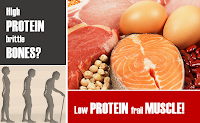
Shouldn't it be obvious that the "happy medium" must be the solution, when high protein leads to brittle bones, and low protein to frail muscle? Sure! But where is this "happy medium"? Some of you may remember my recent Facebook post "High Protein Diet in the Firing Line. Rodent Study Says: Kidneys Are at Risk". It was based on a press release you could read on all the major science-news outlets on the Internet; a press release that will give the average reader the impression that the corresponding study by Aparicio et al. would "prove" that high protein diets will ruin your kidneys and eventually jeopardize your health ( read more ). Another paper (Cao. 2014), Jose Antonio, the CEO of the ISSN and the editor of the ISSN's journal posted on Facebook yesterday, didn't get as much media attention, though. No wonder, the message of this study is after all not in line with one of the fundamental arguments you will hear, whenever y...

Organ Specific Resting Metabolic Rates and Diet-Induced "Metabolic Damage". Plus: At Rest Heart, Liver & Kidney Consume 83x More Energy/kg Organ Mass Than Muscle

Image
No, your muscles are not the primary gas guzzler in your body. The problems arising as a consequence of a diet-induced reduction of the metabolic rate are among the recurring themes here at the SuppVersity . For a good reason, as I would say. After all, they are the #1 reason for weight loss plateaus and the yoyo effect. Although the notion that "calories count" is not very popular these days there is no debating that an energy deficit is a necessary prerequisite for weight loss. The problem however is that you cannot determine your energy balance with a calculator, a body fat caliper and a scale. There are way too many other factors involved - the amount, macro- and micronutrient composition, timing, frequency, volume, texture and palatability of the ood you eat, stress, hormonal factors, etc - all of which will affect the amount of energy you expend and subvert the results of over-simplistic calories-in vs. calories-out calculations. What are the most notorious gas g...

Electrolyte Supplement Blocks Exercise Induced Elevations in LDH, Urea, Leucocyte Infiltration into the Heart & the Congestion of Renal Blood Vessels

Image
For the average gymrat it is probably not a question of life or death, but an increase in recovery due to a decrease in detrimental muscle damage in response to dehydration should be an very good argument to get some salt and glucose in after / around your workouts. Electrolytes have been at the heart of several SuppVersity articles as of late ( check them out ). Few of them did however have a direct link to exercise. Reason enough to discuss the results of a pertinent paper that was published by two scientists from Cairo University (Osman. 2013). At first sight, the study Hala F. Osman and  Azza M. Atya conducted does not appear to be very exciting. After all, the effects of electrolyte supplements on re-hydration after a workout are nothing that would not have been analyzed in previous studies. Moreover, the study at hand, which has been published in the latest issue of the World of Applied Sciences Journal , is a rodent study and the results would actually be pretty boring...

On Short Notice: EPO Reduces Mitochondrial Biogenesis, Excess Zinc Raises BP + Impairs Insulin Clearance, ALA + UDCA "Cure" NAFDL, Earthing, Estrogen & Your Heart ...

Image
Image 1: 2h of earthing would certainly solve this problem just as they seem to reduce the risk of developing blood clots,  by the way (see below) I thought I could try something new today and just give you a brief research update on stuff that would otherwise not necessarily make it to the SuppVersity , because it is not really worth writing a whole blogpost on it. Please make sure you let me know whether or not you like this format. I am open to comments of all sorts and suggestions on whether to continue posting things like this; on the respective frequency; on whether or not you want stuff in more detail and so on and so forth... You know that I am writing this blog for no-one else, but YOU , so take this chance and give me some feedback to allow me to tailor things even more to your demands. But enough of that, let's get to the studies for today :-) EPO treatment reduces mitochondrial biogenesis... ...in  fast twitch-muscle fibers, only! Vladimir E. Martinez-Bell...
Disclaimer:The information provided on this website is for informational purposes only. It is by no means intended as professional medical advice. Do not use any of the agents or freely available dietary supplements mentioned on this website without further consultation with your medical practitioner.