Posts

Showing posts with the label beta alanine

Popular topics

Show more

Washing Down 6g/d of Beta-Alanine not Enough to Saturate Muscle Carnosine? Beta-Alanine Research Update 07/2020

Image
Carnosine saturation!? It may occur (if at all) only at much higher dosages / longer supplementation periods  than they're currently recommended. If you've been a faithful SuppVersity reader for the last almost 10 years, you will have noticed that my initial excitement about beta-alanine (#BA) has been fading ever since the classic meta-analysis by Hobson et el. was published in 2012. Yes, there were small benefits (2%) but only in the high(er) intensity 'long sprint' exercises... after having read the latest meta-analysis by Rezende et al. (2020), I am asking myself if this rather mediocre result could be in part due to the relatively low median dose of BA. In the studies Hobson et al. reviewed, the median amount of cumulative #BA intake was 179 g of β-alanine. Now, Rezende et al. hypothesize that "commonly used BA supplementation protocols may not come close to saturating muscle carnosine content?" Let's take a look at how a group of Brazilia...
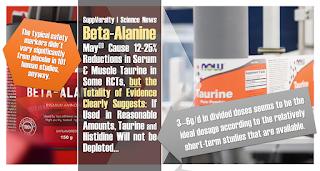
Beta-Alanine, Widely Used, but Rarely Tested for Safety!? Individual Studies Find Serum / Muscle Taurine is Reduced by >20%, However the Totality of Evidence Suggests...

Image
Reductions in muscle and especially serum taurine have indeed also been observed in humans, but the fact that they do not occur in lower dose studies and cannot be observed consistently in studies using higher dosages (6g) suggests that they shouldn't be a problem for the average BA user. Regular SuppVersity  readers will be familiar with the way(s) in which taurine (#TAU) and beta-alanine seem to both complement and antagonize each other. Beta-alanine, in particular, has been found to deplete muscular (and other tissue) taurine stores - a problem, generations of scientists have used to study the ill health effects of taurine-deficiency. While studies have never reported clinical taurine depletion in response to beta-alanine supplements, we have to consider the possibility that ... If it works (no runs + high intensity+volume exercise) bicarbonate is the king of H+buffers: Caffeine + Bicarb Make Champions Bicarb + Asp = Muscle Magic!? NaCHO3 & Leg Days're...

Bicarbonate + Beta-Alanine Supplementation, HIT Exercise Performance and Energy Substrates in 71 Trained Cyclists

Image
If there's one take-home message from the study at hand, it is: While both SB& BA work, it depends on the sport/exercise test if the effects will be significant. If you've been following my articles at the  SuppVersity  for some time, you will know that I have covered beta-alanine and sodium bicarbonate , two of the few ergogenic supplements for which we have enough evidence to assume that they actually work, extensively in the past. You will yet also remember that the synergistic effects you'd expect to see when you combine intra- (beta alanine) and extra-cellular (sodium bicarbonate) H+ buffers didn't show in every pertinent study in the  SuppVersity  archive. Danaher, et al. (2014) , for example, found no effect of combining both during performance test with fixed intensity and volume, while  Tobias et al. (2013) , whose study tested upper body performance and didn't limit either intensity or volume, did - it almost doubled the total work th...

Disappointing Results in 28-Day Creatine + β-Alanine Study: No Performance Benefits, No Muscle Gain, No Fat Loss, No Increase in Phosphocreatine & Carnosine in 32 Women

Image
Let's take a closer look at the study and find how it was possible that two proven ergogenics "failed". Creatine and beta-alanine belong to the few "proven ergogenics", but according to the latest study from the University of Pittsburg , the Texas Christian University , the University of Wisconsin – La Crosse and the Texas A&M University they are not as effective as some of us may think. Specifically the effects of beta-alanine which was tested in what you may call its "comfort zone", i.e. a graded exercise test on the cycle ergometer for VO2peak with lactate threshold determination, and multiple Wingate anaerobic capacity tests. And still, the overall results of the study is that there a "no consistent additive benefits of BA [beta alanine] and CRE [creatine] supplementation in recreationally active women. If you are using creatine already try adding bicarbonate as extra-cellular pH-buffer The Hazards of Acidosis Build Bigger ...

Beta Alanine + Bicarbonate = Synergistic Internal + External Muscle H+ Buffer With Disappointing Real-World Benefits

Image
No matter what this study says, I am pretty sure that the combination of bicarbonate + beta alanine would rule for Tour de France cyclists - at least during the dreaded time-trials. In a recent study researchers from the Victoria University and the Queensland University of Technology observed that the combination of the carnonsine pre-cursor beta alanine and sodium bicarbonate will elevate the buffering potential of skeletal muscle in eight apparently healthy, recreationally active men (26.2 ± 1.9 year; 79.8 ± 2.11 kg; 179.0 ± 2.2 cm; VO2peak 51.0 ± 2.5 ml/kg/min) by increasing muscle carnosine and blood bicarbonate levels, respectively. So much for the good news, the bad news however is that the performance increases on a repeated sprint test were non-signficant and the expected additive effects of beta alanine and baking soda (sodium bicarbonate) during a 110% cycling capacity test were non-existing. You can learn more about beta alanine & bicarbonate at the SuppVersit...
Disclaimer:The information provided on this website is for informational purposes only. It is by no means intended as professional medical advice. Do not use any of the agents or freely available dietary supplements mentioned on this website without further consultation with your medical practitioner.