Posts

Showing posts with the label grass-fed

Popular topics

Show more

Pastured Anti-Obesity Advantage: Lower Body Fat, Reduced Liver Fat and Healthier Guts in French Rodent Study of Health Effects of Pasture vs. Regular High Fat Dairy Diet

Image
Happy dairy, happy tummy. That's maybe not the sexiest, but potentially the most important result of this study. Yes, it's only a rodent study. And no, rodents usually don't drink cow's milk, but the fact that  a pastured dairy diet leads to improved metabolic outcomes and to a stronger gut barrier compared with a standard dairy diet in rodents on an obesogenic high fat diet, is still - in my humble opinion - newsworthy! As Bérengère Benoit and colleagues point out in their latest paper in the British Journal of Nutrition , "this may be due, at least in part, to the protective mechanisms induced by specific lipids" (Benoit. 2014). Learn more about milk and dairy at the SuppVersity Are Camels the Better Cows UHT = Mutant Milk? High Fat Milk Advantage Milk, A Hormone Cocktail? Milk Blocks Green Tea? Dairy, A Full Review Before we are dealing with implications and conclusions, though, let's briefly take a look at what exactly it ...

The Dairy Double-Whammy: Fast & Slow Dairy Protein Equally Satiating, Pastured Cream Reduces Body Fat Accumulation & Strengthen Intestinal Barrier vs. Std. Cream

Image
Whipped cream with strawberries - is it actually healthier with pastured cream? Is it less obesogenic, soothes inflammation and increases the oxidation while reducing the storage of body fat? I guess I could have made two separate articles of the two recent studies from the University of Lyon (Benoit. 2014) and the INRA in Paris (Marsset-Baglieri. 2014), but in view of the fact that there are already plenty of dairy articles at the SuppVersity, I thought, I'd pack them into one large "Dairy Double-Whammy Appreciation Article"; and in that I am about to start with something the average SuppVersity reader should know already: "Milk protein fractions moderately extend the duration of satiety compared with carbohydrates independently of their digestive kinetics in overweight subjects." Well, at least the first part shouldn't be news. The fact that this happens independent of their digestive kinetics, on the other hand, may come as a surprise. You can le...

You Eat What You Feed: How Much Omega-3s Can You Possibly Pack into a Single Steak? The Impressive Effects of a "Grass(+)" Diet on Raw Meat & Meat Products

Image
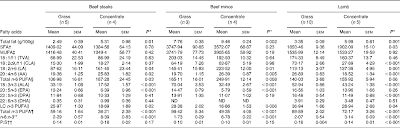
Learn more about the fatty acid and nutrient composition of grass-fed vs. regular beef this SuppVersity article is for you... and make the first step to reduce your CVD risk by 20% irrespective of whether or not you're going to eat grass-fed in the future! I remember that I wrote a previous post about the detrimental effects of growing salmon on a high omega-6 diet. The result is a fish with an omega-3 to omega-6 ratio that is totally different from that of the wild-caught salmon everyone is raving about. Bad news, I know and to be honest, I am fed up with bad news. Luckily you can rely on the scientists over at the Leibniz Institute for Farm Animal Biology in Germany: Dirk Dannenberger and his colleagues have just published a paper that sheds some light on the beneficial side of this ostensibly nasty link between the fatty acid make-up of the feed and the fatty acid composition of the meat of the animals we eat. N6 in N3 out, N3 in N6 out - you see, it works both ways! ...

Devil in the Feeding Trough: PGE-Response to "Bad" Red Meat from Grass-Fed Cattle Could Prevent not Cause Cancer, Stroke and a Whole Host of Autoimmune Diseases.

Image
Image 1: You do not need to hunt your red meat like a paleolithic human being, just make sure it comes from grass-fed animals and you will have a "health food" that modulate the your prostaglandin response to inflammatory assaults and thusly reduce your risk of cancer, stroke and autoimmune disesases in a way no fat-free chicken breast will ever do. I have had this in the news before, in the context of the purported health benefits of CLA, with respect to the modulation of the n3/n6 ratio in your diet and in various other context, you heard me saying, or, I should say, read me writing that rather than popping tons of fish oil caps, you should rather focus on decreasing your overall omega-6 intake by making healthy food choices at the supermarket. In this regard, choosing grass-fed over commercially raised beef (and other meat) products could turn out to be one of the most far-reaching choices you can make. While that alone will help you to concomitantly reduce the n-6 ove...

Short-Term Supplementation with Bovine Colostrum Does Not Improve Immune Variables in Well-Trained Athletes. Localized Effect on Intestinal Health Yet Possible.

Image
Just in case you wonder that there were no news yesterday . Blogger was down, so it took me some time to be able to tell all of you, who followed my advice and tuned in to yesterday's episode of Carl Lenore's Super Human Radio: "Amino Acids for Super Humans" and heard Carl and me talk about his use of bovine colostrums as part of his peri-workout supplementation regimen that my concerns over the digestibility of the (mostly) immunomodulating long-chain peptides in colostrum (the milk mammals produce in the last days / first days after pregnancy), appear to be legit. At least the results of a recents study ( Carol. 2011 ), which failed to produce any (systemic) immunomodulatory effects in well-trained athletes, would confirm my assumption that these longer amino acid chains are not able to overcome the tight gut junctions, which are genetically designed to "close" (the further tightening of the junctions is also known as "closure") within the fi...

Grass-Fed Beef: Does CLA make the difference? Probably Not.

Image
You certainly have heard of the benefits of the meat of grass-fed, i.e. naturally nourished, cows. Well, although I do not want to question its general superiority to corn-fed high omega-6 meat, it probably is not the CLA content which distinguishes good from not so good meat sources. A recent study, which was conducted by scientists from the Iowa State University ( Brown. 2011 ), scientists investigated the effect of a "balanced nutritionally complete diet" (31% energy from lipid, 13% from protein, and 54% from carbohydrate) with either high (1.17 g/d) or low (0.35 g/d) CLA content on various health parameters of 18 healthy women aged between 20 to 39 years over a 8 weeks period. These are the results: The CLA diet did not result in any differences in insulin sensitivity, body composition, circulating blood lipids, or other measured disease risk factors as compared with the control diet. Accordingly, the scientists concluded "that a diet naturally enriched wit...
Disclaimer:The information provided on this website is for informational purposes only. It is by no means intended as professional medical advice. Do not use any of the agents or freely available dietary supplements mentioned on this website without further consultation with your medical practitioner.