Posts

Showing posts with the label vegetarian

Popular topics

Show more

#RedMeat for Your #Heart: 500g/Week = Nothing but Healthy for Myocardium and Arteries if it's Lean + Unprocessed
Image
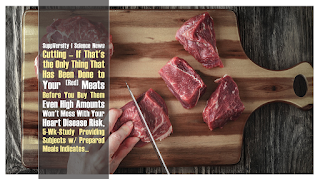
This is the degree of processing that's tolerable ;-) Fat, ground, burnt, and adulterated with steroids, antibiotics, nitrates, sulfites, and chemical preservatives - that's how the average Westerner "likes" his meat ('cause it's cheap, you know). No wonder that the majority of epidemiological studies (you know that's the branch of science, where people invent explanations for observations) "shows": red meat kills! As a SuppVersity  reader, you know from previous articles that experimental evidence suggests otherwise... at least for lean, properly prepared meats from appropriately reared animals (those are the animals that don't make taking extra steroids and antibiotics obsolete). Learn more about meat at the SuppVersity You May Eat Pork, too! Body Fat > Meat for CVD Meat & Prostate Cancer? Meat - Is cooking the problem Meat Packaging = Problem? Grass-Fed Pork? Is it Worth it? With the publication of ...

Creatine Non-Responder? Age+Meat Intake - Determinants of Creatine's Effect on PCr (±200%) + Probably Performance

Image
Vegetarian strength athletes belong to the group of people who will probably benefit most from creatine supplementation. Their young, meat-eating peers, on the other hand, may well turn out to be non-responders, because they see highly individual, but overall only non-significant increases in phosphocreatine. It has been a while since I published the last creatine article ("Dubious Effects of Creatine on Markers of CNS Adaptation and Heart Health in "Bodybuilders" - Reason to Be Afraid?" | read it ); the last time that I addressed the issue of "creatine non-responders", i.e. reasons why people simply don't seem to benefit from creatine supplementation has been published in 2014, already, when I presented the results of a study suggesting that it's not a high dietary creatine intake from meat that makes the difference ( learn more ). Needless to say, meat still made it on the list of possible determinants of the individual performance increase...

3.8 vs. 2.3 g/kg Protein + Exercise to Improve Body Comp. | Digestive Enzymes to Pimp Vegan Proteins | High Protein vs. MUFA Meals for GLP1 | ISSN Research Review '15 #3

Image
"If some is good, more is better!" Unfortunately, this simple maxime does rarely apply when it comes to the physiological response to certain foods and/or supplements. For protein, however, it appears as if the relation holds - at least as long as protein does not become the only energy source in your diet. I guess by now I can simply skip the lengthy introduction telling you about how I didn't want to cherry pick only three out of more than twenty newsworthy studies that were presented at the  Twelfth International Society of Sports Nutrition (ISSN) Conference and Expo in 2015, when I started writing this series right ( click here if you have missed the previous articles)? Well, that's good because it leaves more room for a brief preview of the studies I am about to discuss in today's third serving of the SuppVersity ISSN Research Review 2015  - studies that are all related (in one way or another) to increased protein intake. Either in overweight or obese...

Carnitine Deficiency of Vegetarians Can Be Compensated W/ 2g of L-Carnitine Tartrate Per Day - Unfortunately, Without Measurable Metabolic or Performance Benefits

Image
Vegetarian athletes do lack carnitine in their diets and muscle, but whether this has significant effects on their performance appears to be questionable based on the results of the study at hand. In a recent study, researchers from the University Hospital Basel investigated whether the previously observed low carnitine levels of vegetarians could be compensated for by longterm oral treatment with 2g of l-carnitine to replenish the body carnitine pool. Furthermore, the scientists wanted to know whether this would have significant effects on (a) fuel metabolism and (b) physical performance of vegetarians and omnivores. Novakova et al. hypothesized that "treatment with carnitine would increase plasma and possibly also skeletal muscle carnitine concentrations in vegetarians and would thereby improve skeletal muscle energy metabolism and physical performance" (Novakova. 2015). Getting enough protein is still a problem for some vegetarians Protein Timing DOES Matter...

Vitamin B12 - A Nutrition Guide for Vegetarians & Vegans: From Nori to Mushrooms, Omnivores Can Benefit, Too!

Image
With 77µg per 100g of the Nori leaves in the wrapping sushi makes an excellent B12 source, even if you stick to the vegan, no tuna version ;-) If this is not your first visit to the SuppVersity you will be aware that I am not a exactly a proponent of vegetarianism let alone vegan dieting. Just like any other severely restrictive diet people who don't eat animal products are at an increased risk of nutrient deficiencies. For vegetarians and even more so for vegans, it is not exactly easy to cover their daily requirements of vitamin A, vitamin D3, iron, cholesterol (yes, cholesterol is an essential nutrient!), n-3 polyunsaturated fatty acids and saturated fats. The most urgently needed nutrient for the average vegetarian / vegan dieter, however is vitamin B12, or cobalamin, as scientists say. Actually dairy happens to be an excellent B12 source. Why not become lacto-vegetarian? Dairy Has Branched-Chain Fatty Acids! Is There Sth. Like a Dairy Weight Loss Miracle? ...
Disclaimer:The information provided on this website is for informational purposes only. It is by no means intended as professional medical advice. Do not use any of the agents or freely available dietary supplements mentioned on this website without further consultation with your medical practitioner.