Posts

Showing posts with the label EPA

Popular topics

Show more

Fish Oil for Athletes? Fish for Everyone? Not for Ergogenic Benefits | Summary of Latest Metas + Umbrella Review

Image
An illustrated synthesis of the most recent evidence. There are two fishy articles in the latest issue of Advances in Nutrition , two articles worth taking a closer look at, as I've found. Paper 1 and probably the more SuppVersity-ish paper comes from the University of Bath and is, as the authors themselves highlight, the first systematic review of fish oil supplements (#FS) in athletes that has ever been conducted in the 25-years+ history of fish oil supplements 😮 (the "fish-eating"  umbrella review is addressed in the infobox). You can learn more about omega-3 & co. at the SuppVersity Don't drink rancid fish oil How to Avoid N3 Oxidation N3/N6 Ratio Doesn't Matter!? MUFA & Fish Oil Don't Match Fish Oil Doesn't Help Lose Weight Rancid Fish Bad 4 Health Impossible? Everybody knows that fish oil is rather a vitamin than a supplement, right? So why wouldn't athletes benefit? Ahh... Wrong question: The right question wou...
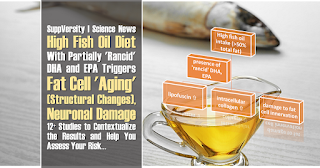
High Fish Oil Diet ➯ N3-Oxidation ➯ Fat Cell 'Aging', Plus Neuronal Damage | 12+ Studies to Contextualize the Results

Image
Athletes could be at particular risk of 'going rancid' You will probably remember both my previous article about the "rancidity" problem with over-the-counter fish oil products (see "3/3 TOP-Selling US Fish Oils Exceed Maximal Peroxide and Total Oxidation Levels - Levels Roughly 4000% Higher Than in Medical Grade N3 Supplements, Harvard Study Shows" | read more ), as well as my often-phrased general skepticism about the usefulness of high dose (>1-2g/d) fish oil supplements. You can learn more about omega-3 & co. at the SuppVersity Krill vs. Fish Oil - Is one Better? How to Avoid N3 Oxidation N3/N6 Ratio Doesn't Matter!? MUFA & Fish Oil Don't Match Fish Oil Doesn't Help Lose Weight Rancid Fish Bad 4 Health Back in the day, I already mentioned that the evidence on whether and how detrimental the consumption of (partly) oxidized fish oil actually is 'skinny' to say the least. As researchers from the U...

Krill vs. Fish: Krill Oil Still More Rapidly Absorbed, but Does it Matter in the Long-Run? Plus: Krill Research Update 2018

Image
Bio-advantage of krill may not be relevant in the long run | Plus: What we learned about krill oil in 2018 I've previously written about the question whether krill oil is, in fact, as the proper Latin name of the small critters it is made of, i.e.  Euphausia superba , would suggest "superba", ahh... I mean better than fish oil when it comes to its effects plasma and organ DHA and EPA. A large number of previous trials - almost all short-term, by the way - verify the commonly held belief that the largely (35-65%) phospholipid-bound krill oil (KO)  has a bioavailability advantage over the exclusively   triglyceride-bound fish oil (FO)  Di Marzo 2010 ;  Konagai 2013 ;  Ramprasath 2013 ). Another "K" you should have plenty of in your diet is  potassium (K)  (in German it's Kalium)! Potassium vs. Diet-Inducded Insulin Resis. In the Lime Light: The Ill Effects of Low K Intakes Bad News: Most Americans are Sign. K Deficient Lean...

Eat Your Fish Oil and Digest it, Too (Unoxidized!) | DHA:EPA Ratio of 1:1 Minimizes Oxidation, Maximizes Uptake | Plus: Fishes that Come Close are Sardines, Rainbow Trout, ...

Image
The often-heard "the more DHA, the better"-rule is - like so much you'll read about fish oil online - not the evidence-based truth it seems to be. Some extra EPA may keep the oil from getting oxidized before you even absorb it. No, I am not a fish oil fanboy, that's for sure. But how can you be if your chances to get already oxidized fish oil are 100% if you buy any of the US TOP-sellers (and assume that it's not different in Europe). Speaking of which: There's new research allowing us to add two new and potentially important criteria to the inofficial SuppVersity-"How to buy and use your fish oil" guide. The corresponding research comes from an international team of researchers and was first published in 2017. It is thus not exactly revolutionarily new but in view of the fact that I haven't seen the results being addressed anywhere before still SuppVersity  newsworthy ( Dasilva 2017 ). You can learn more about omega-3 & co. at th...
Disclaimer:The information provided on this website is for informational purposes only. It is by no means intended as professional medical advice. Do not use any of the agents or freely available dietary supplements mentioned on this website without further consultation with your medical practitioner.