Showing posts with label concurrent training. Show all posts

Wednesday, August 9, 2017

30 Min "Moderate Intensity Cycling" Enough to Cut Biceps Muscle Gains by 59%, Follow Up on 2015 HIIT Study Says

Cardio (legs) and biceps training don't mix.
You may remember my 2015 article about how "HIIT-ing it After Arm Workouts Will Ruin Your Gains" ((re-)read it), well the authors are back and published a follow-up study in the latest issue of the Journal of Sports Science and Medicine. In it, Shigeto Tomiya and colleagues from Japan write: "Changes in CSA might be affected by subsequent cycling exercise after 8 weeks of training."

And indeed, the relative difference between the 12.1% and 5% increases in biceps muscle size the scientists measured is the reason for concern for everyone trying to increase his sleeve sizes as fast as possible.
You can learn more about the optimal exercise order at the SuppVersity

Before, After or In-Between?

Exercise Order and Leptin Levels

Cardio First for Anabolism?

Large Muscle Groups First?

Combine Cardio & Strength, Right

Cardio or Weights First? What the...
With their previous study investigating the effects of relatively hard interval training, the purpose of the present study was to examine the effect of 30-min moderate intensity cycling exercise immediately after upper-body resistance training on the muscle hypertrophy and strength gain.

What is "moderate intensity"?

Unfortunately, this question must be answered for each and every study individually, because scientists haven't yet adopted a standard everyone would comply to. For Tomiya et al. doing "moderate intensity" cardio right after the workout meant...
"30-min moderate intensity endurance training at 55% load (W) of VO2max using a cycle ergometer immediately after 30 min of the resistance training protocol (CT) or on separate days at least 24 hours apart (SEP)" (Tomiya 2017).
The subjects, 14 male volunteers (age: 22.0 ± 0.7 years, height: 1.72 ± 0.05 m, weight: 62.1 ± 5.8 kg, arm-curl 1RM: 22.3 ± 3.0 kg), were randomly divided into two groups. One group performed the previously described moderate intensity (55% of maximum oxygen consumption [VO2max], 30 min) cycle training immediately after arm resistance training as concurrent training (CT; n = 7, age: 21.8 ± 0.7 years, height: 1.68 ± 0.06 m, weight: 60.3 ± 7.4 kg); the second group performed the same endurance and arm RT on separate days as control group (SEP; n=7, age: 22.1 ± 0.7 years, height: 1.76 ± 0.05 m, weight: 63.8 ± 3.6 kg).
Figure 1: Concurrent training protocols. RT, resistance training; ET, endurance training; SEP, concurrent endurance, and resistance training on separate days; CT, endurance training immediately after resistance training (Tomiya 2017).
The authors explain that the "supervised progressive RT program was designed to induce muscular hypertrophy (3-5 sets of 10 repetitions) with bilateral arm-curl exercise using 75% of the one repetition maximum (1RM) with 2-min rest intervals" (Tomiya). The RT program was per formed for 8 weeks, twice per week.
Figure 2: Overview of size and strength gains; %-ages indicate pre vs. post differences (Tomiya 2017).
Muscle cross-sectional area (CSA | measured by RMI), 1RM, and VO2max were measured pre- and post-training. And here are the results:
  • Significant increases in muscle CSA from pre- to post-training were observed in both the SEP (p = 0.001, effect size [ES] = 0.84) and the CT groups (p = 0.004, ES = 0.45). 
  • A significant increase in 1RM from pre- to post-training was observed in the SEP (p = 0.025, ES = 0.91) and CT groups (p = 0.001, ES = 2.38). 
  • There were no interaction effects (time × group) for CSA, 1RM, or VO2max. 
  • A significantly higher percentage change of CSA was observed in the SEP group (12.1 ± 4.9%) compared to the CT group (5.0 ± 2.7%, p = 0.029), but no significant difference was observed in the 1RM (SEP: 19.8 ± 16.8%, CT: 24.3 ± 11.1%). 
As I already hinted at, the scientists rightly point out that their "data suggest that significant improvement of CSA and strength can be expected with progressive resistance train ing with subsequent endurance exercise performed immediately or on a different day" (Tomiya 2017). For me, that seems odd, but eventually not impossible.
"Cardio Can BOOST Your Gains?! Do it Before Weights and be Rewarded With 28% Increased Fiber Size & VO2 Gains" - This previously discussed study seems to refute the results of the study at hand; but there are a few important differences: muscle groups involved, type of exercise, timing.

Putting things into perspective: As usual, there are a few issues you should keep in mind when interpreting the results - with the most important issue being the lack of dietary control. With neither control nor suggestions for energy and protein intake, it's not clear if and to which extent the reduction in biceps gains may be mediated by a decreased ratio of protein intake/energy requirement and/or a reduced ratio of total energy intake/energy requirement.

In addition, the absolute differences don't sound anywhere as huge as the 59% relative difference in CSA gains. While the SEP group upped their sleeve size from 8.8 to 9.9 cm² (+1.1 cm²), the CT group made it from 9.7 to 10.2 cm² (+0.5 cm²) - that's 0.6 cm² more for the "biceps only" group.

It's also odd that the size gains were impaired, while the strength gains were not. Previous studies usually found detrimental effects on both (Hickson 1980, Hennessy 1994, Leveritt 1999, Häkkinen 2003) - albeit in most cases in studies where cardio and strength training trained the same muscle group (legs). The mechanistic explanation for these observations is that the muscle receives disparate signals (Docherty 2000), with one saying build more mitochondria and the other signaling the muscle to increase protein synthesis, is thus not really applicable the study at hand. Plus: The results are inconsistent (Alabinis 2003) and depend on the "modality, frequency, and duration of the endurance training selected" (Wilson 2012).

A working model of the intracellular signaling networks mediating exercise-induced skeletal muscle adaptations. While RT works the mTOR signaling cascade, "cardio" ramps up AMPK signaling, which may (a) inhibit mTOR signaling via TSC and (b) suppress resistance exercise-induced muscle-protein synthesis (Nader 2006).
With respect to the observations in the study at hand, the authors speculate that the reduced gains are a potential consequence of reduced "phosphocreatine (PCr) recovery in strength trained muscle [...] due to blood redistribution for subsequent leg exercise" (Tomiya 2017). The authors elaborate: "Increased blood flow in arm muscles is important not only for early recovery of PCr but also for muscle development after strength training. Blood flow might be decreased in the arm during lower extremity exercise due to redistribution". It would be nice if we had fractional muscle synthesis or other data that would give us more than speculative insights into the underlying mechanism of the effect... also, if the scientists' hypothesis is correct, any type of exercise that doesn't involve the previously trained muscle group would compromise your gains. If that's indeed the case, this would mean that you'd better switch to a 6-way split if you want to maximize your gains. Studies that this way of training is superior, on the other hand, doesn't exist.

Furthermore, the previously discussed study by Kazior suggests, albeit for cardio before weights, increased gains in fiber sizes, when the same muscle (here legs) are trained during both, the cardio and resistance training regimen. Would be interesting to see what pre-lifting arm cranking would have done to the subjects' gains... but hey: that's a chance for another follow-up | Comment!
References:
  • Docherty, David, and Ben Sporer. "A proposed model for examining the interference phenomenon between concurrent aerobic and strength training." Sports Medicine 30.6 (2000): 385-394.
  • Hennessy, Liam C., and Anthony WS Watson. "The interference effects of training for strength and endurance simultaneously." The Journal of Strength & Conditioning Research 8.1 (1994): 12-19.
  • Hickson, Robert C. "Interference of strength development by simultaneously training for strength and endurance." European journal of applied physiology and occupational physiology 45.2 (1980): 255-263.
  • Leveritt, Michael, et al. "Concurrent strength and endurance training." Sports Med 28.6 (1999): 413-427.
  • Nader, Gustavo A. "Concurrent strength and endurance training: from molecules to man." Medicine and science in sports and exercise 38.11 (2006): 1965.
  • Tomiya, Shigeto, Naoki Kikuchi, and Koichi Nakazato. "Moderate Intensity Cycling Exercise after Upper Extremity Resistance Training Interferes Response to Muscle Hypertrophy but Not Strength Gains." Journal of Sports Science and Medicine 16 (2017): 391-395.

Monday, December 28, 2015

"HIIT-ing it After Arm Workouts Will Ruin Your Gains", Study Says and Confuses Statistical and Practical Significance

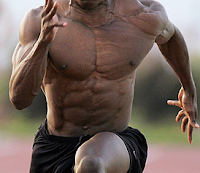
Does this look as if sprinting would impair muscular development of arms or any other muscle? I mean, come on - look at the average sprinter: Many gymrats dream of the arms and overall muscular physique they have; no wonder that the data from the full-text shows a different picture than the abstract would suggest.
I have repeatedly written about combining strength and classic endurance training. With endurance first, endurance last and even endurance in-between the studies yielded often very different results in terms of what would be the optimal way to combine both. With a few exceptions in which resistance training was combined with crazy endurance training sessions, however, I've yet never written about nor seen compelling evidence for the often-heard claim that "cardio ruins your gains".

For HIIT, i.e. high-intensity interval training, a recent study from the Nippon Sport Science University does now claim, though, that my that combining HIIT and weight training may be a very bad idea, ... an idea that may in fact, just as the broscientific nightmare suggests "ruin your gains, bro!" Upon closer scrutiny, however, things appear less unambiguous than the abstract would have it...
You can learn more about the optimal exercise order at the SuppVersity

Before, After or In-Between?

Exercise Order and Leptin Levels

Cardio First for Anabolism?

Large Muscle Groups First?

Combine Cardio & Strength, Right

Cardio or Weights First? What the...
The purpose of the study was to examine whether or not lower limb sprint interval training following arm resistance training influences training response of arm muscle strength and hypertrophy. Or in short: Will doing HIIT sprints immediately after an arm workout ruin the strength and strength gains you've primed before? 
Figure 1: According to the study, you better don't do HIIT sprint training after an intense arm workout if you don't want to ruin the strength and size gains you "primed" with curls and co (photo from Kikuchi. 2015)
The subjects, twenty previously only lightly trained men, were divided into resistance a training group (RT, n=6) and concurrent training group (CT, n=6).
  • The RT program was designed to induce muscular hypertrophy (3 sets x 10 repetitions (reps) at 80% 1 repetition maximum [1RM] of arm curl exercise), and was performed in an 8-week training schedule carried out 3 times per week on nonconsecutive days. 
  • Subjects assigned to the CT group performed identical protocols as strength training (ST) and modified sprint interval training (4 sets of 30-s maximal effort, separated in 4m 30-s rest intervals) on the same day. 
The relevant study outcomes the researchers evaluated were the changes in maximal oxygen consumption (VO2max), muscle cross-sectional area (CSA), and 1RM that were measured before and after the 6-week study.
Figure 1: Relative changes in VO2max (conditioning), muscle size (CSA) and strength (1-RM) over 6 wks (Kikuchi. 2015).
As the data in Figure 1 reveals, significant increases in VO2max from pre- to post-test were observed only in the CT group (p=0.010, ES=1.84), but not in the RT group (p= 0.559, ES= 0.35). The rest of the results in Figure 1, however should be kind of surprising to anyone who has read the researchers conclusion that "our data indicate that concurrent lower limb sprint interval training interfere with arm muscle hypertrophy and strength" (Kikuchi. 2015).

No, you are not mistaken. The average muscle size and strength gain in the combined training group was larger. The reason the scientist still claim that their study would show that HIIT impedes strength adaptation is a statistical one. While the changes in the CT group had p-values p > 0.05 and were thus not statistically significant. The (albeit smaller) mean increase in the RT group was significant. Accordingly, the corresponding "effect size" in the RT group is larger than the one in the CT group and thus HIIT training must be bad, right? Well,... I don't think so.
If you take a closer look at the individual muscle  size and strength development, you should notice that being afraid that sprints would ruin your arm development is unwarranted and the statistical significance and effect sizes of the changes practically irrelevant.
Beware of bling faith in abstracts! If you look at my plot of the individual data the scientists luckily published with their full-text, it is yet obvious that this study does not prove and if we are honest, not even really suggest that there practically relevant negative effects of doing HIIT in this workout. If you just read the conclusion to the abstract, which reads "our data indicate that con-current lower limb sprint interval training interfere with arm muscle hypertrophy and strength" (Kiku-chi. 2015), you may be inclined to make unne-cessary changes to your workout that are neither necessary or productive. After all, the objective result of the study is that in some individuals it is possible that the addition of HIIT to an arm workout may have a minor impact on their gains.

In view of the facts that there's (a) one person with a roughly ~41% increase in sleeve sizes in each group and that (b) the average increase in sleeve size would be 23% in the CT and only 21% in the RT group if the two outlayers who lost muscle (one in each group) were excluded, though, I would suggest you ignore this possibility unless you realize that you're making no gains at all with concurrent training. This doesn't falsify the scientists' conclusion, which is based on scientific standard procedure, i.e. look for statistical significant results, use those to make your conclusion, but I felt I needed to write this article to put the theoretically correct interpretation of results of an unquestionably under-powered study into perspective | Comment!
References:
  • Kikuchi et al. "The effect of high-intensity interval cycling sprints subsequent to arm-carl exercise on muscle strength and hypertrophy in untrained men: A pilot study." Journal of Strength and Conditioning Research Publish (2015): Ahead of Print | DOI: 10.1519/JSC.0000000000001315