Posts

Showing posts with the label bodyfat

Popular topics

Show more

Chest Fat, Bitch Tits, Chesticles, Gynecomastia, Lipomastia and Co.: Infinite Ways to Name it, Only 5 to Get Rid of It

Image
Image 1: Is it what he eats, is it what he drinks or is it just  andropause? Whatever it may be, Jack does not have the "classic gyno". In the last installment of this two-part series on gynecomastia, lipomastia and co. we have seen that the number of appellations this common, mostly benign enlargement of the male breast has been given, is easily outnumbered by the potential, mostly pharmacological, but also supplemental and/or dietary factors which have been implicated in its development. In a recent paper, Krysiak and Okopien estimate the incidence of mild proliferation of the glandular breast tissue to 30%-50% of the male population ( Krysiak. 2012 ). Against that background, the universal ignorance towards the profound psychological effects, as well as the tacit acceptance that, breasts or no breasts, "men don't cry" are certainly uncalled-for. If it's benign you got to live with it! The idea, "if it's not cancerous", it won...
Overweight Korean Adults Benefit from Protein Rich "Oriental" Diet - More than from Conventional Diet Program.

Americans and Europeans are by no means the only people with unhealthy weight problems. Korea, where the traditional diet is gradually replaced by an Americanized fast-food diet, faces a similar obesity epidemia. The solution, on both sides, appears to be the same: a significant increase in protein intake. Compared to a 2006 conventional dieting regime the subjects who participated in the 12 week high protein dietary intervention described in a recent study ( Joo. 2011 ) lost more weight (- 4.7 kg vs. -2.3 kg), had a greater reduction in waist circumference (- 6.8 cm vs. 3.3 cm) and lost more body-fat (- 4.2 kg vs. -2.0 kg). In view of the obesity related health issues it is also noteworthy, that... ... the triglyceride reduction was significantly greater (- 30.16 mg/dL, p < 0.001) in the PRO Diet group after intervention compared to the conventional group. Unfortunately, the original study is missing the dietary guidelines the subjects were provided (the file is not on the s...

Calcium + Vitamin D for Breakfast Increase Dietarily Induced Thermogenesis and Fatty Acid Oxidation

Ever since the first studies suggested beneficial effects of dairy on weight loss, there have been a lot of trials that investigated the role of (supplemental) calcium in these contexts (mostly with discouraging results). A very recent study by Wendy and Soares ( Wendy. 2011 ) took a very similar approach, but added vitamin D to the equation. In their study, the scientists fed their 11 subjects (aged (mean ± SEM) 54 ± 1.2 y and BMI 31 ± 2.4 kg/m ) a meal that was either high (HCT) or low (LCT) in vitamin D and calcium and measured diet induced thermogenesis (DIT) , fat oxidation rates (FOR) , serum leptin, subjective feelings of hunger/satiety hourly over a period of 8 hours. The results were far from earth-shattering; they could however solve the mystery of why most people find it easier to lose weight on a diet that is generally rich in dairy and calcium + vitamin D rich foods: HCT resulted in lesser suppression of ΔFOR (p=0.02) and a significantly greater DIT (p=0.01) . Furthe...

16 Weeks Vitamin D @ 2.000 IU per Day Effective Against Artherial Stiffness, But Without Effect on Body Composition

Image
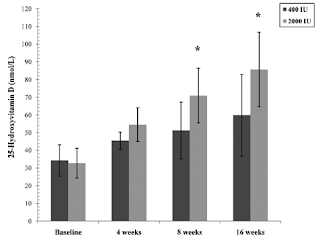
Although news on possible benefits from Vitamin D supplementation crowd in on a daily basis, trials, not done with post-menopausal women, are still scarce. It is therefore worth a SuppVersity post that Dong, et. al. will publish a paper ( Dong. 2010 ) on in the October issue of the Journal of Clinical Endocrinology & Metabolism , which investigates the effects of 16 week supplementation of 2.000 IU Vitamin D3 on 25-hydroxyvitaminD[25(OH)D] status, adiposity and arterial Stiffness in 49 Black Youths. Fig. 1: Vitamin D supplementation @2.000 IU raised 25(OH)D levels significantly more than supplementation @ the RDA, i.e. 400IU ( Dong. 2010 . Fig.1) While supplementation did raise 25(OH)D levels by 183% (vs. 87% raise in the group that was given 400IU VitD3/day) and had beneficial effects on cardiovascular risk measured by "carotid-femoral PWV, the 'gold standard' measurement of arterial stiffness in the central vasculature (e.g. aorta)", significant improvemen...
Disclaimer:The information provided on this website is for informational purposes only. It is by no means intended as professional medical advice. Do not use any of the agents or freely available dietary supplements mentioned on this website without further consultation with your medical practitioner.