Posts

Showing posts with the label tnf-alpa

Popular topics

Show more

Blocking Inflammation is Like Choking the Fire: Long Term Weight-, Visceral- and Android-Fat Gain in Human Study Emphasizes Essential Role of TNF-α in Metabolic Control

Image
Can cooling down the inflammation make your belly grow!? (Mito-)Hormesis and the important and beneficial role of "inflammatory" cytokines, molecules etc. are one of my favorite topics. It's simply intriguing that health, performance and longevity apparently depend on the presence of a healthy amount (whatever that may be) of inflammation. Even the provision of low dose arsenic does not - as you may expect - shorten, but prolong the lifespan of several common model organisms (Schmeisser. 2013). Findings like these don't just conflict with common sense, they are also in opposition to the still prominent free radical theory of aging and it's central message: Oxidation and inflammation are bad for you! No matter what!  Too little is just as bad as too much Most of you will remember one of my previous articles on (mito-)hormesis - if if that's not the case, I'd recommend you start with the "Inflammation is a True Fat Burner" article ( re...

Topical Fat Loss: Capsaicin Cream Blunts Weight Gain in Rodent Model and Increases Leptin, Adiponectin, Lipolysis and Fatty Acid Oxidation in Visceral Fat Depots

Image
Image 1: If you infused your ice-water with an extract of those, that could supercharge your "cold thermogensis" (see " Ephedra vs. Cold Thermogensis " ;-) Those last 1-2lbs of stubborn fat have been and still are the focal point of countless of discussions among trainees, trainers and  magazines even average Joes and Janes who would not even remotely consider to go to the gym to get rid of those love handles - interestingly, all these groups are similarly susceptible to one message: "Revolutionary breakthrough in topical fat loss: " Whatever-Our-Marketing-Department-Came-Up-With- Burn will obliterate the stubborn body fat that's still covering your abs, obliges, butt, and whatever else you hate about yourself in record time!" Sounds and, as the countless disappointed testimonies on the Internet confirm, is usually too good to be true. How many scoville (SHU) does it take to burn 1lbs of body fat? A soon to be published study by researche...

Neptune Krill Oil Effective for Athletes, as well

Image
As a reader of the SuppVersity, you already know about the positive effects of Krill Oil on blood lipids and glucose homeostasis. A very recent investigation into its effect in trained athletes (rowers) revealed significant effects on exercise recovery at only 1g/day. The polish scientists ( Scarpansca. 2010 ) report: Exercise significantly increased values of SOD, TNF-α and TBARS in both groups, but recovery levels of TBARS were significantly lower in athletes receiving Krill oil compared with the control group. Figure 1: Training schedule in the week preceding blood sample collection before, and after the supplementation period; volume in minutes per day ( Scarpansca. 2010 ) Interestingly, supplementation had no effect on antioxidant enzymes, TNF-α and serum lipid profiles . So, there appear to be various reasons for very different parts of the public to consume, or rather supplement, with Krill Oil : Of yet, we know it does improve blood lipids for the ordinary couch potato o...

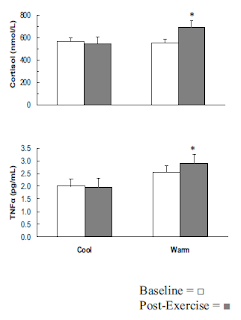
Exercising in Warm Environment is More Stressing As Measured by Cortisol And TNFα

Image
As Hosick et.al. found ( Hosick, 2010 ) the exaggerated core temperature response to exercise in warm water environment triggers a significant increase in cortisol and TNFα , both parameters of increased metabolic stress in the 8 male subjects (men age 24y) who participated in "two 40 min trials of cycle ergometry at 65% of VO 2 peak immersed to chest level in cool (25 °C) and warm (38.5 °C) water". Cortisol & TNF-alpha values for subjects before and after 40min exercise immersed in cool or warm water ( Hosick, 2010 ) With a score of 16 (warm ) vs. 16 (cool) the rating of perceived exertion (Borg scale 6-20) was also significantly elevated and correlated with the heart rate (180BPM, warm vs. 144BPM, cool) of the subjects. The researchers conclude that: "[...] this finding is of importance to individuals, coaches, and fitness professionals attempting to understand ideal training load and design in warm or hot environments." ( Hosick, 2010 ) Just another...
Disclaimer:The information provided on this website is for informational purposes only. It is by no means intended as professional medical advice. Do not use any of the agents or freely available dietary supplements mentioned on this website without further consultation with your medical practitioner.