Showing posts with label flexing. Show all posts

Wednesday, May 23, 2012

Two Max. Isometric Contractions Reduce Muscle Damage and Promote Regeneration Before You Even Hit the Gym! Plus: How to Add 0.5 Inch to Your Biceps in 6 Minutes!

Image 1: Believe it or not, Arnold is just "pre-regenerating" ;-)
If you have not taken a mental health day for your gray matter the past two days and skipped your obligatory daily visit at the SuppVersity, you will probably have noticed that the last posts on the overtraining induced shift in the ratio of pro- to anti-inflammatory signals (cf. "Overtraining, Inflammation, Insufficient Repair") and yesterday's hot bath "pre-regeneration" post (cf. "Speed Up Your Regeneration and Propel Your Gains by Taking a HOT Bath Bath 2-Days Before Arduous Workouts"), share a common motif: He who recovers the fastest spends the least time on repairing and the most time on building muscle! Today you are going to learn about yet another pre-regeneration technique...

Muscle preconditioning by maximal isometric contractions

Similar to the hot bath, of which I know that it's probably not for everyone, a recently published paper by Hsin-Lian Chen and his colleagues from the National Chiayi University in Taiwan, the Edith Cowan and the Deakin University in Australia (Chen. 2012), the execution of only no more than 2 isometric maximal contractions (duration 3s, 45s rest between contractions) at an elbow-flexor angle of 20° (where 0° would indicate a straight arm / stretch position) on something a bodybuilder would probably call a "preacher bench" can have statistically significant effects your curl performance and muscle damage during an eccentric biceps workout 48h later.
Figure 1: Relative peak maximal torque and change in biceps circumference 0-10 days after an eccentric exercise bout with and without 2 or 10 maximum isokinetic contractions 48h before (data adapted from Chen. 2012)
The decrease in peak torque (cf. figure 1), the increase in peak torque angle (indicating that you cannot apply full force right from the beginning of the movement; not shown) and the change in the range of motion (not shown) were profoundly attenuated in the 26 of the 39 young previously untrained men who had undergone the isometric preconditioning protocol. As the data in figure 1 shows, the same was true for the so change in muscle circumference - and no this does not mean that preconditioning will diminish your gains, but rather that it will reduce the muscle damage, the (micro-)trauma and subsequent edema!
Figure 2: Creatine kinase and muscle soreness 0-10 days after an eccentric exercise bout with and without 2 or 10 maximum isokinetic contractions 48h before (data adapted from Chen. 2012)
The decreased creatine kinase, muscle soreness, and plasma myoglobin concentration in the pre-conditioned vs. the control subjects confirms (figure 2). We are dealing with less damage and thus less swelling, and not with decreased "growth".

Practical implications & suggestions

You don't add 0.5 inch of muscle in 6 minutes. In a way it's a pitty, wouldn't it be great to be able to add 0.5inch to your biceps within 14 minutes of which you actually trained for 6 minutes, only? It certainly would, but let's be realistic, if that worked, you would soon have to stop training because Popeye would look like a shrimp next to you and Jay Cutler would ask himself, why on earth nobody had told him about that before the last Mr. Olympia ;-)
Image 2: A slightly more bend arm and a cable pulley - otherwise that's your position for the isometric contractions. Hold them for 3s, squeeze to make your bis explode, rest 10s repeat & go home!
How can I mimic the protocol and what's the use? Go to the gym, grab a preacher bench / scott bench, put it in front of a low cable pulley, attach a grip to the pulley, perform 2-10 isokinetic contractions at an elbow angle of 20°, go home. Come back 2 days later, use the same equipment, crank out 5 sets of six maximal eccentric contractions at an angular velocity of 90°/s from a half-flexed position (elbow angle 90°) to a fully extended position. Rest 10s between reps (use your other hand to get back to the starting position), repeat. After 65 sets you drop everything, go home and wait. If you did the preconditioning you will be sore for 3-4 days, if you didn't for the rest of the week and your creatine kinase (indicator of "leaky" = damaged muscle) wont be back to normal before day 10!
But seriously, unless you like to suffer from muscle soreness or are in dire need of the bragging rights, the 0.5 inch of edema under your skin have to offer, pre-recovery strategies like hot water baths (see yesterday's news) and isometric maximal contractions could actually be a valuable tool to decrease excessive muscle damage, increase regeneration and improve your gains!

Guess what: Arnold knew it all along!

Image 3: Austrian Wisdom ;-)
With posing being not much different from "maximal isokinetic contractions", I do - once again - have to credit the one and only Arnold Schwarzenegger for his intuitive knowledge of what would help you build slaps of muscle. And despite the fact Arnold's rationale for holding his poses for "hours and hours" (if possible), in order to "make the muscle harder and more defined" was somewhat different, the absence of edema (and water retention as a result of inflammation) and an improved growth of real muscle tissue in the workouts which followed sessions like that could in fact have produced those exact results harder a harder and more defined look, many pros call "muscle maturity" also because it takes time to build real muscle that will not just pop, when it's full of water.

Further evidence and alternatives

If neither posing, nor bathing, nor going to the gym to perform no more than 2-10 isometric contractions is something you could imagine to do, you may be happy to hear that this is not the first study by Chen et al. In their previous work the researchers that
  • "low-intensity eccentric contractions (ECC) of the elbow flexors with a dumbbell set at 10% of maximal isometric strength (10%-ECC) either 2 days, 7 days (1 week), 14 days (2 weeks) or 21 days (3 weeks) before 30 maximal eccentric contractions (Max-ECC)" (Chen. 2011) elicited similar protective effects, and that
  • "repeating submaximal eccentric exercise confers the same magnitude of protective effect as one bout of maximal eccentric exercise against the subsequent maximal eccentric exercise" (Chen. 2010)
In other words, no matter what you do - as long as it does not already hurt the muscle, it will elicit protective effects in a subsequent workout; effects, which can last for up to 3 week (I don't think that this will be the case in trained athletes) and are present after only two days. Don't you agree that "light days" (light must be defined against your current conditioning, the "light" day of a pro-athlete would probably already overtax the non-trained subjects in the study at hand) - as long as you got the willpower to actually keep them light - could have their merits, just as posing intensely on a rest day has? No? Well, then go ahead "Mr. +0.5 inch edema arms" ;-)

References:
  1. Chen HL, Nosaka K, Pearce AJ, Chen TC. Two maximal isometric contractions attenuate the magnitude of eccentric exercise-induced muscle damage. Appl Physiol Nutr Metab. 2012 May 11. [Epub ahead of print] 
  2. Chen HL, Nosaka K, Chen TC. Muscle damage protection by low-intensity eccentric contractions remains for 2 weeks but not 3 weeks. Eur J Appl Physiol. 2012 Feb;112(2):555-65. Epub 2011 May 25.
  3. Chen TC, Chen HL, Lin MJ, Wu CJ, Nosaka K. Potent protective effect conferred by four bouts of low-intensity eccentric exercise. Med Sci Sports Exerc. 2010 May;42(5):1004-12.

Thursday, March 1, 2012

Adelfo Cerame - Road to Wheelchair Nationals '12: Pose Your Way to Better Workouts & a Freakier Physique! Plus: How to Take Photos that Will Do Your Physique Justice

Image 1: It goes without saying that the changes you see here go well beyond what the best Photoshop artist can do
For the unsuspecting out there, this is already the big week: After all, it is the week of the Arnold! But let's be honest, there is the most important name missing from the line-up. I mean who are Fouad Abiad, Gustavo Badell, Lionel Beyeke, Matthias Botthof, Evan Centopani, Eduardo Correa, Brandon Curry, Dexter Jackson, Michael Kefalianos, Ben Pakulski, Shawn Rhoden, Branch Warren, Ben White and Dennis Wolf if you can get Adelfo Cerame Jr. right here at the SuppVersity?

All jokes aside, less than 21 days and it's going to be "the day" for Adelfo. Personally, I believe that he has more than just a "fair chance" to take his pro-card, but you never know how the competitors will come in... I just hope they don't read the all the tips Adelfo is giving away here, week by week. I mean those are for you - and no one else ;-)

Three more to go to the big show!

If we wanted to be uber-correc, the subheading should actually read "2 ½ more to go to the big show!", but that would not rhyme and with me being 100% on track as far as my nutrition and training are concerned, it does not actually matter all too much. After all, I am not going to take any risk and try to make some radical last-minute changes to my regimen. I’ve learned from reading articles and blogs from seasoned bodybuilders such as guys like Dr. Layne Norton, and Ken “Skip” Hill, that it isn’t wise to make hasty changes during your final weeks of prep, just 'cause you feel that "doing X could make me come out even harder" - just stay the course, and stick to the foundation and staples you used throughout the prep to get you where you are. If you are not lean enough 2 ½ out, you made a mistake and there is no magic trick that would get you down into the low single digit body fat percent range by show time. No matter if you decrease or increase your water intake, carb load, play with my sodium and potassium or do whatever else any bro is telling you will get you ripped in no time - it is not going to do the trick, when you have not done your homework. And if you have done those, you won't need any of those tricks, anyway ;-)

Posing and flexing the key to a freaky physique, even for the "average gymrat"

I guess this may sound kind of weird at first, but if you think about it, you will have to concede: Whether you are a bodybuilder or not, flexing is something that all athletes do from time to time - often without even noticing it. I mean look at the guys in image 2, none of them is a competitive bodybuilder, yet still they flex their muscles as if there was no tomorrow.
Image 2: These guys aren’t bodybuilders, but they sure know how to instinctively throw a pose ;-)
To show off that you are not the same dud as the average grandpa competing in your sport and to sell your merchandise, to scare dangerous and sometimes imaginary enemies away or to celebrate a victory or to celebrate a touchdown are only three examples of occasions where hitting a pose it "totally human" - don't worry folks posing is also "100% paleo" ;-)

For bodybuilders, on the other hand, posing is an essential, or I should say, an obligatory part of the sport. Therefore I have increased the time I spent posing over the last couple of weeks from my usual "check your progress" and "get a feeling for your muscles" posing to training my actual routine for the night show. In that, hitting the right poses is yet only part of the game... bodybuilding is all about looks, so as the show approaches I am also laying out my plans as far as tanning, clothes, shoes and even haircut are concerned - I guess, you are smiling or even literally "rolling on the floor", now, but all that can make the difference between victory and defeat... Shit! I even clean and shine my wheelchair the night before!

Pose your way to better workouts and a freakier physique!

I know that most of you probably believe that anyone who is not training for a bodybuilding competition and still hits his poses in the gym is an arrogant jerk, ...and in 90% of the cases you may be right, the other 10% however may just be aware of how important and useful this practice actually is. I mean, I also felt awkward, when I started posing - and that despite the fact that I always knew that I wanted to get on stage - but when I realized how my muscles began to get harder, to lose some of the subcutaneous water and to be - I guess, the best word to describe it is "more responsive" to my commands, I suddenly realized that there is actually much more to those forceful maximal contractions than just "showing off".
Recipe of the week:  
My godchild's Pepperoni Sushi is an
innovative treat for your re-feed
Pepperoni Sushi:

Ingredients:
  • Pepperoni or turkey pepperoni
  • Sushi rice (eg. from Sprouts or Trader Joe’s)
  • 1/3 cup of Rice vinegar
  • 2-3 Tbs. of sugar
  • 1-2 tsp. of sea salt
Credits: I must admit that the original idea to this recipe comes from my godson, who inspired me to make re-feed meal out of what he calls his "pepperoni sushi".

How to prepare it:
Read the directions on the back of the bag! Lol. J/p… Well not really… If my little nephew can make it, then I’m pretty sure you intelligent suppversity readers can read the instructions in the back of a bag of rice…  And the picture is pretty self-explanatory on how to prepare it ;-)
Nothing, not even the DHT-based prohormones, the bros recommend for this puprose, builds and strengthens the "mind-muscle connection" like hitting your poses - hard and regularly. You will be amazed how this practice will exponentiate the gains you are making in the gym. It will help you to finally understand what the real "pros" (not the aforementioned bros) are talking about, when they say that they try to "make a light weight as heavy as they can, to really exhaust the muscle" - the mind-muscle connection is what distinguishes lifting weight from body building (just in case you wonder, I intentionally wrote this in two words). I don’t know - and honestly don't really care - if there is any truth or science to it - I just know that it works.

Posing is commonly overlooked prerequisite to objectively evaluate your progress

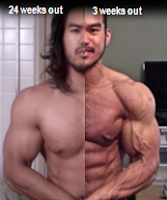
Image 3: Obviously you can tell the difference from 24 weeks out to 6 weeks out, but from then on, the details and the changes are very minute. The only thing you’ll probably notice is the tanning I’ve been doing the last 2 weeks - which, by the way, is something that may not improve your physique (although the vitamin D may), but certainly your look :-)
At this point in my contest preparation, knowing where I am at, progress-wise, if of paramount importance. At the same time, however, this is getting increasingly more difficult, after all the "progress" you make should - assuming that you did your homework in the weeks before - be getting more an more subtle as the big day approaches (I outlined the reasons above)... in fact, I am now at the point, where I can hardly tell anymore if my body is making any forward progress, at all.

It's always easy to see progression, when you are still losing 2lbs of water per week, in the early days of a prep just from dropping your carb-intake. In the course of any diet, regardless of whether you are dieting for a contest, or, as Dr. Andro would probably write "just to look good naked" *lol* there will be the point, where you suddenly feel that you are stuck. And while this may actually be the case for some of you, often the scale or the measuring tape or whatever tool you have been using is just fooling you. This is why I believe in taking progress pics. They won't fool you, but you have to make sure that you take them under identical conditions, and that mean...
  1. identical lighting - nothing changes the way you look like different lighting conditions, and I am not referring to taking pics in the dark here; go and take two shots of yourself, one with light right from the front and one with a light source right above your head,... you will be surprised how fast you can "improve your physique"
     
  2. identical camera - this should actually be obvious but some of my clients send me a picture they took with their old iPhone and one they took with their shiny new digi cam; how can you tell what is a technical and what a physical difference between the two?
     
  3. identical time - now, this is something I myself have long neglected, but especially when you are getting leaner, the time you take the photo can make a huge difference; you will have to figure out at what time of what day you look best (obviously you want to judge your progress by the "best you can look on a given day") and for me this is usually either on Monday’s, right after my Sunday re-feeds, or right after my 20min HIIT sessions, in the course of which I usually consume 12 oz of water with ~1 tbs. of sea salt in it (The image under 4 weeks out was on a Wednesday morning after experimenting with the 12 oz of water and sodium, and the image under 3 weeks out was the morning after my Sunday re-feed).
     
  4. identical stomach content - contrary to your body water, where it is hard to tell if being watery is just a temporary thing or something related to your diet and/or training (which would obviously be important for your evaluation), the content of your stomach is something you should actually be well aware of and I guess, it should be evident that posing and taking pictures right after your Sunday re-feed binge is not the best idea of all ;-)
Still, even if you follow all these rules, your photos will be worthless if you do not alway hit the exact same poses and that (and this should go without saying) will not work, if you don't practice them, right?

Unfortunate but true: Just being in the shape of your live won't cut it!

Although people like Dave Palumbo always repeat that "conditioning wins a show", the latter is by no means all about being lean. It is about as important to look conditioned as to be conditioned... What? I know that may sound dumb, but if the tanning or the lighting are off, even Phil Heath will look like the average bro form your local  gym - well, sort of ;-)
Image 4: You need better definition in your abs? Just click "improve lighting" in your favorite image processing software and you are good to go; original image (left); digitally improved lighting (right)
That being said, did you ever wonder why individuals with darker complexions (assuming that they are fairly lean and muscular), seem to have better-looking physiques? The reason is the light, or rather the way it interacts with the color (or paleness ;-) of your skin - if you are tanned, it will underline your muscularity, if you are white like a ghost, it will expose your weaknesses.

Homework assignment: Shine the right light on your tanned physique

If you have ever seen (either in person or on TV) one of those celebrity photoshootings, you may have noticed the the camera assistants running up and down the scence, carrying with strange small lblack boxes in their hands. Those are light meters, they use to stage J.Lo, Brett Pitt and Co in a way that will minimize the workload for the Photoshop guys, who will later spot out the fat pads, the spider veins, the cellulite, the acne and all the other nasty blemishes on their computers. Trust me, go get a tan, find a place with a good lighting, take a photo and use the standard "improve lighting" functions of your average graphics software - you will be amazed about the progress you made within hours ;-)

Sunday, November 27, 2011

Intermittent Thoughts on Intermittent Fasting - Programing Success: Accept Your Weaknesses, Learn From Your Mistakes, Identify Your Strengths and Build a Better Body!

Image 1: You may call it "toning" or "shaping", but in the end it's bodybuilding in the literal sense.
Assuming that you are all "lean and mean" by now and thus ready to build some serious muscle (for those who missed it, read last week's installment on "Why you better lean out before bulking"), we can finally delve into your first steps on your way to ... wait. I hope you did not forget your "motivational elevator pitch" from the first part of this part of the Intermittent Thoughts, where I asked you to come to terms with what it actually is that you want to achieve. Now, the good news is that regardless of whether you are just sick of that lose skin on your upper arms or want to compete against Phil Heath at the 2012 Mr. Olympia, there are a few fundamental principles that apply regardless of whether you are striving for "toned" 11 inch arms or Coleman-esque 22 inch guns.

Gaining weight? Yes! Getting fat? No!

With that we have actually arrived at the very first of three key points, I promised to address in this issue (cf. end of last installment): effective ways to measure your progress. In the "weight loss installment" of this series you have already learned that other than the morbidly obese "King Size Homer", physical culturists and athletes who do not compete in weight-classes are ill-advised to step onto the scale too often.
Figure 1: Lee Priest's transformation is certainly amazing, but let's be honest, do you really want to run around like Michelin man in the off-season and then have to resort to extreme measures to get back in shape for a few days, only? (comparison posted by "Tibo" at the SRTrading Forum)
While dieters (here indicating people who want to lose fat), may get discouraged, because their weight-loss stalls, when they are actually just beginning to finally add some muscle to their increasingly lean physique, many self-proclaimed (hobby-)bodybuilders think that "gaining muscle" is all about increasing their off-season weight (interestingly, many of those people do not even compete and define their off-season as the time when they do not go to the beach to impress the ladies). What could make sense for a professional bodybuilder like Lee Priest (cf. figure 1) certainly is not an appropriate approach for the average gym-rat, whose "weight loss arsenal" is less well-stocked than the ones of a high level pro-bodybuilder ;-) Or put more simply, when former chubby, like Peter Griffin (cf. "Healthy Weight Loss") bulks up the way, Lee did, he will not (and I guarantee that) be able to drop that fat again and achieve the grainy look from figure 1 (right) within a few weeks time before a contest, by diet and exercise (and OTC fatburners), alone...
Figure 2: Other than for the "pros" with their versatile arsenal of "weight loss tools", the journey of the dirtily bulking average self-proclaimed hardgainer is a one-way street.
And even for the self-proclaimed "ectomorph" there is nothing worse than a dirty bulk, where the number on the scale serves as his / her yardstick of success. This is especially true, because many self-proclaimed "hard gainers" are lean mostly because they are still eating like a bird (or missing even the most fundamental basics like a sufficient protein intake of at least 1g/kg per day), even when they claim that would eat until they puke. If those people start forcing down tons of calories in form of sugary weight gainers, most of their weight gain will come from fat. Their initially low fat cell count will soon have to increase to provide enough storage capacity for the "valuable" energy, so that, rather sooner than later, the former "ekto" finds himself in a similar situation as Peter Griffin, who, no matter what he will do, will always have a harder time leaning out than his friends who have never gotten chubby in the first place.

Bottom line: Do not rely on the scale too much. Yes, you want it to go up steadily, but faster weight gain does not automatically equate greater muscle gain. Keep a close eye on your waist circumference and decide a priori when (no matter how close you may be to your superordinate goal, e.g. "achieving 20" arms") you need to cut back on calories to avoid "adipolateral damage" ;-)

Taking stock also implies coming to terms with yourself

Image 2: Just as when you are "dieting", the scale is not the best meter for your progress. A measuring tape, a notebook and a digital camera should be your tools of choice.
Assuming that you have decided that you could use some additional muscle on your scrawny frame, another often overlooked thing you will have to do even before you start "bulking" is to take stock of how "scrawny" you actually are - not by stepping on the scale, but by taking, or rather have someone take measures of your waist, your arms, your chest, your shoulder and thigh cicircumferences. Just like any good custom tailor would do. You will then take a camera and shoot photos, from the front, from the side and (don't neglect that!) from the back. Depending on how much progress you have already made, this may seem ridiculous or even embarrassing at first. After all, you probably do not look any of the cover models you are looking up to... but remember: You take these photos as a yardstick - your yardstick. It won't help you if you keep admiring the girls and guys from the magazine-covers and shy away from your own mirror image.

In order to make a change you must initially objectively assess and accept where exactly you are standing in order to decide what you want to change and by which means you can achieve that. As long as you keep thinking of you and your body as disconnected units, you will never achieve whatever physique it may be that you are dreaming of. So, this kind of  initial stock taking is way more than just setting the baseline reference. It is (at least for many trainees) also a matter of coming to terms with theirselves.

Bottom Line: You are your own yardstick. The figures on your measuring tape and your weekly progress pics are objective measures of your progress, which is defined against where you are coming from. 10" arms are an awesome achievement, if 8" where you are coming from!

Build on your strengths while working on your weaknesses

Start out with your strengths! What is that you like about your physique? What is your most developed muscle part? And if you are already training... ask yourself what it may have been that you have done right, here. I remember that I have always been pissed off that my legs appeared to grow like crazy, while my arms and "most importantly" (my perception at that time) my chest "just wouldn't grow". I looked at the figures and pictures and then peeked at my routine. "How on earth can my legs grow like that if I only train them once a week and do nothing like some warm ups on the leg extensions and some squats?" It was back then, when I eventually realized two things:
    Image 3: Do you really think anyone would know Tom Platz, today, if he had decided to neglect his strength (obviously his legs)?
  1. Everybody has certain strong and certain weak body parts. Part of this is genetics. Especially if you have not reached your "full genetic potential", an even more important factor is however what you do in the gym, at work or in your free time. If you are carrying beverage crates all day, chances are that your "strong" body parts are your neck and your back, no matter if those are the muscle groups with the greatest genetic potential. If, on the other hand, you are like I once was and have a reasonable training plan for your legs (because people say that you have to train legs ;-), but are so eager to grow your chest and arms that you totally overtrain them, you must not wonder if you grow tree-trunk legs, whie your arms and chest shrivel away.

  2. Success comes from building on your strengths, and working on your weaknesses. It does not make sense to stop training legs, to "save the energy" for whatever other bodypart you feel is lagging behind. Not only will you run the risk that your former strength becomes your future weakness. You could also end up with two not one weaknesses by overtraining your weak and detraining your strong body parts.
For me that meant that I had to maintain my leg regimen and adapt my chest and arms routine by cutting out a lot of high volume auxiliary movements and focusing on improving my strength and technique on those movements of which I felt that they worked - and YES! This meant that the classic bench press was no longer a part of my routine!

Bottom line: Cherish your strengths and stop lamenting about your weaknesses. Analyze and build on what worked for you and acknowledge and learn from your own mistakes.

Hearing and listening to what your body is telling you

Image 4: Cable crosses certainly cannot replace the bench or dips, but they allow you to practice to flex your chest against resistance.
I see, that was a shocker. Dr. Andro does not do bench presses!? Well, not exactly, I have reincorporated them into my routine months later only to rotate them out again with the next change in my regimen. While the bench may have built massive chests like the ones of Arnold Schwarzenegger or Franco Culambo, but it just did not build mine.  

Sticking to what does not work, because people keep telling you that it does work is probably the most stupid and yet most common mistake I see in the gym.

If you read all the information in the "SuppVersity EMG Series", then you will be aware which exercises work best for the average trainee in the Boeckh-Behrens and Buskies study. You do not even know if these are also those exercises that work best for "the average trainee in general", but you can easily find out if these are the exercises that work best for you - and more importantly, if they are not, you should give a damn about how they rank in anyone's "Top List" (mine included!).

Bottom line: Never, I repeat, never(!) assume that what worked for someone else, or even the majority of the participants in a scientific study must also work for you. Listen to advice, build new routines based on scientific studies, experiment, but do not stick to a routine / exercise if, after 2 weeks, your body still keeps telling your that it ain't right for you.

Weight is important in weight lifting, posing is key in body+building

Image 5: If you want to maximize muscle gains, posing - or rather learning to flex your muscles against resistance is obligatory (img Johnny Jackson)
In case you are now wondering how on earth you can find out if the bench press or the dip (which is my favorite for chest) is right for you, when you do not have access to the complex measuring apparatus Boeckh-Behrens & Buskies used in their studies, I assume that you have never been posing or deliberately practiced the so-called "mind-muscle-connection" - have you? What? "Posing is ridiculous?" Well, that was what I thought as well, when I began training. I mean, I never even remotely thought about competing, so why on earth would I practice posing? The reason is simple and has little to do with the ability to showcase your muscles, but all with your brains ability to address the motor neurons on your muscle fibers.

If there is one thing I want you take away about goal setting for muscle building from this installment of the Intermittent Thoughts then it is that your primary goal in the gym must always be to work the muscle against resistance and not to break personal records. Here lies a fundamental difference between weight lifting (as in O-lifting or powerlifting) and bodybuilding. As someone whose primary goal is to improve his physique, the lifting weights is only a means to a completely different ends.

If all you want  is to build a bigger bench, fine! But don't expect to make similar gains as someone who understands that he is at the gym to work his muscles, not his ego. By practicing posing and doing what I like to call 1-2 "acclimatization sets" with ~50% of the weight you would use for 6-8 reps before every exercise, not as a warm-up but to memorize the movement pattern, to feel and flex the target muscle and to be able to transfer this pattern to your working sets, you will soon be able to decide which exercises are working for you, and which aren't.

Bottom line: You are not in the gym to move maximal amounts of weight, but to induce maximal muscular stimulation. This requires that you train your mind-muscle-connection and accept that the weights you are using are just a means to another end - the physique of your dreams. Remember: You increase your weights to keep challenging your muscle, and thusly to be able to record a new personal best in the notebook with your body measures, not the one where you keep track of your weights.

Preliminary conclusion(s)

Although, I did not get totally side-tracked this time, I still have to postpone the scientifically based considerations of the implications of the biological underpinnings of skeletal muscle "hypertrophy" (and maybe hyperplasia), at which I have been hinting in yesterday's blogpost, to another installment of the Intermittent Thoughts.
Note, in view of the pictures I have been using in this part of the series, I may have evoked the false impression that these rules apply exclusively to "bodybuilders". This is however not the case. There is no fundamental difference between training "to look good naked" and training for the "Mr. Olympia", as far as the take-home messages from this installment of the Intermittent Thoughts are concerned. Flexing your muscles, "posing" and practicing the mind-muscle-connection for example could be even more important for the ladies who want to "tone" their physiques than for the skinny ectomorph whose primary goal is to "get big".
For the time being, you would be well-advised to get yourself a measuring tape and a camera to take stock of where you are, physique-wise, to (re-)evaluate your strengths and weaknesses, to identify what worked for you and to get to know and learn to flex all the muscles in your body - and yes, there are more than biceps and chest, or chest and biceps ;-)