Posts

Showing posts with the label environment

Popular topics

Show more

There's Microplastics in Our Poop! Wait! Do We Even Care? An Evidence-Based Estimate of our Microplastic Exposure and its Putative Effects on Gut-Health & Beyond

Image
It's impossible you haven't read or heard about this study! I guess by now, all of you will have heard that an internationally covered pilot study by Austrian researchers (Schwabl et al. 2018) that was presented earlier this week at the  UEG Week in Vienna  claims to have initial prove that "Microplastics Find Their Way Into [Our] Gut" ( NYTimes ). The results of the studies are all over the place and the (fearmongering) press coverage seems to convey only one message: "Uh oh, now we're doomed!" But, are we? I mean, we're talking about a study with N=8 subjects?! Moreover, no one questions our exposure to the sub-millimeter sized particles and the fact that we actually seem to poop them out would, after all, suggest that they do not accumulate in our bodies - that's good news, isn't it!? If MPs have ill health effects they are probably mediated via their effects on our gut-health Bugs Dictate What You Crave Sweeteners & You...

Is it Your Neighbor(hood)'s Fault That You are an Obese Couch Potato? Plus: Higher Incomes Increase Obesity Risk in Men, Better Education Decreases Risk in Men & Women

Image
Image 1: If this photo looks as if it was taken in your neighborhood, statistics say that you will have a harder time than others warding off obesity. If you have not already been aware that the major weightloss obstacles are not so much of physio- than of psychological, or I should say behavioral natural, Monday's blogpost on the inability or unwillingness of the majority of the study participants in the Krebs study should have reminded you that there is more to losing weight than having an "optimal" diet plan. In this context, the results of a recently published paper from the University of Ottawa , Canada ( Prince. 2012 ), comes to mind, in which Stepanie A. Prince and her colleagues report the results of a large-scale cross-sectional multi-level analysis of the association between neighborhoods, physical activity and obesity in Ottawa. Mislead and misfed, but by no means unable to afford leading a healthier life-style Although obviously of epidemiological na...

Fat and Impotent Due to Tributyltin? Not Adipogenetic or Estrogenic, But Adipogenic and Estrogenic. Organotin TBT Dose-Dependently Increases Fat Deposition and Estrogen Receptor Activity.

Image
Image 1: Chemical structure of tributyltin; the organotin is a common ingredient in pesticides, anti-fungals and marine paints Although large parts of the industry won't concede to it, many of the invisible pollutants of our "post-industrial" age are just as, or even more dangerous than the nasty air and water pollutants of the Industrial Revolution. One of these invisible killers is the organotin, tributyltin (TBT) . It has been long established that TBT exposure during fetal life promotes adipogenesis and predispositions to a multitude of health problems in later life ( Grün and Blumberg, 2006 ) . Other than in other environmental toxins, such as Bisphenol A, it has been established only very recently that TBT may act as an estrogen receptor agonist, as well - in fact, in previous (low-dose) studies ( Lissimachou. 2006 ; Mortensen. 2007 ; Zhang. 2009 ) the exact opposite appeared to be the case. ...

Save Energy to Burn More Calories. Decreasing the Environment Temperature to 19°C and Burn 6% More Calories at Rest

On the northern hemisphere, the days get shorter and the temperatures are falling. I hope you have not turned up your heatings, yet. It is not only the environment that may benefit from a more conscious management of the room temperature. As scientists from the Clinical Endocrinology Branch, NIDDK-NIH, Bethesda have found, reducing room temperature by 6°C (from 24°C to 19°C) will increase human energy expenditure (EE) be 6%! Exposure to 19° C resulted in an increase in plasma and urine norepinephrine levels (p<0.0001), and a 5.96 % (p<0.001) increase in energy expenditure without significant changes in spontaneous physical activity . Exposure to the lower temperature resulted in a significant increase in free fatty acid levels (p<0.01), fasting insulin levels (p<0.05), and a marginal decrease in postprandial glucose levels. A small but significant (p<0.002) increase in serum free T4 and urinary free cortisol (p<0.05) were observed at 19° C. This is of part...

Exercising in Warm Environment is More Stressing As Measured by Cortisol And TNFα

Image
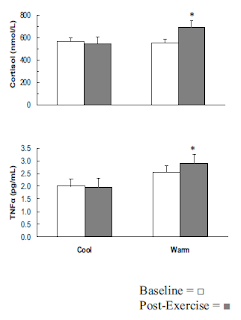
As Hosick et.al. found ( Hosick, 2010 ) the exaggerated core temperature response to exercise in warm water environment triggers a significant increase in cortisol and TNFα , both parameters of increased metabolic stress in the 8 male subjects (men age 24y) who participated in "two 40 min trials of cycle ergometry at 65% of VO 2 peak immersed to chest level in cool (25 °C) and warm (38.5 °C) water". Cortisol & TNF-alpha values for subjects before and after 40min exercise immersed in cool or warm water ( Hosick, 2010 ) With a score of 16 (warm ) vs. 16 (cool) the rating of perceived exertion (Borg scale 6-20) was also significantly elevated and correlated with the heart rate (180BPM, warm vs. 144BPM, cool) of the subjects. The researchers conclude that: "[...] this finding is of importance to individuals, coaches, and fitness professionals attempting to understand ideal training load and design in warm or hot environments." ( Hosick, 2010 ) Just another...
Disclaimer:The information provided on this website is for informational purposes only. It is by no means intended as professional medical advice. Do not use any of the agents or freely available dietary supplements mentioned on this website without further consultation with your medical practitioner.