Showing posts with label muscle growth. Show all posts

Sunday, December 13, 2015

True or False: Adolescent Athletes at Risk of High Tendon Stress due to Non-Uniform Tendon/Muscle Adaptation

Not allowing young athletes to lift weights may in fact increase, not decrease, their injury risk and hamper their recovery.
I am not sure why, but people won't stop inventing new reasons why professional athleticism would be bad for adolescents. One of the more recently heard claims is that early resistance training will lead to a "non-uniform adaptation of muscle and tendon in young athletes" that may "result[] in increased tendon stress during mid-adolescence" (Mersmann. 2015).

In a recent longitudinal study Mersmann et al. investigated the development of the morphological and mechanical properties of muscle and tendon of volleyball athletes in a time period of 2 years from mid-adolescence to late adolescence and the results are quite unambiguous.
Read previous True or False!? Articles at the SuppVersity

You Cannot Consume too Much Whey?!

Caffeine and Creatine Don't Mix, do They?!

Creatine is Better Taken After Workouts!?

Low Fat for Lean, Low Carb for Fat Individuals!?

Protein Timing Really Doesn't Matter!?

Nicotine Gums Will Help Fat Loss!?
A total of eighteen elite volleyball athletes participated in magnetic resonance imaging and ultrasound-dynamometry sessions to determine quadriceps femoris muscle strength, vastus lateralis, medialis and intermedius morphology, and patellar tendon mechanical and morphological properties in mid-adolescence (16 ± 1 years) and late adolescence (18 ± 1 years).
Figure 1: Mean values ± standard deviation of the muscle volume of volleyball athletes in mid-adolescence and late adolescence; %-ages indicate relative mid-to-late differences (Mersmann. 2015).
As the data in Figures 1 and 2 indicates, the muscle strength, anatomical cross-sectional area (CSA), and volume showed significant (P < 0.05) but only moderate increases of 13%, 6%, and 6%, respectively. In contrast to the muscular development, the patellar tendon CSA (P < 0.05) which is under constant stress in (semi-)professional volleyball players showed a substantially higher degree of hypertrophy (27%) that wen in line with increased stiffness (P < 0.05; 25%) and reduced stress (P < 0.05; 9%). Accordingly, the scientists conclude that - in contrast to the commonly heard prejudice - exercise during early adolescence will lead to
"pronounced hypertrophy of the patellar tendon led to a mechanical strengthening of the tendon in relation to the functional and morphological development of the muscle - [...] adaptive processes [that] may compensate the unfavorable relation of muscle strength and tendon loading capacity in mid-adolescence and might have implications on athletic performance and tendon injury risk" (Mersmann. 2015).
You know what, I can read your minds: "What about resistance training, then?" That's the question that's preying on your mind, right now - right? Well, as one of the more recent reviews says, "there is evidence that resistance training may reduce injury in a young athlete’s chosen sport" (Myer. 2006). The authors of the review point out that ...
Heyna et al. have demonstrated as early as 1982 that young athletes who regularly perform resistance training exercises are not just less likely to be injured, they also recover faster (Hejna. 1982).
"[t]his evidence is based on the beneficial adaptations that occur in bones, ligaments, and tendons following training and is further supported by epidemiologic-based reports. Lehnhard and colleagues were able to significantly reduce injury rates with the addition of a strength training regimen to a male soccer team. [...] Hejna and coworkers reported that young athletes (13-19 years) who included resistance training as part of their exercise regimen demonstrated decreased injuries and recovered from injuries with less time spent in rehabilitation when compared with their teammates" (Myer. 2006).
Similar results have been found specifically for female athletes for whom strength training - especially when performed in theh preseason and as regular part of in-season conditioning - reduced injury risk factors and anterior cruciate ligament injuries significantly.
Figure 2: Mean values ± standard error (bars) of (a) patellar tendon cross-sectional area (CSA) as a function of tendon length (in 10% intervals from proximal to distal; n = 18), (b) tendon force-elongation relationship (obtained from ramp contractions, see 'Methods' section; n = 12), and (c) maximum tendon force and stress (calculated for iMVCs; n = 12) of volleyball athletes in mid-adolescence (white) and late adolescence (black | Mersmann. 2015)
So, what's the verdict, then? The study at hand refutes the general claim that a non-uniform adaptation of muscle and tendon in young athletes may result in increased tendon stress during mid-adolescence. Furthermore the comprehensive overview of the effects of resistance training Myer et al. present in their 2006 review shows that additional "resistance training is not only a relatively safe activity for young athletes but that it may also be useful to reduce injuries during competitive play" (Meyer. 2006). To tell your young athletes to stay away from the gym is thus tantamount to telling them not to care about injury prevention.

As the 2014 International Consensus Statement on Youth Resistance Training in the British Journal of Sports Medicine (Lloyd. 2013) points out, it is yet important that your kids and youthsare following "[a]ppropriately designed resistance training programmes" if you actually want to make sure that they reduce, not increase, sports-related injuries. As such, LLoyd et al. even say that resistance training programs "should be viewed as an essential component of preparatory training programmes for aspiring young athletes" (Llyod. 2013 | my emphasis) | Comment on Facebook!
References:
  • Lloyd, Rhodri S., et al. "Position statement on youth resistance training: the 2014 International Consensus." British journal of sports medicine (2013): bjsports-2013.
  • Mersmann, F., et al. "Muscle and tendon adaptation in adolescent athletes: A longitudinal study." Scandinavian Journal of Medicine & Science in Sports (2015).
  • Myer, Gregory D., and Eric J. Wall. "Resistance training in the young athlete." Operative techniques in sports Medicine 14.3 (2006): 218-230.

Wednesday, May 15, 2013

Nonuniform Muscle Hypertrophy: Activation Patterns and Eventually Exercise Selection Determine Triceps Growth

Is it possible that you can - within your genetic limits - influence the growth pattern of your tris by the way you train?
"Localized muscle growth? Wtf now you're kiddin' me, right!?" Well, I want to be honest with you. It's not like you could actually grow exclusively the peak of your biceps, but the fact that even the observation that the maximal increase in muscle cross-sectional area does actually correspond to the area of maximal stimulation can be considered a "novel finding", is testimony to how under-researched the optimal modalities of training for such profane things as cosmetic muscle gains actually are. In the end, you'd even have to wonder that Taku Wakahara and his colleagues from the Waseda and Doshisha and Ritsumeikan Universities in Japan even dared investing precious time and money into a part of human physiology that's still looked down upon by large parts of the scientific establishment.

Maybe, it's like a carte blanche young researchers have!? After all, the study was supported partially by a grant for young scientists. So, before we get to the details, let's briefly thank the board members for turning a blind eye to the fact that the purpose of the present study was ...
"[...] to examine whether the regional difference in muscle hypertrophy induced by a training intervention corresponds to the regional difference in muscle activation in the training session." (Wakahara. 2012)
... and did not involve the frail, the obese or the frail and obese, but 24 completely healthy young male volunteers. With an average age of 26 years and 66kg on a 172cm frame (likewise averages) the letter were yet either sedentary or (maximally) "recreationally active" and had not been involved in a regular resistance training program for the upper limbs for six months before the beginning of the experiment.

Why would they use sedentary / hardly trained subjects?

Now you may certainly argue that it would be nice to see the very same study done in young bodybuilders. And this would in fact have been quite "nice" it would probably have been quite useless, as well. After all, you would have been hard pressed to measure any significant significant differences in muscle growth in already highly trained subjects.

That being said, there is still something to criticize: Why on earth do you need N = 12 subjects in the sedentary control group? I mean, it's not exactly likely that people who are sitting around anyway are suddenly growing big guns due to anything, but the 12-week exercise intervention they were part of? If the 12 subjects in the ...
  • The lying dumbbell press was performed with a TUT of 2s on the concentric and 2s on the eccentric potion of the exercise.
    control group, who did not perform resistance training, but maintained  their  normal  activities  during  the period,
had, for example, performed the same workout as the ...

  • training group, who performed 5x sets of 8x reps at 80% of their pre-determined 1-RM max of a dumbbell press-type movement; a multi-joint exercise that involved forearm extension and arm flexion in the sagittal plane to failure (if necessary the instructors helped them to complete any missing reps; rest between sets was 90s),
but with different rest times or using different exercises the scientists would have been able to collect much more valuable data in the same 12-week study period. Information muscle-heads like you and me would have highly appreciated.

But again, who am I to pass criticism on Taku Wakahara, Atsuki Fukutani, Yasuo Kawakami, and Toshimasa Yanai? A smartass blogger... no, I suggest we'd better be happy with the results and accept the limitations of the study at hand.

So what were the results, then?.

Before the training intervention, there was no significant difference in the age, body height, body mass or the maximal CSA of the triceps brachii between the two groups. After 12 weeks with three training sessions per week, however, the scientists did observe a highly significant increase in muscle CSA in the participants in the active arm of the study.
Figure 1: Activation patterns for lateral, medial and long head at at different distances (in cm) from the elbow joint and correspoding changes in muscle CSA after the 12 week intervention (left; figures indicate sign. diff. to position in cm); MR images used for the assessment of the activation pattern after the first session (right; Wakahara. 2013)
As mentioned before, this observation is neither surprising nor novel. What's quite telling and of practical relevance, however, is the observation that the different activation patterns the scientists had observed during the first training session, where the "%activated area of the triceps brachii had been significantly higher in the middle regions than that in the most proximal region" (Wakahura. 2013) did - just like "broscience" would have it - yield corresponding increases in the cross-sectional area in the respective parts of the muscle.
"The relative changes in CSA after the training intervention distributed nonuniformly (P= 0.029, partial η² = 0.327) along its length in the training group. The relative changes in CSA were significantly greater at 10 cm (P= 0.030, r = 0.753), 16 cm (P= 0.019, r = 0.774) and 22 cm (P= 0.001, r = 0.869) from the elbow joint that [sic!] the value at 28 cm from the elbow joint."  (Wakahura. 2013)
Interestingly, the scientists did not observe any significant change in the muscle thickness of the long head in the training group (before: 2.0 ± 0.3 cm, after: 2.1 ± 0.2 cm). This is a result that stands in line with the activation patterns Boeckh-Behrens & Buskies observed in their Y2k study on which the data in the SuppVersity EMG Series is based on (click on the respective body part below to see the activation patterns for different exercises for all muscle groups).

ChestBicepsBackCoreLegsTricepsShoulders
Navigate the SuppVersity EMG Series - Click on the desired body part to see the optimal exercises.
According to the said EMG data, the optimal exercise for the caput longum are dumbbell triceps kickbacks on an incline bench - an exercise that was obviously not part of the workout. The same goes for possible replacements, such as the seated dumbbell extension.


Suggested read: "Shoulder Presses Ain't for Delts Only! Standing, Seated w/ BB or DB, They Also Hammer the Core, Biceps & Triceps"(read more)
Practical implications: Irrespective of the previously discussed limitations / shortcomings of the study at hand the results are anything but worthless. After all the correspondence of the activation patterns and hypertrophy response the scientists observed in the study at hand supports the notion(*) that EMG activity patterns as they were measured by Boeckh-Behrens & Buskies (see The SuppVersity EMG Series) are practically relevant and can be used as a starting point to build highly specific hypertrophy workouts.

In this context, the "(*)" after the expression "supports the notion" is of utmost importance. Why? Well, the study at hand used MR imaging, not electromyography (EMG), to evaluate the skeletal muscle activation patterns and - probably even more importantly - a sluggishly performed DB kickback is not going to yield the exact same activation patterns as a picture perfect DB kickback "right from the textbook".

With form, inter-individual physiological difference (e.g. the length of your limbs), personal preference, training experience, auxiliary movements etc. all having a more or less pronounced influence on the activation pattern, EMG studies or other data on activity patterns should always be regarded as a guide, as inspiration to give things a try - not as a prescription! In the end, it will always be up to you or an experienced trainer who is actually watching you as you train (!) to pick the "truly optimal" exercises for you, as an individual.

References:
  • Wakahara T, Miyamoto N, Sugisaki N, Murata K, Kanehisa H, Kawakami Y, Fukunaga T, Yanai T. Association between regional differences in muscle activation in one session of resistance exercise and in muscle hypertrophy after resistance training. Eur J Appl Physiol. 2012 Apr;112(4):1569-76.
  • Wakahara T, Fukutani A, Kawakami Y, Yanai T. Nonuniform Muscle Hypertrophy: Its Relation to Muscle Activation in Training Session. Med Sci Sports Exerc. 2013 May 7.

Sunday, January 1, 2012

Intermittent Thoughts on Building Muscle: Zoning in on "The Big T" - Does Testosterone (Alone) Build Muscle?

Image 1: As a "serious" researcher you better don't use the words "testosterone" and "muscle" without "anti-doping", "hypogonadism" or "sarcopania" in one of your papers, if you don't want to risk your career.
In many of the past installments we have been talking about funky things such as mTOR, myostatin, IGF splice variants and even more exotic stuff. Testosterone, the "big T", the allegedly most important contributor to skeletal muscle hypertrophy has hitherto been "overlooked" - was it the principle of saving the best for last which drove my decision not to address the influence of testosterone on muscle building in the first installment? Was it ignorance? Plain stupidity? Or did I want to start the new Year off with a big Tang... ah pardon "bang"?  The answer is, I was scared. Not because the word "testosterone" has gotten such a bad rep in our metrosexual/feminist society that I was put on the index of "too masculinizing" websites, but rather because I feel very uncomfortable, whenever I have to talk about things I don't fully understand... and if we are honest to ourselves, few other aspects of the physiological underpinnings of skeletal muscle hypertrophy are still so obscure as the role the "big T" plays in-between all those signaling cascades, phosphorylated proteins and newly discovered growth factors.

Testosterone, the big bad T!?

One reason for the our lack of knowledge about how (some researchers may even say "if") testosterone builds muscle certainly is a practical one. Unless you can do your research under the pretext of trying to
  • treat muscle wasting disorders (associated with age, cancer, AIDS, etc.),
  • invent new methods that could be useful in the WADA's antic battle against doping, or
  • help infertile or hypogonodal men to a better life
you, as a researcher, will not only have a hard time to find "sponsors" to fund your obviously very expensive (think of large scale studies with many healthy human participants, think of "potential risks", think of compensations, think of all the expensive lab work) studies, you may even risk to get labeled as "the doping doctor", an appellation which would certainly not be career-enhancing.

Testosterone, the Jerry Bruckheimer of skeletal muscle hypertrophy?

Even if you got enough funds for your research, were not afraid to put your reputation at stake and got the approval of all the ethical committees, you would still be faced with the problem that testosterone, contrary to muscle protein synthesis, mTOR activity in tissue samples, and even the muscle specific splice variants of IGF-1, is a systemic hormone. It is (at least this is what scientists currently believe) not expressed at the tissue level (autocrine), but produced (predominantly) in your testes, from which it then carried through your bloodstream to "dock" (even that is a total inadequate oversimplification) to its receptor and... but I don't want to waste our time by going into the details of a process, of which I would assume that you have read about roughly 143x on other websites. Instead, I want to provide you with another metaphor (you know I love those), of which I hope that it will help you to understand both the complexity of the issue, as well as the current dilemma we are in.

Image 2: The producer of a movie (here Jerry Bruckheimer at the set of PoC4, img screenrant.com) is obviously an important guy, but do you know what he does? He is important, right, but how?
Imagine "Skeletal Muscle Hypertrophy" was the title of the newest blockbuster from tinseltown. It would be pretty easy for you to name the main protagonists, like Mr. L. Leucine, Mrs. A. Mpk, Mr. M. Tor and all the others. You could assign their names to the respective characters and would have at least a preliminary understanding of what their function in the plot of the movie may be. If you take a closer look at the film poster, you recognized another familiar name "a Big T production"... "Yo, cool! Big T that is the guy who has produced all those blockbusters. Man, this guy, must really know what he is doing...", you may be thinking, but tell me: Do you have any clue what guys like Jerry Bruckheimer actually do? No? Well, me neither. We know that without the producer there would not even be a movie, we know that he is of utmost importance and we know... or I guess, we automatically assume that guys like Jerry Bruckheimer (cf. image 2) have a fundamentally important role in the whole production process - I mean, wtf., they are called "producers" ;-)

In essence the situation for scientists (and science geeks like us) looking at the "the big T" is not much different from your's in front of the film poster:
  1. We know that the loss of lean body and interestingly also bone mass is one of the fundamental characteristics of hypogonadism (below "normal" testosterone levels).
     
  2. We know that restoring testosterone levels to normal via hormone replacement therapy (HRT) alone will oftentimes suffice to reverse / repair the muscle loss.
     
  3. We know, or I should rather say, we like to believe that the granite hard muscle of 99% of the IFBB pro bodybuilders are built on supraphysiological levels of testosterone. 
But even if we take all that for granted (and I am not tackling the first two issues here, as they are pretty irrelevant for us). The question for average gymrats and science-geeks like us remains:  

"Does testosterone build muscle?"

Image 3: Granted, Prof. Hubert from Futurama would probably need some exogenous test, anyways. Luckily Bhasin et al. recruited young eugonadal men for their study ;-)
Imagine you were a brainy, not brawny scientist, someone like Professor Hubert from Futurama (cf. image 3). What would be the most obvious way to answer this vexing question? Well, that's easy: You sit down on your chair in the lab, inject some testosterone and just continue your overly intellectual day work. Before each of your weekly testosterone enanthate injections, you briefly hop into the DEXA scanner in the neighbouring medical department, measure your tighs and quads and take a blood sample to the lab. If after about half a year you still did not see any changes in body composition (DEXA), muscle size (tighs and quads), although your blood analysis reveal that your testosterone levels have been persistently elevated into super-physiological ranges, the answer to the question is... NO! If, however, you start noticing more and more muscle on your scrawny body, your little gut has disappeared, and you have to pay attention not to slam the lab-doors too hard, you know: Testosterone builds muscle!

Probably in view of the aforementioned "obstacles", there is only a single well-designed, and above all, extensively documented study in which researchers put our thought-experiment into practice. Obviously, the latter was no N=1 study, but involved a a group of 61 absolutely healthy eugonodal (= totally normal testosterone levels) young men (age 18-35y). Over a time-course of 20 weeks, the subjects received a weekly injection of an GnRH antagonist (to shut down endogenous testosterone production) and 25, 50, 125, 300, or 600 mg of testosterone enanthate (Bhasin. 2001). They did not exercise (in fact they were specifically advised to refrain from "strength training or moderate-to-heavy endurance exercise during the study"), did not increase their protein intake, did not co-administer any other performance enhancing drugs, yet still, they grew - well, to be precise that was the case for 3/5 of the subjects (cf. figure 1):
Figure 1: Changes in body composition measured by under water weighing (UWW) and DEXA after 20 weeks on the given amounts of testosterone enanthate; due to a -5% decrease in the fat-free mass to water ratio in the 125mg group (all other groups draw, not lost water) the highlighted UWW value is unrealiable (data calculated based on Bhasin. 2001)
As you can see in figure 1, only the subjects in the groups which received 125mg, 300mg, and 600mg testosterone enanthate per week were able to increase their lean muscle mass and decrease their body fat levels by literally lying on the couch (+5%, +15% and +37% increase in the free-to-fat mass ratio). The changes in the body composition of the 25mg and 50mg groups, on the other hand, were less favorable, to say the least (+37% and +16% body fat, as measured by DEXA in the 25mg and 50mg groups) - but how come, I mean testosterone does build muscle, right?
Figure 2: Changes in total testosterone (ng/dl) and IGF-1 (ng/ml) levels (left) and testosterone to IGF-1 ratio (right) of young eugonodal men after 20 weeks of GnHR antagonist + different doses of testosterone enanthate  (data calculated based on Bhasin. 2001).
If we take a look at the actual changes in the testosterone levels of the participants, the answer is quite obvious. With the exogenous suppression of the their own natural testosterone production by the Gonadotropin-releasing hormone (GnRH) antagonist, only 25mg or 50mg of testosterone enanthate per week, and corresponding reductions of both total and free testosterone by -57% and -46%, respectively, the poor sobs were essentially hypogonodal.

The complexities emerge: The testosterone-IGF1 connection

If you are the intelligent reader, I suppose you are, you will already suspect that I did included the relatively minor changes of the serum IGF-1 levels for a purpose - a purpose, those of you who have followed the last last installments of this series will probably already anticipate. After all, we do now know that testosterone does build muscle, but in the previous installments we have learned that a myriad of other factors, IGF-1 included, appear to do the same.

In view of the fact that I am still bone weary from New Year's Eve and do not want to compromise the quality of this series (and don't tell me it had no quality ;-), I will take a break here and catch up on this thought... tomorrow - I mean I know that it would be unfair to put you on the racks for a whole week ;-)

Tuesday, November 8, 2011

HIT Your Satellite Cells to Increase Your Gains! Only High Intensity "Cardio" Exercise Will Fuel Your Satellite Cell Pool and Set You Up For Future Muscle Growth.

Image 1: NO-mediated satellite cell
recruitement (Anderson. 2000)
You have read it on the SuppVersity, you have heard about it on Carl Lanore's Super Human Radio and the BodyRX Show and those of you who have seen videos or pictures from the latest New York City Marathon, should actually have been able to infer it from the way the "finishers" looked like. Intensity not duration is what counts, when doing "cardio". Yet, as a very recent (7 days old) study shows (Naito. 2011), High Intensity Training (HIT) will not only burn off your lovehandles, while keeping your muscles intact, it will also prime your musclefibers for future growth by increasing the number of satellite cells, the small dormant mononuclear progenitor cells that are sandwiched between the basement membrane and sarcolemma of the fibers of your muscle and are recruited, whenever your body feels that you could use a little more or have to replace some damaged muscle mass.
While I will go into more detail on how your muscles actually grow in the upcoming parts of the Intermittent Fasting Series, in the course of which I am going to explain how you should train, eat and sleep in order to exploit all three major pathways of skeletal muscle growth, I want to give you a sneak peak at what you are going to learn, by highlighting that protein synthesis, i.e. the accrual of muscle protein in existing myonuclear domains, and the recruitment of satellite cells to replace damaged or add new myonuclei are distinct processes. It should nevertheless be obvious that with all the protein synthesis of the world you will - sooner or later - hit a plateau, when all the existing myonuclei have "blown up" to their maximal size - or as Naito et al. put it: "Increases in the number of satellite cells are necessary for full skeletal muscle growth and hypertrophy" So, whenever the existing myonuclei have reached their "full potential", the only way to keep growing is by adding new myonuclei via satellite cell recruitment. Keep that in mind before you discard the results the following study, because the "HIT rats" did not gain more "active" muscle than the "LIT rats" ;-)
In their experiment Hasashi Naito and his colleagues from the Tokai University and the Juntendo University in Japan put 17-week old (these are old rats!) female Sprague-Dawley rats on one out of four exercise regimen (for a detailed outline of the regimen, cf. table 1):
  1. High Intensity, High Duration (90H)
  2. High Intensity, Low Duration (30H)
  3. Low Intensity, High Duration (90L)
  4. Low Intensity, Low Duration (30L)
Table 1: Outline of the exercise
protocol (from Naito. 2011)
In the course of the 10-week study period the rats were exercised five times a week on one of those funky rodent treadmills. What's funny is that despite the fact that, as the scientists say, "[e]lectrical shocks were used sparingly to motivate the animals to run", two of the critters in the high intensity groups refused to do their workouts, which reminds me of what Dr. Layne Norton had to say on one of the past installments of BodyRX Radio: "Most of those who will tell you that they cannot do HIT for whatever reasons are usually just too lazy" - we may thus consider those two lazy rats as evidence for the accuracy of the model... and by the way, it did not save them from being anesthetized and deprived of their plantaris muscle, which was weighed and analyzed for its fiber composition and satellite cell count.

As it was to be expected in view of the high age of the rats, where skeletal muscle mass maintenance, may be considered a success, there were no statistically significant increases in plantaris and/or body mass in any of the treatment groups.
Figure 1: Changes (compared to untrained control) in number of myonuclei and satellite cells per muscle fiber (data calculate base on Naito. 2011)
Despite the absence of measurable skeletal muscle hypertrophy, the pronounced (cf. figure 1) and fiber-type specific (cf. figure 2) increases in satellite cell counts in the high intensity groups may well be considered as the necessary prestage of a hypertophic growth spurt, which could be triggered by appropriate training (which would obviously be strength training) and endocrine (more on that in the conclusion) stimuli.
Figure 1: Satellite cells per muscle fiber in type I (slow twitch) and type II (fast twitch) muscle fibers of rats in the control and the high intensity, high duration (90H) groups (data calculate base on Naito. 2011)
In that, it is also interesting to note that contrary to popular believe, the slow-twitch type I fibers, with their greater number of satellite cells, have an increased propensity for maximal myonuclear numbers, the fable of the "hypertrophy-prone fast-twitch type II" fibers, on the other end, is a consequence of their ability to accumulate more protein per myonucleus. And while I will - as promised in the red box above - dig deeper into that in future installments of Sunday's Intermittent Thoughts, I can already tell you that the fiber composition (not the size!) of professional body builders is almost identical to those of non-strength-trained individuals and thusly fundamentally different from that of strength athletes, like powerlifters (Tesch. 1982) - in order to achieve maximal muscularity you can thusly not neglect your type I fibers!

That being said, both the strength training, which would make use of the increased propensity to grow by recruiting satellite cells to form new myonuclei, as well as the necessary local IGF and MGF responses, which have been shown to decrease with age (Grounds. 2002), were absent in the study at hand. In someone like you, a young, vigorous strength trainee, both stimuli will yet obviously be present in abundance (at least I would hope so ;-). Accordingly, 1-3 high intensity (and in view of the fact that the duration, 30 vs. 90min, did not make a difference probably also high intensity interval) training (HIT or HIIT) sessions per week could not only make your increasingly fat-free muscles shine in their full glory, they will also "precondition" you for future muscle growth by increasing your satellite cell pool. I would thus suggest, you better not join the two lazy rats from the study, and rather find yourself the next best track to do a bunch of sprints ;-)

Saturday, November 20, 2010

1046 ng/dL Increase in Testosterone for 1.5kg Lean Body Mass in 16 Weeks

Before you read on: This was a study done on 112 men aged 65–90 years, so the results are only partly significant in view of the effects of testosterone supplementation on younger men.

In a double-masked 2x3 factorial design the scientists administered testosterone gel (5g/day vs. 10g/day via Leydig cell clamp) and rhGH (0 vs. 3 vs. 5 µg/kg/d) to the subjects who had a mean baseline testosterone level of 493ng/dL. They summarize the results for the testosterone and the testosterone + rhGH groups as follows:
Increases in total testosterone of 1046 ng/dL (95% confidence interval = 1040–1051) and 898 ng/dL (95% confidence interval = 892–904) were necessary to achieve median increases in lean body mass of 1.5 kg and appendicular skeletal muscle mass of 0.8 kg, respectively, which were required to significantly enhance one-repetition maximum strength (≥30%). Co-treatment with rhGH lowered the testosterone levels (quantified using liquid chromatography–tandem mass spectrometry) necessary to reach these lean mass thresholds. 
So, in view of supplement producers boasting with "all natural" products boosting natural testosterone levels by up to 80% , the fact that a 112% boost in testosterone delivered a mediocre increase of 1.5kg in lean mass over 16 weeks should remind you that even with the most effective natural test booster, a sound nutritional regimen and an intense workout plan are a must to see those results in muscle tone and size you are probably striving for.

Saturday, October 16, 2010

L-Carnitine Changes Gene Transcription in Muscle - After all, it Works!

L-Carnitine has long been among my favorites of expensive supplements with ostensibly conclusive scientific background which are pretty worthless in practice. Now, a new study by Keller et al. (Keller. 2010) found that L-Carnitine supplementation in piglets had a distinct effect on gene expression in skeletal muscle:
Transcript profiling revealed 211 genes to be differentially expressed in muscle by carnitine supplementation. The identified genes were mainly involved in molecular processes such as cytoskeletal protein binding, insulin-like growth factor (IGF) binding, transcription factor activity, and insulin receptor binding. Identified genes with the molecular function transcription factor activity encoded primarily transcription factors, most of which were down-regulated by carnitine, including pro-apoptotic transcription factors such as proto-oncogene c-fos, proto-oncogene c-jun and activating transcription factor 3. Furthermore, atrophy-related genes such as atrogin-1, MuRF1, and DRE1 were significantly down-regulated by carnitine. IGF signalling and insulin signalling were identified as significantly up-regulated regulatory pathways in the carnitine group.Conclusion: Carnitine may have beneficial effects on skeletal muscle mass through stimulating the anabolic IGF-1 pathway and suppressing pro-apoptotic and atrophy-related genes, which are involved in apoptosis of muscle fibers and proteolysis of muscle proteins, respectively.
For athletes and gymrats the part in bold could be of particular interest, because after all, improved IGF and insulin signalling should translate into enhanced muscle growth.Unfortunately, the scientists from the Justus-Liebig-Universität in Gießen, Germany, do not mention the amount of carnitine the piglets were fed, so we cannot tell, whether the effect may be due to "L-Carnitine-overfeeding" or if the usual amounts of supplemental carnitine (1-5g) would suffice to produce similar results in pig and/or man.

Saturday, October 9, 2010

Leucine + Whey = Upper Body Strength and Mass Gains

In a very recent study, Walker et. al. (Walker. 2010) investigated the effect of 8 weeks whey-Protein and leucine Supplementation on physical and cognitive performance. The provided 30 moderately fit individuals with 19.7g whey and 6.2 g leucine (WPL) or a calorie-equivalent placebo (P) and put them on a standardized exercise regimen. The results suggests that the availability of high quality protein adds to the protein anabolic effect of leucine to produce strength and lean mass gains:
Bench-press performance increased significantly from Week 1 to Week 8 in the WPL group, whereas the increase in the P group was not significant. Push-up performance increased significantly for WPL, and P showed a nonsignificant increase. Total mass, fat-free mass, and lean body mass all increased significantly in the WPL group but showed no change in the P group.
Are you missing something? Yes? To be honest, I cannot tell you about the effect on cognitive performance, because, obviously, the authors forgot to include the results in the abstract (full-text of the study is not yet available). I assume there won't have been any effects, because otherwise this would have been the more exciting result of a study which otherwise only confirms what we already knew: leucine is protein anabolic, but it needs sufficient levels of all other amino acids to work its magic.

Sunday, September 12, 2010

60% More Testosterone by 10 x 5 Reps of Speed Squats at 70% of Body Weight

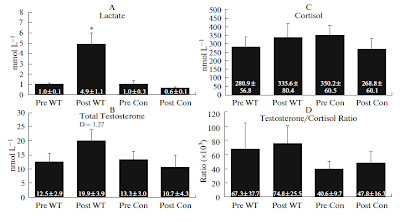
We all know that intense exercise is the way to trigger hormonal responses and muscle hypertrophy in the gym. Now a study by Fry & Lohnes (Fry. 2010) quantified this effect to +60% increase in testosterone. The scientists had four weight trained men perform 10 x 5 speed squats at 70% of system mass (1 RM +/- BW) with 2 min inter-set rest intervals. Five minutes upon completion of the workout blood was drawn and cortisol and testosterone levels were analyzed:
Post-exercise Tes exhibited a very large effect size (nmol x L-1 pre = 12.5 +/- 2.9, post = 20.0 +/- 3.9; Cohen's D = 1.27).
What is confusing, however, is that the scientists state that while cortisol did not change the cortisol/testosterone ratio would not be influenced, only to conclude:
The acute increase for Tes is in agreement with previous reports that high power activities can elicit a Tes response. High power resistance exercise protocols such as the one used in the present study produce acute increases of Tes. These results indicate that high power resistance exercise can contribute to an anabolic hormonal response with this type of training, and may partially explain the muscle hypertrophy observed in athletes who routinely employ high power resistance exercise.
This observation, on the other hand, makes sense only under the assumption that there was a significant effect on the testosterone/cortisol ratio.
Figure 1: Lactate and hormonal responses (X ± SD) before and after the high power resistance exercise and control sessions. * Different from pre (p < 0.05). The Cohen’s D value for total testosterone represents a very large effect size. (Fry. 2010. Fig. 3)
In view of the graphs in figure 1, the numbers are in fact put into perspective, because there is an increase in cortisol (fig.3 C) which compensates part of the anabolic response associated with the 60% increase in testosterone. In spite of all that, the study gives you another good reason to do your squats!

Monday, September 6, 2010

Yes, Skin Bursting Pumps Will Make Your Muscles Grow

Arnold already knew: "If you want to grow, go for the pump!" A recent study by Soltow et al. (Soltow. 2010) expands on Arnold's hypothesis - what you need is pump and stretch. The scientists studied the effect of nitric oxide (NO) on C2C12 myoblasts and found:
NO, COX-2, and NF-kappaB are necessary for stretch-induced proliferation of myoblasts. Although COX-2 and NF-kappaB are both involved in basal proliferation, NO does not affect basal growth. Thus, NO requires the synergistic effect of stretch in order to induce muscle cell proliferation.
So, more NO, some stretch and / or skin bursting pumps? That reminds me of the good old first generation pump supplements with arginine, of which I can only repeat do not dump your good old NO Xplode, White Flood, Super Pump 250, VPX Shotgun, etc. down the toilette. It is not for nothing that they have been around for years!

What's more, Arginine and Ornithine (ingredients of the first generation Pump Supps) have been proven to improve exercise performance even when administered on their own. This is something one cannot say of most of the "advanced" ingredients of the next-generation pre-workouts, though.