Posts

Showing posts with the label corticosteroid

Popular topics

Show more

16 Little Known Plants + Phytocompounds to Control(!) Your Cortisol Levels | Plus: A Dozen Better-Known Alternatives

Image
Don't forget: Cortisol is no stressor, it's released to help us cope w/ stress. While I have repeatedly emphasized that the notion of cortisol as the "muscle-catabolic stress hormone" you have to "keep as low as possible" is fundamentally flawed, there are reasons why you may want to control your cortisol levels within what would be considered the circadian normal zone, i.e. high(er) levels of cortisol that get you going upon waking, lower levels of cortisol in the PM and at night to facilitate optimal glucose control, avoid HPTA suppression (=keep normal thyroid, GH, and testosterone/estrogen levels), allow for healthy and recuperative sleep and so on and so forth. If you are physically healthy and not overweight/obese, you are probably able to achieve this goal if you have the following (health) habits: (1) getting enough sleep (6-8h), (2) adhering to fundamental rules of sleep hygiene (same time, same routine, no blue light exposure before and dur...

The Counterintuitive Catabolic & Pro-Diabetic Effects of Leucine Supplementation in Rodents on Corticosteroids

Image
Not the mice from this study, but still a nice example of the effects of dexamethasone on skeletal muscle (right; Quin. 2012) "Leucine-laced water + stress = insulin resistance" - This simple equation is the net result of a recent study by Nelo Eidy Zanchi and his colleagues from the Laboratory of Applied Nutrition and Metabolism at the School of Physical Education and Sports of the University of Sao Paulo in Brazil. Inspired by previous research which clearly indicated that leucine does not only have pro-anabolic, but also insulin sensitizing effects, Zanchi et al. speculated that the provision of adequate amounts of leucine would blunt the catabolic and pro-diabetic effects of 7 days of intraperitoneally injections of  dexamethasone, an artificial corticosteroid that's used to treat all sorts of inflammatory diseases. Remember SuppVersity Rule of Smart Supplementation No. 2? Right. Specificity! In order to test their hypothesis that leucine supplementati...

Eating by The Clock: Is Eating 3x a Day Making You Fat? Scheduled Feeding Results In Adipogenesis in Growing Rats - Less Lean, More Fat Mass.

Image
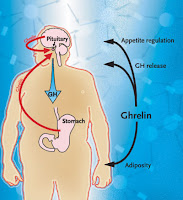
Image 1: Simplified illustration of the purported function of ghrelin in the human body ( healthhabits.ca ) Eating whenever you feel "hungry" (I suppose most of us don't even know what hunger is, anyway) seems to be a bad idea in a society where the abundance of readily available (low quality) foods turns out to be at the heart of many of the health problems we are facing these days. Thus, it seems counter-intuitive that our standardized 3xday feeding schedules, which, if nothing else, do prevent us from eating nutritional bullsh** 24/7, could in fact be making us fat . This, i.e. the finding that eating at fixed times 3x a day induces weight, or more specifically, fat gain in rats on an other wise (calorically) unrestricted diet, is yet the surprising result of an investigation ( Verbaeys. 2011 ) the results of which have been published in the March issue of the American Journal of Physiology. For 14 days the sci...

The Hair-to-Belly Cortisol Connection: Hair Analysis As Reliable Tool for Longterm Cortisol Analyses

Image
Figure 1: 3D model of molecular structure of cortisol (Wikipedia) Although cortisol is probably one of the most important hormones, and a lack of cortisol will provoke symptoms which can range from simple fatigue to death, chronically elevated levels of this essential corticosteroid are associated with increases in visceral obesity and its entailing metabolic pathologies, which are commonly described as "the metabolic syndrome". The results of a very recent study ( Manenschijn: 2011 ), that was published in the medical journal Steroids , may thus turn out to be a valuable tool in the a:nalysis of the underlying causes of pathological obesity and its consequences. Manenschijn et al. collected hair samples of 195 healthy individuals, 9 hypercortisolemic and one hypocortisolemic patient and measured the cortisol levels in the hais and saliva of their subjects. They then correlated the data with waist and hip circumferences, as well as blood pressure values of 46 of the h...

Poly-Unsaturated Fatty Acids (PUFA) Alter Glucocorticoid Action on White Adipose Tissue

Image
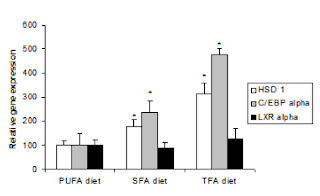
A very recent investigation found a possible explanation for the protective effects of high PUFA consumption against adiposity and the metabolic syndrome. On the cellular level, PUFA decreases an enzyme, called 11beta-hydroxysteroid dehydrogenase type 1 (11beta-HSD1), which amplifies intracellular glucocorticoid action by converting inactive glucocorticoids to their active forms in vivo. Figure 1: Effect of Diet high in PUFA, SFA, TFA on enzyme activity (HSD1 basal = 10%). The scientists explain that, in mice, "adipose-specific overexpression of 11beta-HSD1 induces metabolic syndrome [...], whereas 11beta-HSD1 null mice are resistant to it." For the average human being this means avoiding overgeneration of this enzyme may well keep him/her lean. And in fact, the most effective way to do so, is to follow the general advice to avoid trans-fatty acids (TFA) and saturated fatty acids (SFA) and consume polyunsaturated fatty acids (PUFA) instead: 11beta-HSD1 gene expressio...
Disclaimer:The information provided on this website is for informational purposes only. It is by no means intended as professional medical advice. Do not use any of the agents or freely available dietary supplements mentioned on this website without further consultation with your medical practitioner.