Showing posts with label bioactives. Show all posts

Friday, July 8, 2011

The Soy Formula: Pregnant or Lactating Mother + Soy = Metabolically Deranged Male Offspring

Image 1: Newsweek title from the
year 2000 - "Fat for Life?"; did his
mother love her soy protein more
than her son's health?
Those of you who listened to my dissertations on yesterday's fourth installment of the Amino Acid Series on Carl Lenore's Super Human Radio will probably remember the lack of carnitine in the not-yet-enriched soy based baby-formula of the late 1970s. Now, a recently published rodent study suggests that the negative effects of soy may well begin before the offspring is even born: Exposure of pregnant and lactating rats to a soy (vs. a casein) based diet "increased the presence of the characteristics of the metabolic syndrome in the offspring" (Jahan-mihan. 2011).

In the course of their study, the results which was published in the latest issue of the British Journal of Nutrition, the scientists randomly assigned pregnant rats (at day 3 of gestation) to one out of two calorically identical diets, which different only with regard to the source of their protein content. While half of the rats were fed a soy based formula, the other half received a casein based diet.
Figure 1: Amino acid composition of the cystein- (C) and cystein+methionine (S) fortified (indicated by the asterisk) casein (C) and soy-based (S) diets rat dams and their offspring were fed in the course of pregnancy and lactation and weening, respectively (data adapted from Jahan-mihan. 2011).
The whole study consisted of two almost identical test series, which lasted 9 (Exp. 1) and 15 weeks (Exp. 2) and provided unambiguously detrimental results for the male pups :
In Expt 1, pups born to S-fed dams had higher fasting blood glucose (BG), systolic blood pressure (SBP) and diastolic blood pressure (DBP) at week 4, higher blood glucose (BG) response to a glucose administration (P,0·001) and higher body weight (BW) at week 8 (P,0·05). In Expt 2, consumption of the S diet throughout gestation and lactation resulted in higher BW (P,0·05), DBP (P,0·005) and SBP (P,0·005) in the offspring. They also had higher homeostasis model assessment of insulin resistance (HOMA-IR; P,0·05) and plasma homocysteine (P,0·05) at weaning, higher fasting BG and glucose response to glucose administration (P,0·005) at week 12 and higher HOMA-IR (P,0·01) at week 15.
It goes without saying that in absence of other variables, either the amino acid composition or the genistein, daidzein and glycitein content of the soy diet must have been responsible for the metabolic priming towards high blood pressure, obesity and diabetes.
Figure 2: Relative elevation of glucose, insulin, HOMA-IR (marker of insulin resistance) and corticosteroids (stress hormones) in offspring of soy-fed rats compared to pups of casein-fed mothers at different time-points in their lives (data adapted from Jahan-mihan. 2011).

In that it is worth mentioning that the extension of the duration of the soy feeding from gestation in experiment 1 to gestation + lactation in experiment "resulted in a more robust effect of the S diet on BW, body composition and glucose metabolism in the offspring". These results contradict the hypothesis "that offspring weaned to similar diets as their mothers will adapt more appropriately to their postnatal environment"; an observation a cynic may comment with the words: 'I guess, they did not have enough time for genetic adaption'.

As far as the underlying reasons for these detrimental effects of a soy-based pregnancy and lactation diet go, the scientists argue that bioactive peptides such as valine–proline–proline and isoleucine–proline–proline, which are present in casein, but are not contained in soy proteins, may play a factor. On the other hand, Jahan-mihan et al. discount the isoflavone content of the soy protein (36.1, 31.3 and 4.4µg/g for Genistein, daidzein and glycitein, respectively) as potential cause of the metabolic derangement, because "the genistein content of the S diet was 36 µg/g of the diets, well below that reported (250 mg/g diet) in the maternal diet to affect epigenetic and phenotypic changes in mice". The latter, however, makes me question the reasons, the researchers had to chose exclusively male pubs in their study!? What if not the phytoestrogens in soy would whack up the male pups endocrine system? Be that as it may, if you are a mother to be, you better not make soy protein your no.1 source of dietary protein, in order not to set your children up for high blood pressure, obesity and diabetes in their later lives.

Friday, January 21, 2011

Drink Your Milk! Scientists Unlock the Health Secrets of the White Elixir of Life

Arnold said "Milk is for babies", yet recent studies showed that chocolate milk is among the most effective post-workout drinks you can consume and whey proteins are a stable not only of almost every bodybuilder's diet regimens.

In a recent review, a group of Irish scientists (Mills. 2011) attempt to summarize all the available information on the "ever-accumulating range of bioactivities associated with milk substituents"; and the sheer size of the paper underlines that there probably is much more to milk than Arnold would have imagined.
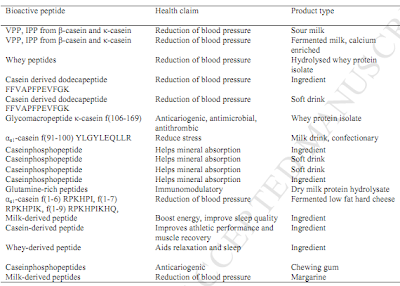
Table 1: Milk-derived bioactive peptides in commercially available functional foods and ingredients (Mills. 2011)
Table 1 (truncated from Mills. 2011) shows a summary of the most important components of milk and their proclaimed beneficial health effects. So, don't let anyone tell you milk was for babies, only ;-)

Edit: I think it is noteworthy to say that (of course) this review was supported by the milk industry. While this does not change the reliability of the scientific evidence cited, one should keep that in mind when looking at which studies the authors selected.

Friday, August 27, 2010

Want to Relieve Insulin Resistance? Eat your Blueberries!

Scientists from the Center for the Study of Botanicals and Metabolic Syndrome at the Pennington Biomedical Research Center of the Louisiana State University have found that bioactives in blueberries improve Insulin Sensitivity in Obese, Insulin-Resistant Men and Women. The researchers measured inflammatory biomarkers and adiposity of 32 obese, nondiabetic, and insulin-resistant men and women and found that after 6 weeks of supplementation with either a smoothie containing 22.5 g blueberry bioactives (blueberry group, n = 15) or a smoothie of equal nutritional value without added blueberry bioactives (placebo group, n = 17) twice daily,
The mean change in insulin sensitivity improved more in the blueberry group (1.7 ± 0.5 mg·kg FFM–1·min–1) than in the placebo group (0.4 ± 0.4 mg·kg FFM–1·min–1) (P = 0.04). Insulin sensitivity was enhanced in the blueberry group at the end of the study without significant changes in adiposity, energy intake, and inflammatory biomarkers.
Being effective for minor improvements in insulin sensitivity, blueberry supplementation is obviously not indicated as a weight loss aid - So don't expect to see "visible" results, if you do not replace your daily chocolate pudding with a hand full of blueberries!