Posts

Showing posts with the label mercury

Popular topics

Show more

Mercury Toxicity - Is Your Whey Protein Worse than Your Amalgam Fillings? Maybe, but That's not so Bad, Anyway...

Image
Could your whey protein contribute more to your mercury exposure than your 20-year old amalgam fillings? 30 years ago Eggleston, et al. published a paper in "The Journal of Prosthetic Dentistry" which confirmed that there is a statistically significant "positive correlation between the number of occlusal surfaces of dental amalgam and mercury levels in the brain (p < .0025 in white matter)" (Eggleston. 1987). Only recently Bentsson et al highlighted that modern amalgam fillings may leak even more of the toxic substance into your saliva (from where it will take a tour around your body). And earlier this year the European Union banned amalgam fillings - albeit only for kids and without admitting that they are a definite health threat. High-protein diets are much safer than some 'experts' say, but there are things to consider... Practical Protein Oxidation 101 5x More Than the FDA Allows! More Protein ≠ More Satiety Satiety: Casein > W...

Removal of Amalgam Fillings Associated With Reductions in Memory Loss, Fatigue, Anxiety, Confusion & Other Health Problems, Observational Study from Canada Shows

Image
Amalgam removed = health restored? While there is little doubt that mercury vapor poses a known health risk, there is neither a clearly established safe level of exposure, nor evidence that similar ill health effects can occur with chronic low grade exposure to mercury vapor from dental amalgam fillings. As you may know amalgam is not 100% but "only" 50% mercury, but is that enough to represent a significant health risk? The objective of a recent study from the University of Calgary was "to determine if mercury exposure from amalgam fillings is associated with risk of adverse health effects" (Zwicker. 2014). Mercury is among the reasons fish should not be your exclusive protein source Salmon Better Than Whey? Cod protein for recovery Krill = Super Protein? Farmed vs. Wild-Caught Fish Fast vs. slow protein 5x More Than FDA Allows To this ends, Zwicker et al. conducted a large longitudinal non-blinded study involving participants from a p...

Farmed vs. Wild-Caught: Pollutants and A Low Omega-3/6 Ratio - Is Wild Caught Fish Always the Better Choice? Plus: Krill, Fish Oil, or Whole Fish - What's Best for Your Health?

Image
Wild caught or farmed? If you google it, it appears to be as if eating farmed  fish could be worse than eating no fish at all, but is this actually true? Farmed fish is the ugly duckling in the "superfood" family. It is - at least that's what you'll read on the Internet - low in omega-3s, full of "bad" omega-6 fatty acids and laden with all sorts of pesticides. But wild caught fish is expensive and if we all ate it day in and day out not exactly eco-friendly, right? In today's SuppVersity special parts of which you may have recently seen pop up for a few hours in interview form over at www.fighterdiet.com , before Pauline Nordin and I decided that due to its length and complexity it was rather an article than an interview and should thus be published as such, I am going to tackle the issue of "farmed vs. wild-caught" and "fish vs. fish oil" from all possible angles. Do not underestimate fish as a protein source - fish is mor...

Commercially Available Teas "Not Suitable For Human Consumption": Potentially Hazardous Amounts of Lead, Aluminum, Arsenic & Co in Every Cup

Image
Would all commercially available teas have to be labeled like this? I am usually not a fan of articles with titles like this one (see above) - they have what you call in Germany "Bildzeitungsniveau" (the German tabloid with news like "World about to disappear in a black hole, when CERN starts operating). It is however hard to resist the urge to use a headline like the one above, if the it fits the results of peer-reviewed scientific paper so well, as it is the case with the relatively recent paper from the University of Alberta and the Luleâ University of Technology in Sweden this SuppVersity article is (almost) all about. The corresponding experiment, the results of which were published in the peer-reviewed open-access Journal of Toxicology in October 2013, already, addresses the increasing concern about contamination of foodstuffs and natural health products. With the emphasis being on foodstuff and health, it's only logical that tea, or more precisely all...

Magnesium vs. Diabetes - Which Form is Best? Exercise, Energy Intake & the HPTA. Glutamine & CHO For Sprinters & HIITers. Mercury & Diabetes, Amalgam, Se, Zn & Detox

Image
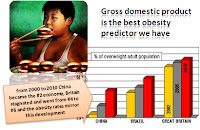
Won't take long until China is the world economy #1 and not much longer until they are the fattest economy, as well ;-) Let's see which one do I pick? Oh, ok... The SuppVersity Figure of the Week is 0.19 . This is the correlation coefficient that describes the statistical relation - which is as every SuppVersity student knows no evidence of causal relationships (!) - between the per capita gross domestic product (GDP) and the prevalence of obesity as it was calculated by Mario Siervo and colleagues from the Newcastle University and the UCL Institute of Child Health in London as part of their analysis of country-specific prevalence estimates of overweight, obesity and hypertension and their relation to nutrient and food intakes and (and this is new!) the economy (Siervo. 2013). The scientists used the WHO Global Infobase database, year- and country-specific Food Balance Sheets (FBS) and information on urbanization rates, per capita GDP and physical inactivity and did ...
Disclaimer:The information provided on this website is for informational purposes only. It is by no means intended as professional medical advice. Do not use any of the agents or freely available dietary supplements mentioned on this website without further consultation with your medical practitioner.