Posts

Showing posts with the label black tea

Popular topics

Show more

To Boil or Not to Boil? What's Going to Make Your Tea the Healthiest? Recent Study: It Depends on the Type of Tea

Image
Hot or not? That could be a matter of health or ah... well almost death ;-) Usually a "tea" is a hot beverage, right? No? Well, ok there's ice-tea, but even the coolest of all teas is initially brewed with hot, sometimes almost boiling water. A practice of which a recent study from the   Universidade Tecnológica Federal do Paraná in Brazil suggests that it may actually impair some of the beneficial effects of Baldo, White, Black and Mate tea. How come? Well, in the study Vanessa de Carvalho Rodrigue, et al. conducted, it made a huge difference in terms of the total phenol and flavenoid content of the extracts (=the aformentioned teas) when the scientists used cold water instead of water that was 80°C "hot". You can learn more about tea at the SuppVersity Use Roiboos for Stress & Virus Control Tired? Theacrine Will Get You Goin' in Minutes Milk, Tea & Honey Don't Mix?! Theacrine or Caffeine for Brain Power? Aluminum, Lead...

Chinese Black, Green & Oolong Tea is NO Health Beverage. Lead, Chromium, Cadmium and Potentially Toxic Levels of Manganese + Endocrine Disrupting PFCs Are the Rule

Image
"Pesticide pollution: Chinese tea may not be safe to drink," this is what you could read on the website of Greenpeace in 2012, already and obviously this has not changed over the last 2 years | read more I've actually written about the problem with toxins in tea, specifically green tea from China, before and I wouldn't be too sure, whether bad news like the previously reported "-20% Reduction in Green Tea From Just 5 Cups a Day" ( learn more ) could not possibly be a result of heavy metals and/or other toxins, as well. This and the fact that the data I am going to talk about in the following paragraphs is based on analyses of 43 representative tea products (including 18 green, 12 Oolong, and 13 black teas) from 7 main tea production provinces in China makes today's SuppVersity article relevant for everyone who consumes green tea from China or of unkown origin - China is the cheapest, so guess, where it's from ;-) You can learn more about tea ...

Will Drinking Tea Solve Our Sugary Problems? Commercial Tea Preparations Contain Effective "Carb Blocker"

Image
Tea: An anti-oxidant carb-blocker with class - The Britons do it right - the always have a cup of tea with their scones. As a (hopefully) regular SuppVersity reader you will know that I don't buy into either the fructose or the sucrose theory of everything (diabetes, cancer, obesity, stupidity, etc.). This does not mean that I wouldn't understand that the average Westerner would largely benefit from a reduction in carbohydrate intake. A reduction that - and this is what a recent paper in the peer-reviewed journal Advances in Preventive Medicine can tell us could be achieved by something as simple as drinking more tea (Oboh. 2014). Commercial teas turn out to be carb-blockers In said paper Ganiyu Oboh and his colleagues from the Federal University of Technology and the Obafemi Awolowo University in Nigeria report that: "The antidiabetic property of the teas could be attributed to their inhibitory effect on carbohydrate hydrolyzing enzymes implicated in diabete...

Commercially Available Teas "Not Suitable For Human Consumption": Potentially Hazardous Amounts of Lead, Aluminum, Arsenic & Co in Every Cup

Image
Would all commercially available teas have to be labeled like this? I am usually not a fan of articles with titles like this one (see above) - they have what you call in Germany "Bildzeitungsniveau" (the German tabloid with news like "World about to disappear in a black hole, when CERN starts operating). It is however hard to resist the urge to use a headline like the one above, if the it fits the results of peer-reviewed scientific paper so well, as it is the case with the relatively recent paper from the University of Alberta and the Luleâ University of Technology in Sweden this SuppVersity article is (almost) all about. The corresponding experiment, the results of which were published in the peer-reviewed open-access Journal of Toxicology in October 2013, already, addresses the increasing concern about contamination of foodstuffs and natural health products. With the emphasis being on foodstuff and health, it's only logical that tea, or more precisely all...

Theanine or Caffeine? Soda, Black or Green Tea? What's Going to Get Your Brain Going? Plus: What About Sleep?

Image
Caffeinated soft drink, coffee or tea, caffeine alone or caffeine + l-theanine what's going to yield the desired afterburner effect for your brain? The answer to this question came out probably less straight forward than you'd expected. "L-theanine, coffee or both? What's going to get your brain going?" That's the question form the title of today's SuppVersity article and it's a question with an astonishingly simple answer:  Both ! I guess you will be well aware that both caffeine and l-theanine have scientific evidence to support their usefulness as cognitive enhancers (Quinlan. 2000; Hindmarch. 2000; Nathan. 2006). Their interactions however have not been studied that extensively. It's thus worth to take a closer look at the data Hira Zameer et al. collected for their most recent paper in the International Journal of Endorsing Health Science Research - data on the effects these agents can have on the cognitive performance and reaction ...

Milk, Tea & Honey - Two Things Don't Belong: Milk & Sugar Potently Reduce Antioxidant Effects of Green & Black Tea

Image
Chi Latte is a sugar bomb, but no healthy, antioxidant beverage. Over the past couple of weeks it has become relatively quiet in the "tea is good for your health", "tea makes you lose weight magically", "tea reduces diabetes risk", etc. column of the science news here at the SuppVersity, and in general. Ok, you still got your daily "green tea reduces inflammation study", but let's face it. That's boring. What is interesting, however, are the results of a recent study that's about to be published in Food Chemistry (Korir. 2013). In this very paper, a group of researchers from the Egerton University in Kenya, the Association for Strengthening Agricultural Research in East and Central Africa in Uganda and the Tea Research Foundation of Kenya report that... Adding milk or sweeteners to your tea will reduce its antioxidative capacity And the effects the researchers observed in vitro and in vivo, were pretty significant, as y...

Science Round-Up Seconds: 8 Nootropics to Combat Stroke, Alzheimer's & Co, Boost Cognitive Performance. Plus: 7 Unknown Side Effects of High Dose Glutamine.

Image
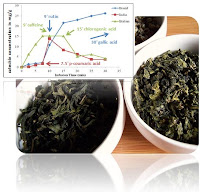
Effects of infusion times on phenol content of black tea (Ramalho. 2012) If you have already listened to the podcast of yesterday's Science Round-Up on the Super Human Radio Website ( click here if you haven't and wan't to know what the following is all about), I suppose you will not mind that I compiled some of the complex information about "optimal" tea brewing in the illustration to the right (based on Ramalho. 2012). The colored arrows indicate the time-points at which the given compounds in the tea achieved peak values. The exact time point is also given in minutes, so that a 9' in front of the green caffeine and on the left to the green arrow pointing at the 9 min point tells you "it took 9 minutes for the caffeine content to reach it's maximum in the British tea". The graph in the background shows the catechin concentration depending on the infusion time. Cholinergenic nootropics - What a recent review says I guess some of you wil...
Disclaimer:The information provided on this website is for informational purposes only. It is by no means intended as professional medical advice. Do not use any of the agents or freely available dietary supplements mentioned on this website without further consultation with your medical practitioner.