Showing posts with label HED. Show all posts

Saturday, October 29, 2011

1.3g of Grape-Seed Extract Could Protect You From Oxidative Damage, Viral Infections, Obesity and Insulin Resistance, Reduce Your Heart Rate and Blood Pressure and Increase Your Nitric Oxide Production by >25%

Image 1: Bought in bulk, grape-seed extract is actually reasonably cheap... and it does not even taste as awful as some other herb / seed extracts ;-)
After initially being hailed as the yet another anti-oxidant panaceum, grape-seed extract (GSE) has been displaced by newer, fancier "superfoods" from the headlines of the major health and wellness newscasters. Therefore, even you, as a highly self-educated student of the SuppVersity could have missed out on a handful of recently released studies which reported antiviral effects of GSE (Su. 2011) and confirmed its ameliorative effect on diet-induced obesity (Ohyama. 2011) and (high) fructose-induced insulin resistance (Meeprom. 2011). Moreover, a meta-analysis of nine controlled with more than 300 human subjects and daily doses ranging from 250mg to 2,000mg of GSE, which was published in the Journal of the American Dietetic Association (Feringa. 2011), found that ...
[b]ased on the currently available literature, grape seed extract appears to significantly lower systolic blood pressure and heart rate, with no effect on lipid or CRP levels.
These results suggest that we (at least some of) the beneficial health effects that have been observed in rodent studies actually translate to human beings - something  we cannot (yet?) say for some of the next generation "panacea" ;-) This is also important in view of the significance of the results GSE-administration had on exercise-induced oxidative stress in a more recent study by scientists from the universities of Konya and Dicle in Turkey (Belviranli. 2011), which was published in the latest issue of the British Journal of Nutrition.

The experiments were carried out with 64 adult male Sprague Dawley rats who were randomly assigned to one of the following six groups:
  • sedentary control (C, n=10), 
  • chronic exercise control (CEC, n=11), 
  • acute exercise control (AEC, n=11), 
  • GSE-supplemented control (GC, n=10), 
  • GSE-supplemented chronic exercise (GCE, n=11), and 
  • GSE-supplemented acute exercise (GAE, n=11)
The rats in the treatment groups received a standardized GSE extract containing 54% dimeric, 13% trimeric, 7% tetrameric and <5% monomeric proanthocyanidines and undisclosed amounts of cathechines and oligomeric proanthocyanidines, at a daily dose of 100mg/kg body weight in their drinking water for 6 weeks.
Image 2: Click here to learn how to calculate human equivalent doses (HED)
Rat to human equivalent dosage calculation: If you have already read my dissertation on how to calculate the so-called human-equivalent-dose (HED), you will probably already have whipped out your calculator and are just about to type "100mg times the K-value for rats, which is 6; divided by the K-value for humans, which is 37" ... and what does your calculator tell you? Correct! The HED of 100mg/kg GSE in rats is 16.33mg/kg - in other words, if you weigh 80kg you will have to take roughly 1,300mg of grape-seed extract per day to mimic the dosage that was used in the study.
The dosage, according to the scientists, was chosen because it had elicited beneficial anti-oxidant effects in previous studies on alloxan induced diabetes (El-Alfy. 2005) and age-related oxidative damage (Balu. 2006). And, as Belviranli et al. had suspected, it exhibited similar protective effects against the oxidative stress triggered by both chronic, 5x a week treadmill exercise at 25m/min for 45 minutes, as well as, acute running on the treadmill at 30m/min until exhaustion.
Figure 1: Effects of acute or chronic exercise and grape seed extract (GSE) supplementation on plasma malondialdehyde (MDA) levels (data calculated based on Belviranli. 2011).
As you can see in figure 1, administration of 100mg/kg grape-seed extract per day augmented the beneficial effect of 6 weeks of chronic exercise on muscle MDA levels (-37% vs. -18% in the control group) and ameliorated the acute +22% increase in MDA levels due to increased lipid peroxidation during exhaustive treadmill running.
Figure 2: Effects of acute or chronic exercise and grape seed extract (GSE) supplementation on plasma nitric oxide (NO) levels (data calculated based on Belviranli. 2011).
GSE supplementation also increased the expression of nitric oxide (NO in  plasma; on average +25%) in all animals (cf. figure 2). Moreover, GSE ameliorated the increase in xanthine oxidase and adenosine deaminase activities due to acute exercise and triggered an overall increase in antioxidant enzyme activities.

So, even if your favorite anti-aging and health (onilne-)magazine or vendor appears to have forgotten about grape-seed extract. For a physical culturist like you and me, it may yet well be worth to (re-)include the extract from the seeds of the fruits of Vitis vinifera, which are a particularly rich source of vitamin E, linoleic acid and, most importantly, oligomeric proanthocyanidins, into our supplement regimen. And if the current study does not convince you, it may help, if I remind you of the 2006 study by Kijima et al. who were able to show that GSE due to its anti-aromatase activity can suppress tumor growth in a breast cancer model (Kijima. 2006) ... ah, and before I forget: don't be stupid and buy over-priced caps. Use google and find yourself a source of bulk grape-seed extract - don't worry the taste is not all too bad ;-)

Sunday, June 19, 2011

Ask Dr. Andro: What Are Human Equivalent Doses (HED) and How Do I Calculate Them?

Image 1: Rat & guinea pig. Both very
popular animal models. Both about the
same size and weight, but with very
different reactions to identical treatments.
I won't waste too many words on this being a new series on the SuppVersity, I suppose the name "Ask Dr. Andro" is self-explanatory. It is based on questions posted in the comment section that are relevant for the majority of the visitors and require and deserve a more sophisticated response. So, if you want your question answered, learn a lesson from "Learner" who posted the following question in the comment section of "Spicing Up Fat Loss: Structural Similarity to Melanocortin-4 Agonists Powers Piperine's (Black Pepper Extract) Fat Loss and Lipid Lowering Effects".

Question from "Learner": Why is the mg/kg dosing ratio different for humans than rats, and does that vary by the agent?

Answer from Dr. Andro: Most of what we know about the effects of (new) drugs, supplements, vitamins, minerals, diets, macronutrient ratios and all the other stuff you read about here at the SuppVersity are derived from animal studies. The reasons thereof are manifold:
  1. Animal models are "save" - you do not risk a human life, if you test your new drug on a rat, so this is "safe" for humans
  2. Animal models are cheap and readily available - just order a bunch of lab mice, a few cages and the respective chow and get going; even in the days of slavery that would have been way more difficult with human beings
  3. Animal models (at least some) are easily genetically modifiable - turn off a gene and see what it does
  4. Animal models are time-efficient - if you want to know how life-long supplementation with substance A affects a critter, you better not use a tortoise or your experiment will literally "survive" you
  5. Animal models have an endless list of other advantages, I do not want to list here, because they are not really relevant for the question at hand...
Notwithstanding all these benefits, as a faithful visitor of the SuppVersity you will be familiar with the problems that arise in interpreting data from studies conducted on one species in view of expected results of similar experiments conducted with another species. Even rats and mice can react very differently to a given substance and despite their similar weight and seize guinea pigs and rat models can by no means be used interchangeably.

But let's get back to the "human equivalent" - obviously, two of the most apparent differences between human beings and rats, are body size and body weight. As you probably know, most studies provide information about dosages relative to body weight, so that, for the reader, the difference in body weight would not matter, anyways. Unfortunately a direct translation of the effects observed in a rodent model to a human scenario, based solely on body weight turns out to be very misleading.

Example 1 (this is how it is not done): A very prominent example, where the futile effort of calculating human equivalent doses simply by multiplying the given dosages with the weight of an average human being, lead to major (public) confusion, were the studies on the beneficial effects of the red wine polyphenol resveratrol by Joseph A. Baur et al. (Baur. 2006) and Marie Lagouge et al. (Lagouge. 2006) that were interpreted by the "laypress" as meaningless, because the purported "equivalent" dosages (as mentioned before, calculated solely by multiplying the dose used in the study by the weight of an average human being, cf. figure 1) would amount to hundreds, if not thousands of liters of red wine per day.
Figure 1: Example of a simplistic (and inappropriate) calculation of the human dose equivalent.
This procedure, apparently fails to take into account that oxygen utilization and caloric expenditure are much greater in rodents than in human beings, or in other words: rodents burn through food and metabolize drugs, supplements and whatever you feed them much faster than humans. In the very extreme this may mean that what is a very small dose kilogram per kilogram for a mouse, may well kill an adult human being within minutes.

Image 2: Max Rubner was
probably the first to collect
reliable data on the correlation
of surface area, caloric expen-
diture and oxygen consumption
in mammals (image from The
Eskind Biomedical Library

at the Vanderbilt University)
Thanks to the meticulous research of the German scientist Max Rubner (Rubner. 1883), we do yet know that, in most mammals, both oxygen utilization and caloric expenditure correlate quite well with the ratio of the surface area of the critter to its body weight. An average laboratory mouse, for example, has a very small body weight of ~20g and a comparably large surface area of roughly ~0.006m². An average, normal weight male human being (height 1.73m), on the other hand, weighs roughly ~70kg and has a relatively small surface are of ~1.9m². This means that a man weighs about 3500x as much as a mouse, yet his surface area is only 316x larger than that of the small rodent.

You may now ask yourselves how all that relates back to energy expenditure and metabolic rate - well, no matter how thick the fur of the mouse may be, there is no way for the little critter to escape the basic laws of thermodynamics, which state that the heat flow (for the mouse heat loss) across the surface of an object is proportional to its surface area. On a pound per pound base, the mouse will thus expend way more energy than the man just to keep its body from cooling down.

With that being said, it should be quite obvious that the ratio of body weight [in kg] to surface area [in m²], the so called Km factor, can be used as a relative measure of the metabolic rate of an animal. Using the previously given data, we can now calculate Km factors of Km =3 and Km=37 for mouse and man, respectively. Then, the ratio of the two, Km(mouse)/Km(man) = 0.081 = 8.1%, indicates that the human metabolism runs at 8% of the metabolic rate of a mouse, or in other words, mice metabolise whatever supplement or medication you feed or inject them at a 12 times higher rate than human beings. If you compare that to the respective respiratory ratios of 165 breaths per minute for mice and 12-20 breaths per minute for healthy adults, the aforementioned correlation between body weight and surface area on the one hand and metabolic rate and oxygen consumption on the other becomes quite obvious.
Now, we can save ourselves future troubles associated with the experimental determination of the aforementioned metabolic parameters for each and every species (and animals of the same species, yet with different body sizes / form, e.g. children vs. adults) if we just collect the respective data on body weights and surface areas, and tabulate the respective Km values. Using these values we can easily calculate the equivalent doses for a given species by using the following equation (cf. Reagan-Shaw. 2008):

HED (mg/kg) = Animal dose (mg/kg) * (Animal Km : Human Km)

Where the term in (mathematically unnecessary brackets) would be a conversion factor given by the ratio of the Km value of the species that was used in the respective study to the Km value of the target species. For the majority of the studies you will find on the SuppVersity, the original study was done on mice (Km = 3) or rats (Km = 6) and the conversion factors which are probably of greatest interest for you, i.e. the ones for humans would be 3/37=0.081 for mice (cf. discussion above) and 6/37=0.162 for rats, respectively.
The people from the FDA, who always tend to think nobody could be half as smart as they are, obviously wanted to play safe and included these "conversion factors" along with the Km values in their Guidance for Industry on "Estimating the Maximum Safe Starting Dose in Initial Clinical Trials for Therapeutics in Adult Healthy Volunteers" (FDA. 2005):
Table 1: Km values for various species according to FDA Guidance for Industry (FDA. 2005)
Example 2 (this is how it is done): With this new knowledge you can also calculate how much black pepper you would have to consume to achieve the effective dosage of piperine that was used in the study mentioned in the SuppVersity news last Thursday. With an average piperine content of 3 to 8 g/100g and about 0.2-0.3g/100g of the minor alkaloids piperyline and piperettine in black pepper (Schulz. 2004), a rat would have to consume somewhere between 500-1300mg of black pepper corns per day to achieve the 40mg/kg dose that effectively accelerated the metabolism of the rats in the study by Shat et al. (Shah. 2011). All you have to do now, is look up the Km values of rats (Km=6) and humans (Km=37) and insert the respective values in the given equation, so that

HED(40mg/kg in rats) = 40mg/kg * (6 kg/m² : 37kg/m²) = 6.5mg

would yield the amount of piperine and

HED(1000mg/kg in rats) = 1000mg/kg * (6 kg/m² : 37kg/m²) = 162mg

the amount of pepper corns you would have to use to achieve the "same effect" in human beings.

A final word on the italicized "same" in what would otherwise be the last sentence of this article: You will probably never see identical effects across different species, regardless of how exact you try to calculate the equivalent doses. There are simply too many differences between mice and men and the way they metabolize different substances to be able to translate results from experiments with oftentimes fundamentally different agents from mice to men and vice versa using nothing but the ratio of body weight to surface area as your guide. Consequently, you should consider human equivalent doses as a means to interpreted whether or not animal data is practically relevant and what amounts of a given substance would roughly have to be used in follow up studies to evaluate whether or not the results can be reproduced in human beings.

Wednesday, November 17, 2010

Taurine Effective Against High Fructose Induced Symptoms of the Metabolic Syndrome

Regular visitors of the SuppVersity know about the diverse positive effects of dietary taurine on health, body composition and exercise performance. Now, a recent study by Mesallamy et al. (Mesallamy. 2010) found another good reason for the non fish-eaters among you (fish is particularly high in taurine) some supplemental taurine in your diet / supplement regimens.
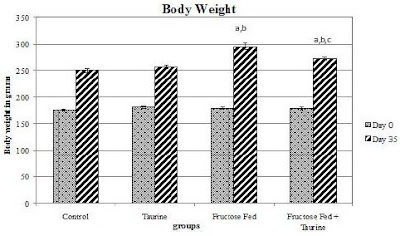
Figure 1: Effect of HFD and taurine supplementation on weight gain at days 0 and 35 of feeding.
Each value is expressed in grams. (Mesallamy. 2010. Fig. 1)
The scientists put rats on either a control diet or high fructose diet (HFD), with both groups receiving additional 300 mg/kg/day taurine via intra-peritoneal (i.p.) route for 35 days. While the decrease in body weight gain illustrated in figure 1 is relatively low, the overall effect of taurine on makers of the metabolic syndrome was significant:
Fructose-fed rats showed significantly impaired glucose tolerance, impaired insulin sensitivity,
hypertriglyceridemia, hypercholesterolemia, hyperhomocysteinemia (HHcy), lower total antioxidant capacity (TAC), lower paraoxonase (PON) activity, and higher nitric oxide metabolites (NOx) concentration, when compared to rats fed on control diet. Supplementing the fructose-fed rats with taurine has ameliorated the rise in HOMA by 56%, triglycerides (TGs) by 22.5%, total cholesterol (T-Chol) by 11%, and low density lipoprotein cholesterol (LDL-C) by 21.4%. Taurine also abolished any significant difference of TAC, PON activity and NOx concentration among treated and control groups. TAC positively correlated with PON in both rats fed on the HFD and those received taurine in addition to the HFD.
While the human equivalent dose of the 300mg/kg taurine used in the study is about 100mg for a person weighing 70kg, previous studies on the positive health effects of taurine have used 1.5-3.0g of taurine - and this would also be my suggestion for those of you who have now become interested in the health benefits of this sulfur-amino acid.

Wednesday, August 4, 2010

Taurine Necessary for Testosterone Production

As avid visitor of the SuppVersity you may remember that taurine appears to exert beneficial effects on insulin resistance, body composition and overall health, but did you know that it is a vital nutrient for the formation of testosterone?

In a recent study by Jang et.al. (Jang. 2010) taurine has been shown to protect the rat testis from oxidant damage. Their study done on isolated rat leydig cells and living laboratory rats also revealed that the positive effect of taurine on testicular testosterone production is dose-dependend and bi-phasic, i.e.
low concentrations of taurine (0.1–100 lg/ml) could stimulate testosterone secretion, whereas high concentration of taurine (400 lg/ml) could inhibit testosterone secretion.
It is however relatively unlikely that levels >400lg/ml and thus negative effects will be achieved by orally administered doses of taurine. This hypothesis is validated by the results of the study (cf. Jang. 2010 Figure 5; below) which clearly illustrate that levels >1.5% taurine in drinking water did not significantly increase taurine levels in the rat testes above the levels achieved with 1.0%.

With a normal laboraty rat consuming roughly 50ml/day water (Warrington. 2001), the reported intake of 0.5-1.5% taurine via drinking water would amount to 0.25-0.75 mg of taurine per day.