Posts

Showing posts with the label legs

Popular topics

Show more

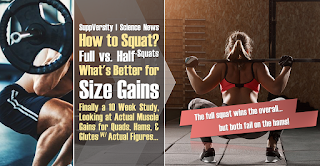
Full vs. Half-Squats - Study Measures Actual Size Gains! A Tie for Quads, a Fail for Hams, and a Small Win for Glutes
Image
The result, the full-squat is slightly superior, is not as clear as you may have expected it to be. Furthermore, the study suggests that you won't get away without an additional hamstring exercise if you want tree-trunk legs and a fabulous behind. A new study ( Kubo 2019 ) in the "European Journal of Applied Physiology" compared the effects of squat training with different depths on lower limb muscle volumes (that's news as previous studies measured way too often only the acute EMG response |  Neto 2019 )... with a realistic workout program and a sensible study duration of 10 weeks. over which twenty young men were randomly assigned to a full squat group (#FST, n = 10) or half squat group (#HST, n = 10 at study onset). Are you trying to optimize your training for gains ? Find inspiration in these articles: What's the Latest on Failure? 36% Extra-Gains W/ Rest-Pause Pyramid- and/or Drop-Setting!? Training to Failure = Extra Gains? Super-Setting...

Weightlifting Shoes: What Does Research Tell Us About WL-Shoes' Effect on Performance, Form & Muscle Activity?

Image
Nice gimmick or must have gym equipment? Answer: "it depends". People are investing more in gym-gear than ever before. $150, for example, for 25% discounted Adidas Weightlifting Shoes  - is that a bargain or just a waste of money? Today's SuppVersity  review will help you decide if weightlifting or O-lifting shoes, of which Bloomberg writes that they are among the fastest growing markets in sportswear ( Bloomberg 2017 ), are a good or useless investment. The distinguishing feature of all weightlifting shoes is the raised heel: the exact heights differ, but range from three-quarters of an inch to one inch and are implemented by solid wood or another hard, rigid material. With laces and a strap to tighten and narrow the fit, the shoes facilitate an optimal transfer of force to the ground... that's at least what the theory and shiny adds will tell us. Unlike weightlifting shoes, creatine will boost your squat performance Age, Meat and Cr Non-Responder...

Eccentric Training Keeps You Gainin' and T & GH Up When, in Weeks 5-10, Traditional Training Stops Yielding Results

Image
Extra gains, testosterone, and GH in one scientific paper?  That will catch every gymrats interest, right? I know, the name SuppVersity  implies that gains were all, or at least to a significant degree about supplements. In fact, though, they are about busting your ass out in the gym and eating like a freak. And with respect to the former, a new study from the  University of Jyväskylä  in Finland suggests that there is a deeper truth to the former part of this often-heard claim: busting your a** in form of eccentric training, i.e. using the maximal weight you can lift on the concentric and a supra-maximal weight on the eccentric phase of a more will  indeed produce significantly greater increases in maximal voluntary contraction torque (MVC) and (almost) significant increases in muscle gains. Are you trying to optimize your training for gains ? Find inspiration in these articles: What's the Latest on Failure? 36% Extra-Gains W/ Rest-Pause Pyramid-...

Full Squat for Full Size Gains, Partial Squat for Full Strength Benefits - Heavy(/-ier) Weights for Both Size & Strength

Image
In most, but unfortunately not all studies, this would be a partial squat... The latest resistance training study from the Charles Sturt University  comes to a somewhat expected suggestion in the practical implications: "[R]esistance training programs designed to change body composition (e.g., hypertrophy, fat loss) are reliant not so much on power and force but more on total work performed, high-intensity FROM [full range of motion] squats should be the focus" (Drinkwater. 2016). Unsurprising for everyone, who has read the previous SuppVersity  articles, in which I've often argued for " full squats for full development ". Different ROMs may also be used as part of classic periodization schemes. 30% More on the Big Three: Squat, DL, BP! Mix Things Up to Make Extra-Gains Linear vs. Undulating Periodizationt 12% Body Fat in 12 Weeks W/ Periodizatoin Detraining + Periodization - How to? Tapering 101 - Learn How It's Done! The argu...

Discontinuing the Set When You Slow Down on Squats May Boost Strength Gains + Preserve MHC-IIX Fiber Percentage

Image
You want to get rid of those tiny weights and squat big time? Maybe you should watch your squatting velocity... and no, I am not talking about slowing down - rather about keeping your rep speed. While the headline may suggest that this is yet another article about time under tension, the "speed" I refer to in the headline is only indirectly related to the TUT concept. Rather than that, speed, in this case, refers to the velocity with which you squat... or, to be more precise, the magnitude of repetition velocity loss allowed in each set (20% vs 40%) and its effects on structural and functional adaptations in response to resistance training (RT). Previous studies have shown that the degree of neuromuscular fatigue induced by RT protocols can be monitored by assessing the repetition velocity loss within a set (Sanchez-Medina. 2011). Different velocity loss schemes may also be used as part of classic periodization schemes. 30% More on the Big Three: Squat, DL, BP! ...
Disclaimer:The information provided on this website is for informational purposes only. It is by no means intended as professional medical advice. Do not use any of the agents or freely available dietary supplements mentioned on this website without further consultation with your medical practitioner.