Showing posts with label sedentary. Show all posts

Sunday, March 10, 2013

High Intensity Exercise & Decreased Post-Exercise Energy Expenditure? Why the Latest Study Results are No Reason To Stop Working Out or Return to the "Fat Burning Zone"

Is HIT obesity incompatible? One thing appears to be sure - the purported post-workout increase in energy expenditure is reversed in the obese.
You may remember the positive results of the 100 squats a day challenge from the SuppVersity news on Friday, right? If you do, you will probably also remember the red box in which I mentioned the ongoing debate that's revolving around the issue, whether or not regular bouts of vigorous physical activity can protect you from the detrimental effects of sitting around 8h+ per day (see "100 Squats A Day Challenge"). While it may not really help us to answer the question whether "sporadic" activity is enough, a recently published study in the journal of the International Association for the Study of Pediatric Obesity certainly provides an interesting and novel angle on the debate.

What happens after you've burned those extra calories?

In a series of three experiments, a group of French researchers tried to elucidate why most of the studies that investigate the effect of physical activity on the change / loss of body fat report sub-optimal results. Within the last two decades, researchers such as Goran et al. (1992), Morio et al. (1998) or Donelly, et al. (2003), have repeatedly suggested that the primary reason for insufficiency of physical activity alone to modulate body weight was not restricted to the compensatory intake of food, but would - at least partly - be mitigated by a compensatory decrease in total daily energy expenditure (DEE).

As usual the existing evidence in ambigous, but a 1999 study by Kriemler et al. provided evidence that the high intensity exercise early in the morning will result in a decreased energy expenditure during the res of the day and the following day (Kriemler. 1990). Since Kriemler and his colleagues relied exclusively on the heart rate of their subjects to assess the energetic expenditure, Thivel et al. re-investigate the purported metabolic slow down in response to high intensity exercise in a series of three experiments.
  • The fitter you are the greater the benefits of working out at high intensities (learn more)
    Study 1 involved only obese adolescents and used a combination of heart rate and accelerometer data to evaluate the energy expenditure
  • Study 2 was conducted with lean (17% body fat) and obese (44% body fat) adolescents and evaluated the energy expenditure by the means of a SenseWear Armband
  • Study 2 involved only obese adolescents and used the most sophisticated measuring technique, a open-circuit whole-body calorimeter in a metabolic chamber
In study 1 and 2 the subjects had to perform a cycling exercise consisting of 3 x 10 min at 70%VO2max (EX), while study 3 compared a 3 x 11 min at 75% VO2max high intensity (very long) interval protocol to a 3 x 20 min at 40% VO2max low intensity extremely long interval protocol (click here to learn how to design a real high intensity interval workout).

Does HIIT slow down the obese metabolism or does it simply increase laziness?

While the general trend, the scientists observed was pretty meaningless (more on that in the "bottom line"), the differences we see between the studies and between lean and obese subjects are quite telling and do in fact relate back to the initially mentioned question of "working out like crazy" and "sitting around lazy" the rest of the day.
Figure 1: "Energy expenditure" in the exercise and control trials of the three studies (Thivel. 2013)
In order to appropriately interpret the data we  have to remind ourselves of what the scientists actually measured in the different studies. Study 1 used accelerometer and heart rate data and did thus access a mixture of metabolic and physical activity. Study 2 used just the SenseWear Armband with a build-in accelerometer, which - despite being more sophisticated than a simple pedometer, still measures only physical activity. Lastly, in study 3, the metabolic chamber actually measures the "true" energy expenditure irrespective of whether that's due to an increase / decrease in metabolic rate or in response to exercise / sitting around.
  • Let's start with the third study, since it's the most sophisticated one. What do we see in the middle of figure 1? Right, we see that conducting a 30min HIIT workout reduces the energy expenditure during the afternoon (-9.2%), but the total daily energy expenditure in a well-controlled scenario and measured with sophisticated equipment is still 8.9% higher than in the non-exercise scenario.
  • So what about study two then? There is no debating that the afternoon energy expenditure in the obese groups dropped, but wait... what do we actually measure here? Right. That's not necessarily the amount of energy the obese youths actually expended. It's just a measure of their physical activity. It is thus not sure, if the obese youths did, as the scientists imply, not still end up with a higher daily energy expenditure. After all, the heart rate remains elevated after a workout in unfit vs. fit individuals. Plus, even with the "physical activity only" measure the exercise trial yielded a marginal, but statistically non-significant higher total energy expenditure for the day. In the lean subjects the exercise advantage amounted to 233kcal and was thus clearly significant - irrespective of the (imho) inadequate measuring method.
  • The results of study one actually speak for themselves: The energy expenditure, which does, as we have noted before, include both, physical activity (accelerometer data) and metabolic rate (heart rate data), simply does not decline after the morning workout.
I guess, I actually don't have to "summarize" the above even more, but since I understand all of you who have been complaining about missing "summaries" in many of the older SuppVersity posts I still will provide you with the obligatory bottom line.


Now that you know it's not bad for you, read up on all previous HIIT articles at the SuppVersity.
Bottom line: "High intensity" exercise is not useless and it does not (in the presence of adequate nutrient intakes) shut down your metabolism. It may be true that especially people who are not used to working out and will thus be correspondingly fatigued after a by no means "high" intensity "HIIT" workout at 70% of their VO2max (actually this is more of one of those stupid "fat burning workouts") tend to decrease their activity levels during the rest of the day, but the beauty of high intensity workout is that they increase your conditioning and as you are getting fitter, this behavioral but not metabolic compensatory effect is going to decline.

And best of all, as long as you don't succumb to the "I worked out, so I can have my cream pie today" idiocy, you are going to lose weight even while this adaptation process is still taking place. Why? Well, the two studies that don't rely on physical activity (study 1 & 3) only to determine the energy expenditure are telling me that you spend ~9% more energy if you work out for half an our at a not too intense pace in the morning. Whether this will help you to escape the detrimental health effects of sitting around the rest of the day is yet questionable, because health in not determined by the difference between caloric intake and expenditure... but whom am I telling that? You know that anyway, right?

References:
  • Donnelly JE, Kirk EP, Jacobsen DJ, Hill JO, Sullivan DK, Johnson SL. Effects of 16 mo of verified, supervised aerobic exercise on macronutrient intake in overweight men and women: the Midwest Exercise Trial. Am J Clin Nutr 2003; 78: 950–956. 
  • Goran MI, Poehlman ET. Endurance training does not enhance total energy expenditure in healthy elderly persons. Am J Physiol 1992; 263: E950–E957.
  • Kriemler S, Hebestreit H, Mikami S, Bar-Or T, Ayub BV, Bar-Or O. Impact of a single exercise bout on energy expenditure and spontaneous physical activity of obese boys. Pediatr Res 1999; 46: 40–44
  • Morio B, Montaurier C, Pickering G, et al. Effects of 14 weeks of progressive endurance training on energy expenditure in elderly people. Br J Nutr 1998; 80: 511– 519.
  • Thivel D, Aucouturier J, Metz L, Morio B, Duché P. Is there spontaneous energy expenditure compensation in response to intensive exercise in obese youth? Pediatr Obes. 2013 Feb 28.

Friday, September 23, 2011

Creatine a Proven Non-Anabolic! It's the Increase in Training Intensity that Will Give You the Hypertrophic Edge.

Image 1: Still my creatine supplement
of choice: plain creatine monohydrate
You've been taking CreaMegaSuperBol (or whatever the name of the next "improved" creatine product may be), the fanciest new creatine product on the market, and despite spending 50 bucks still do not look like Phil Heath (not even like Jay Cutler ;-)? Well, you must be a creatine non-responder, then - no... Actually not! If there is someone to blame for the misery, it's certainly not your parents, who would be responsible for your "genetic disadvantage", you cannot even blame the supplement producer, because those guys also have to make a living. The one person you probably do not want, but have to blame is YOU!

Take some responsibility for your gains!

Now that I got your attention, let me give you a simple explanation of why you did not gain despite taking truckloads of creatine: you did not train hard enough! Although even the earliest studies on creatine back in the 1990s clearly state that the muscle building effect of creatine is most likely related to its ability to increase training performance (Vandenberghe. 1997; Volek. 1999), and not vice versa, the colorful ads producers of "next generation creatine supplements" *haha* are plastering print and online magazines, message boards and lately even video portals with appear to convey the expression that creatine would actually build muscle. In an article that was published ahead of print in Nutritional Research exactly one week ago, Andreo Fernando Aguiar and his colleagues from the Universities of Sao Paulo and Mato Grasso bust this myth once and for all.

Illustration 1: Sketch of the exercise regimen (Aguir. 2011, fig. 1) and schematic illustration of the linear progression.
In their study the Brazilian scientitsts put 32 male Wistar rats (80 days old, body weight 250-300g) on a "high-intensity exercise program" for 5 weeks. Five times per week the poor critters were thrown into a 38cm deep vat of water, where they had to jump to the water surface to gasp for air. Each jump the animals executed counted as "one rep". After one week of "practicing" the scientists strapped a vest with a weight (50% of the body weight of the animals) to the rats' chests and had them perform 4 sets of 10 reps, i.e. 4x10 jumps to the surface with +50% body weight load in the first and second week, + 60% of their body weight in the third and fourth week and +70% of their body weight in the last of the five weeks (cf. illustration one for a graphical outline of exercise regimen and study design).

Although this obviously was a progressive training program. It was not adaptive! Meaning a rat that could have done say another rep, or could have used +65% instead of +60% of its body weight would still go with the same number of reps and the same weight as his peers. In other words - the workload was identical regardless of whether the rats received their 0.5g/kg creatine per day or not (the human equivalent for the dosage used in the study would be 0.08g/kg or 6.5g/day for an 80kg human being and is thusly equivalent to what has been shown to produce strength and size gains in human studies).
Figure 2: Muscle cross sectional area in µm² of 2-3 months old, 250-300 g, male Wistar rats after creatine supplementation and/or 5 weeks resistance training in combination or isolation (Aguir. 2011)
As the effects of training and/or creatine supplementation in figure 2 go to show. Identical workloads (control + training vs. Training + crea) produce identical increases in muscle cross sectional area (CSA), which is the standard measure of hypertrophy in skeletal muscle in response to exercise and supplementation.
Figure 2: Hypertrophy effect creatine supplementation and/or 5 weeks resistance training in combination or isolation on muscle weight and muscle weight to body weight ratio in 2-3 months old, 250-300 g, male Wistar rats  (Aguir. 2011)
And in a similar veign, there were no differences in the increase in muscle weight (something you cannot measure in humans unless you could convince them that, "in the name of science", they would have to sacrifice their soleus muscle, which, by the way, the anesthetisized and decapitated rats probably would not have volunteered to do either) and the ratio of muscle to body weight between the trained and the trained + supplemented group.
Figure 3: Increase in muscle size in sedentary men on 800mg testosterone enanthate for 10 weeks (Bhasin. 1996)
It is important to note that the effects of creatine are in that completely different from those of a "real anabolic" like testosterone enanthate which has been shown in a 1996 study by Bhasin et al. to significantly increase triceps and quadriceps size in 20 "normal" men with prior experience in weight lifting (age 26+/-6y; BMI 26+/-3), even in absence of any exercise training (cf. figure 3), if it is injected at a weekly dose of 600mg for 10 weeks (Bhasin. 1996).
If you add to that that creatine supplementation alone did not have any statistically significant effect on the muscle cross sectional area (figure 1), muscle weight or the muscle weight to body weight ratio (figure 2) Aguir et al. have more than enough evidence to
reject the hypothesis that Cr supplementation promotes an additional hypertrophic effect on the skeletal muscle independent of a greater training intensity on Cr-supplemented muscle in relation to Cr-nonsupplemented muscles [...] any benefits of Cr supplementati on hypertrophy gains during resistance training may not be attributed to a direct anabolic effect on the skeletal muscle.
That being said, you better get your ass back to the gym and put another plate onto the bar (even a 2.5pound plate suffices if you keep making progress) instead of lamenting that your creatine is bunk or that it was your parents fault that you are a "creatine non-responder".
Illustration 1:The Pharmacokinetics of Creatine (Part I/II) - if you want to know more about creatine I suggest you read part 1 and part 2 of the respective installment of the Ask Dr. Andro Series, here at the SuppVersity. I promise you are in for some surprises.
Working your ass off is the way to go, if you want to see those gains the guy at GNC promised you, when he took your 50 bucks for whatever "advanced" creatine supplement he may have conned you into wasting your money on.

Which reminds me - and I am deliberately repeating myself here - to remind you that there still is not a single study which shows that creatine-whatever would produce statistically significant greater strength or muscle gains than the tried and proven, good old (and I know boring) creatine monohydrate. If you insist to spend a few more bucks go for CreaPure to make sure you get a high quality bulk poweder - everything else is an investment in yet another of those colorful ads that may have fooled you or your bros at the gym to believe that creatine was in fact a natural anabolic.

Tuesday, March 22, 2011

Muscle Building Takes Time. Less in Newbies, Though: 9.6% More Muscle in 8 Weeks

"Patience is a virtue!" Many bodybuilders and fitness enthusiasts have to learn this the hard way - even on drugs, muscles won't grow (hypertrophy) within days and visible gains in lean muscle mass will take years or month. Although the results of a recent study (DeFreitas. 2011) done by scientists from the University of Oklahoma won't help to overcome the delay between training induced muscle stimulus and physiological hypertrophy response, the observations of DeFraitas et al. are nevertheless interesting.

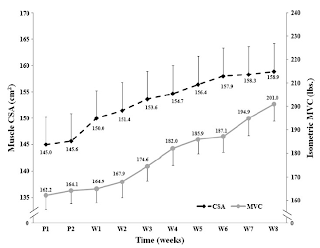
By the means of weekly testing the scientists wanted to determine the "precise time course of skeletal muscle hypertrophy" in response to 8 weeks on a specifically designed high intensity resistance training program in 25 healthy, sedentary men. The measured outcomes were whole muscle cross-sectional area (CSA) of the dominant thigh (via computer tomography) and isometric maximum voluntary contractions (MVC). 
After only two training sessions (W1) [=week 1], the mean thigh muscle CSA increased by 5.0 cm² (3.46%; p < 0.05) from the pre-testing (P1) and continued to increase with each testing session. It is possible that muscular edema may have inXuenced the early CSA results. To adjust for this possibility, with edema assumedly at its highest at W1, the next significant increase from W1 was at W3. W4 was the Wrst signiWcant increase of MVC over P1. Therefore, signifcant skeletal muscle hypertrophy likely occurred around weeks 3–4.
While edema, unquestionably, are one possible reason for the sudden increase in "muscle mass" being a 'sedentary newbie' to strength training may well be another factor contributing to the immediacy of the muscle gains (do not expect to see similar results as an experienced athlete!). The scientists reliance on sedentary subjects compromises the significance of the whole study (in view of what athletes and gymrats may expect), thus the measured overall gains, impressive +13.9 cm² (9.60%) CSA, appear hardly transferable to a "reasonably" trained group of subjects, as well.
Figure 1: Development of muscle size (measured as CSA of thigh muscle) and force (measured as MCV) in 25 formerly sedentary subjects on an 8 week high intensity strength training program (DeFreitas. 2011)

Comment: Its really a pitty that out of monetary and organizational reasons all these studies are done on newbies, whom you could send work on a construction site for 8 weeks and see immense gains in strength and muscles, when they do not get hit by a block of concrete. So, do not feel discouraged if - in the course of the whole last year, you did not gain +13.9 cm² in your tigh muscle. You are probably just to athletic already ;-)