Posts

Showing posts with the label polyunsaturated fatty acids

Popular topics

Show more

Fish vs. Krill Oil, SFA ↔ PUFA - False Advice, Low-FODMAP Diet for Athletes GI Tracts - Nutrition Research Update 9/17

Image
In contrast to the often-asked krill vs. fish oil question, the issue of PUFA vs. SFA seems to be resolved. At least if we focus on replacing SFA with N-6-PUFA well-controlled RCTs don't show a benefit. If studies are interesting, but there's not enough to dissect for a full SuppVersity  article, they make it to the short news . Today's installment is a nutrition research update and it deals with (1) the often-asked question whether there's a health- or performance-relevant difference between fish and krill oil , (2) the often-heard advice to replace saturated fats in your diet with omega-6 fats to improve your heart health, an advice of which a new meta-analysis shows quite cleverly that it's an artefact due to the inclusion of insufficiently controlled studies, and (3) using the low-FODMAP diet in athletes to reduce gastrointestinal problems that range from burping to diarrhea. Learn more about various topics at the SuppVersity Apples a day + Lot's...

Scientists Probe the Interaction Between Saturated and Unsaturated High Fat Diets and Their Corresponding Carbohydrate Sources (Cornstarch vs. Fructose)

Image
This add is a perfect example of how saturated fat, in this case lard has always been blamed for the "lard" on ones hips. Any hypothesis that tries to blame for our "fat misery" on a single nutrient is short-sighted. After years of fat-bashing, carbophobia and fructose hating in the course of which the situation progressively, we are now seeing the first studies which investigate what the Polish researchers, Adam JurgoÅ„ski, Jerzy JuÅ›kiewicz and Zenon ZduÅ„czyk from the Institute of Animal Reproduction and Food Research at the Polish Academy of  Sciences call the "biological interactions among these dietary factors" in their latest paper in the peer-reviewed open-source journal Nutrients (JurgoÅ„ski. 2014). With the publication of the data of a their latest rodent study, the scientists have already taken the first step to a new, an "interactionist" perspective on the obesogenic effects of saturated vs.unsaturated and simple vs.complex ca...

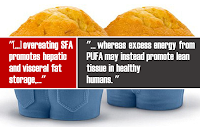
Saturated Fat Makes You Fat! You Read the Press Release - Here is the Whole Story: A Story of Muffins, SFA, MUFA, PUFA, Body, Liver & Visceral Fat and N6s & Lean Mass

Image
I have to admit: Whether a conclusion as general at this is warranted based on the data from a recent study is questionable. Somehow I knew that people would freak out, about a press release I reposted on the SuppVersity Facebook page earlier today ( read it! ). Next to saying that you can eat fructose and not get obese saying that you can eat PUFAs without getting fat is probably as heretic as saying that saturated fat makes you fat... what? Oh yes! You're right, it can be even worse. I mean, imagine you'd say that unsaturated fatty acids are less obesogenic than saturated fats. Ah, come on! That's so mainstream it must be propaganda from the "pharmaceutical enteprise/ cholesterol lowering drug entreprise" [ sic! ], right? Well, I am just looking at the acknowledgements of the study the press release refers. Let's see: "None of the authors have any conflicts of interest to disclose" and "This study was funded by the Swedish Research C...

Making the Right Fish Choices: Fatty Acid Contents of 33 Different Fish Species. Plus: What Are the Implications?

Image
Pollachius virens (Photo: Tino Strauss) is king, when it comes to the n:3/n:6 ratio, but with <1% of fat you will still be hard pressed to get tons of omega-3s from eating pollock... but is more really better, let alone necessary? I have already broached the issue of the differences in the fatty acid composition of fish - even those of the same species - in past articles such as the one(s) on fish as a potential source of mercury in your diet ( read more ). When I saw the recent paper by Claudia Strobel, Gerhard Jahreis and Katrin Kuhnt in Lipids in Health and Disease , I thought that it was about time to supply you with some real data on the actual n:3/n:6 ratio of different fish and its implications for the purported health benefits and anti-obesity effects of regular fish intake. Is there a "super fish" or is it as so often a matter of "mixing and matching" to achieve the right balance? Fish? Of course, I have fish & chips or fish sticks every other...

Grass-Fed Pork? Not Really. Still the Difference in Fatty Acid Composition & Micronutrient Content Are Profound & Not Accounted for by Food Databases - Let Alone Epidemiology

Image
You often hear that pigs are pretty closely related to us humans, but "are all pigs created equal"? Or what may be a more appropriate question for the SuppVersity: Is all pork really created equal? If you like databases like nutritiondata.com or the USDA's very own detailed nutrient database in order to evaluate whether your diet is actually delivering all the nutrients you need you are probably missing half of the picture. At least as far as the more sophisticated details go, a recent paper from the Instituto de Ingeniería de Alimentos para el Desarrollo at the Universidad Politécnica de Valencia clearly indicates that you would at least have to consider what the animals, in this case pork, were fed and from which muscle of the animal the piece of meat you are eating has been cut, in order to get an approximate idea of how much of unquestionably health relevant micronutrients, such as coQ10 , carnosine , anserine , taurine , creatine glutamine or haem you get - a...

Demonized N-6 Pufas Surprisingly Ergogenic: Safflower Oil More Than Doubles Swimming Endurance of Aging Mice.

Image
Image 1: Unexpectedly ergogenic - Carthamus tinctorius   L., better known as "safflower", a highly branched, herbaceous, thistle-like annual. As a regular visitor of the SuppVersity and/or listener of SuperHumanRadio, you will be familiar with my skepticism towards fish oil supplementation as the "good for all" wonder-supplement in an athletic population. You will also be familiar with studies such as Filaire et al. (2010) which showed increased MDA (malondyaldehide) levels (and thus more, not less toxic waste) in athletes receiving 600mg of EPA and 400mg of DHA for 6 weeks. Thusly, it may not come as a total surprise that Guihua Zhang and his colleagues the National Food Research Institute and the National Institute of Vegetable and Tea Sciences in Japan found that 12 weeks on a diet containing 6% fish oil reduced endurance performance in aged mice by -20% . What may be more surprising, though, is that the vilified n6-pufas from safflower oil more than d...

Vitamin D & PUFA - Is There an Overlooked Antagonism Between Polyunsaturated Fatty Acids and Vitamin D3?

Image
Image 1: Do not write off all the "good" foods until you read the full blogpost, including my comment at the end (image by ADAM ) Hah... I knew a newsitem the title of which joins everybody's contemporary "pet supplements", would get your attention. Quasi as a byproduct of one of the hilarious vitamin D + calcium trials in which scientists seek to prevent bone loss and fracture in men and women age 65 and older by supplementation with 700IU (no I am not missing a "0", here) and 500mg calcium per day, Sathi Niramitmahapanya and his colleagues from the  U.S. Department of Agriculture Human Nutrition Research Center on Aging at Tufts University found an interesting and previously not thought of negative correlation between their subjects' plasma levels of 25-hydroxyvitamin D (25OHD) levels and the ratio of poly- to monounsaturated fatty acids in their diets ( Niramitmahapany. 2011 ). Could i...

Body Fat Modulation with Corn Oil & L-Carnitine: What You Can Learn From Your Schnitzel

Image
Its quite remarkable that, primates aside, swine are among the best models of human metabolism . So, even if you do not feel piggy at all, the fact that pigs just as humans are omnivores, makes them a much better model for metabolic disease than rodents. It is thus not too unrealistic to assume that we can learn something about ourselves from the results of a very recent study published in the Journal of Animal Science ( Apple. 2011 ). Figure 1: American Pork Cuts; quality is determined by corn-oil and carnitine intake of the swine. What lessons can you learn from our pink relatives? Investigating the effects of l -carnitine supplementation on the quality characteristics of fresh pork bellies from pigs fed three levels of corn oil, J.K. Apple and his co-workers observed a linear trend towards decreased belly-firmness with increasing amounts of corn oil (0, 2 or 4%) in the diet. If you look at the average American, his/he...
Disclaimer:The information provided on this website is for informational purposes only. It is by no means intended as professional medical advice. Do not use any of the agents or freely available dietary supplements mentioned on this website without further consultation with your medical practitioner.