Showing posts with label form. Show all posts

Tuesday, April 1, 2014

Lat Pulldowns Revisited: What's the "Optimal" Grip Width? A Medium Grip Excels - In Spite or Due to the Increased Biceps Activation? Plus: Harder ≠ More Effective

Building Wings: Is it really about proper grip width or are effort and genetics the real determinants of your wing-size?
As a SuppVersity reader you will be well aware that the term "optimal" in conjunction with grip width will always be goal-specific. It is, for example, well possible that you would have to use completely different grips to "optimally" train the posterior chain of the rotator cuff muscle and your lats and the  results Vidar Andersen and his colleagues from the Sogn og Fjordane University College, the Norwegian University of Science and Technology and the Hysnes Rehabilitation Center at the St. Olavs University Hospital present in their latest paper in the Journal of Strength and Conditioning Research could help us to find out which grip widths these are (Andersen. 2014).

While the researchers point out, "the effects of pronated grip widths in the anterior lat pull down are not yet fully determined" (Andersen. 2014), Suppversity readers know better. There is actually conclusive evidence from a study by Boeckh-Behrens & Buskies I discussed at length in the SuppVersity EMG Series that an optimal stimulation of the latissumus dorsi is achieved with a shoulder-wide and thus probably 10-15 cm narrower overhand grip; and not with the popular "grip-as-far-apart-as-possible crucification" grip generations of bodybuilders considered the "optimal wing builder."
Even though it's more difficult (you can handle less weight), the wide grip is not necessarily more effective.
Individuality counts & difficult does not equal effective: In view of interpersonal differences and the fact that it is, much contrary to popular believe, not the exercise or way to execute a certain exercise that hurts the most, which is most effective, it is well possible that the previously mentioned "generations of bodybuilders" were right and the extra-wide grip gave them their impressive wingspan. It is yet equally possible that they fooled themselves into believing that this was the most effective way to perform the exercise due to the "good pain" they (mis?)interpreted as a signal of optimal muscle stimulation.
I am not sure, whether or not Andersen et al. even know the said study, the results of which have only been published in German. What they do know, though, are the results of a similar, yet small-scale study by Lusk et al. with methodological issues- e.g.:
  • assessment of only two grip widths, 
  • no familiarization session before the 1RM test, 
  • same absolute rather than relative load in all the different grips, and 
  • sets were not performed until or close to failure
As the Swedish researchers rightly point out, the two latter "methodological limitations make it difficult to transfer the findings to real life training" (Andersen. 2014). To underline the validity of this claim, the scientists cite a set of studies by Saeterbakken et al. (2011-2013) to substantiate the hypothesis that using equal relative loads when comparing different exercises is a prerequisite for a reliable comparison of different exercises and exercise modalities.

Optimal research design for optimal grip width investigations!?

Accordingly, a within-participant repeated-measures design was used to examine the relative 6RM strength and concomitant EMG activity in anterior lat pull-down using narrow, medium, and wide
pronated grip widths, defined as 1, 1.5, and 2 times the biacromial distance (BAD), respectively (see Figure 1).
Figure 1: Photo illustrating the different grip widths used in the study at hand (Andersen. 2014)
As Andersen et al. point out, "the participants took part in 1 session approximately 1 week before the experimental test to familiarize the participants with the procedures and identify the 6RM load for the different grip widths." For the test, the exercise order was randomized and counterbalanced for each participant and was identical in the habituation and experimental tests.
In the study referenced in the SuppVersity EMG Series, it's the underhand shoulder- wide grip which produces a maximal activation of the latissumus dorsi - the wings, so to say | learn more
"To simulate a set in a typical workout, the participants performed a 6RM test (Pollock. 1998, Bird. 2005, Kraemer. 2004), which corresponds to approximately 85% of 1RM (Baechle. 2008) and is a recommended intensity for increasing muscle strength and hypertrophy (American College of Sports Medicine. 2009, Peterson. 2004).

By using equal relative load for each exercise with heavy loads performed to volitional failure, we can assess the practical significance of how the independent variable, grip width, affects the dependent variable, muscle activation." (Andersen. 2014)
Thus, the scientists hope to produce practically relevant results, which would make an "important" contribution to the "knowledge for athletes and coaches" (Andersen. 2014) -- and in view of the fact that their subjects were 16 healthy (age, 24 years; body mass, 81 kg; stature, 180 cm) with 6 ± 3 years of resistance training experience the latter, i.e. practical relevance, may actually have been achieved.
Figure 2: Normalized electromyographic activation of the concentric phase (left), and the eccentric phase (right) of the biceps brachii, latissimus dorsi, trapezius, and infraspinatus during 6RM in the lat pull-down performed with 3 different grip widths. Values are given as mean 6SD (Andersen. 2014)
Whether or not the same can be said of the differences you see in Figure 2 is yet (imho) questionable; and that not simply because of the negligible effect size, but also due to the fact that we still don't know how and if high EMG values of which we believe that they tell us something about the intensity of the muscular contraction are even associated with skeletal muscle growth and / or strength gains.

In their discussion of the results, Andersen et al. sidestep this issue and zone in on the quasi non-existent differences between narrow, medium, and wide pronated grips in the anterior lat pull-down, pointing out that a medium grip may still "have someminor advantages over small and wide grips", because - and this is a non-sensical assessment imho - "the biceps brachii had greater activity using a medium compared with a narrow grip in the concentric phase" (Andersen. 2014)

And while Andersen et al. are right and the overall activation of the latissimus dorsi does not appear to be significantly impaired by the increasing biceps involvement, it's still not exactly, what the previously referenced real trainer or trainee will be interested in.
Figure 3: If total time under tension (TUT | learn more) determined your gains, a medium grip would excel.
When all is said and done, we are thus - once again left with the ultimately valuable insight that it's not really worth to overthink the matter of "optimal muscle stimulation". The time you waste pondering the pros and cons of certain grip widths, of which you don't even know if their effects on the electromygraphical activation does even relate to their mass- and/or strength-building qualities, would be better spend actually doing lat pulls, or - even better - pull ups.

So what the f*** - What are you waiting for, the gyms and doorframes of the real world are waiting for you ;-)
References:
  •  American College of Sports Medicine. "American College of Sports Medicine position stand. Progression models in resistance training for healthy adults." Medicine and science in sports and exercise 41.3 (2009): 687.
  • Andersen, Vidar, et al. "Effects of Grip Width on Muscle Strength and Activation in the Lat Pull-Down." The Journal of Strength & Conditioning Research 28.4 (2014): 1135–1142 (in press).
  • Baechle, Thomas R., and Roger W. Earle, eds. Essentials of strength training and conditioning. Human kinetics, 2008.
  • Bird, Stephen P., Kyle M. Tarpenning, and Frank E. Marino. "Designing resistance training programmes to enhance muscular fitness." Sports medicine 35.10 (2005): 841-851.
  • Kraemer, WILLIAM J., and NICHOLAS A. Ratamess. "Fundamentals of resistance training: progression and exercise prescription." Medicine and science in sports and exercise 36.4 (2004): 674-688.
  • Lusk, Stephen J., Bruce D. Hale, and Daniel M. Russell. "Grip width and forearm orientation effects on muscle activity during the lat pull-down." The Journal of Strength & Conditioning Research 24.7 (2010): 1895-1900. 
  • Peterson, Mark D., Matthew R. Rhea, and Brent A. Alvar. "Maximizing strength development in athletes: a meta-analysis to determine the dose-response relationship." The Journal of Strength & Conditioning Research 18.2 (2004): 377-382.
  • Pollock, Michael L., et al. "ACSM position stand: the recommended quantity and quality of exercise for developing and maintaining cardiorespiratory and muscular fitness, and flexibility in healthy adults." Med Sci Sports Exerc 30.6 (1998): 975-991.
  • Saeterbakken, Atle H., Roland van den Tillaar, and Marius S. Fimland. "A comparison of muscle activity and 1-RM strength of three chest-press exercises with different stability requirements." Journal of sports sciences 29.5 (2011): 533-538.
  • Saeterbakken, Atle Hole, and Marius Steiro Fimland. "Muscle activity of the core during bilateral, unilateral, seated and standing resistance exercise." European journal of applied physiology 112.5 (2012): 1671-1678.
  • Saeterbakken, Atle H., and Marius S. Fimland. "Muscle force output and electromyographic activity in squats with various unstable surfaces." The Journal of Strength & Conditioning Research 27.1 (2013): 130-136.
  • Saeterbakken, Atle H. and Marius S. Fimland. " Electromyographic activity and 6-RM strength in bench press on stable and unstable surfaces." The Journal of Strength & Conditioning Research 27.7 (2013): 1101–1107.
  • Saeterbakken, Atle H., and Marius S. Fimland. "Effects of Body Position and Loading Modality on Muscle Activity and Strength in Shoulder Presses." The Journal of Strength & Conditioning Research 27.7 (2013): 1824-1831.16.

Wednesday, December 22, 2010

A Scientific Approach to Bodybuilding: Measuring the Quality of Execution to Predict Hypertrophy

This post is a little different from what you normally find on this blog. This time I'd rather invite you to read a study on your own, than to summarize the main findings. The study (Ivan. 2010) was done by a group of Romanian scientists and published recently in the Body Building Science Journal. What is particular interesting about the authors' approach is that they try to capture "effective" training methods in physical/mathematical equations. The main ideas behind their quantitative analysis is the following:
Indicators for measuring the quality characteristics of exercises 
The level of quality is analyzed using the following indicators:
  • the number of repetitions for each exercise;
  • the number of sets included in each training program;
  • the way in which the athlete executes the exercises taking into consideration the correct position in each key stage of the execution;
  • the weights used for each exercise.
Based on these indicators, grades are given for each exercise like very good, good, satisfactory and unsatisfactory. Based on these grades, a trainer or referee evaluates and differentiates the athletes. Depending on the deviations from the correct execution, the corresponding grade is given.
Their results confirm the concept that form is key to muscular development. The way the scientists present their data unfortunately obscures their findings.
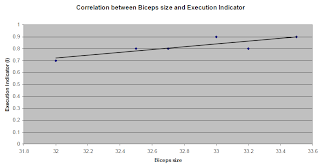
Figure 1: Correlation between biceps size and execution indicator.
The graph in figure 1, for example, would have appeared much more impressive, if the authors had decided to present just the relevant part, i.e. y-axes values from 0.6-1.0. In that case the linear regression would have been much steeper and nobody would have hat to have a second look at the data to accept the conclusion that...
The quality of an exercise influences the obtained results. The higher the execution quality the higher the results obtained by the athlete. Based on the execution quality, an aggregated indicator was defined, that is able to estimate the growth of arm size of an athlete. This indicator is very useful for athletes in order to estimate the arm size over 1 to 6 months of training.
There are other interesting details in the study as well, so go ahead and have a look.